

Archive position — measured, not model output
0 likes on Devpost
2,263 of the 7,850 archived projects have more likes, and 5,587 share exactly 0 — so this project's #4,370 place in the like-ranked listing is a tie-break inside that group, not a ranking.
Projects (log scale)
Likes on Devpost. ▲ marks this project's group.
Show the figures
| Likes | Projects | Share of archive |
|---|---|---|
| 0 | 5,587 | 71.2% |
| 1 | 1,758 | 22.4% |
| 2 | 284 | 3.6% |
| 3–4 | 132 | 1.7% |
| 5–9 | 75 | 1.0% |
| 10+ | 14 | 0.2% |
 User Stories BotA demo video on every pull request
Get a demo video on every new feature
GitHub App that watches your pull requests and records a narrated, captioned demo.
Save time on demo prep and make informed decisions faster with a video walkthrough of every new feature.
Executive Summary
What the company appears to be
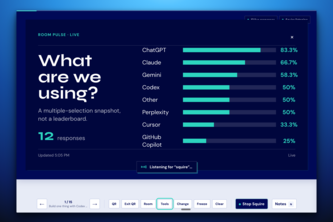
GPT Realtime Slides is a self-reported tool for educators and speakers that enables voice-operated slide presentations with real-time audience data injection. It uses GPT Realtime and integrates with Cloudflare and OpenAI APIs.
What changed
The project was submitted as part of the OpenAI 2026 hackathon, indicating it is in an early-stage prototype or proof-of-concept phase. No commercial traction, revenue, or customer data are provided.
Single most important open question
Is there any evidence that this tool has been used beyond the hackathon context, or whether it has evolved into a product with real market demand?
What The Product Actually Is
The description states:
- It is a "custom slide UI with HTML slides and manual controls if you want."
- Navigation is exposed to a GPT real-time model, which can be invoked via a wake word for voice control.
- It allows audience data to be collected and injected into slides in near real time.
- It was built using Codex, GPT 5.6 Sol high, Cloudflare, and the GPT Realtime model.
Inference The tool is designed for educators or speakers who want to present without being tethered to a machine and who wish to dynamically update slides with audience feedback during presentations.
Positioning & Claim Evolution
The author states:
- The tool is intended for "workshops" and "speaking" by educators.
- It aims to eliminate the need to look at audience feedback after sessions.
- It is positioned as a voice-operated, real-time audience data injection tool.
Inference The positioning appears to be niche — targeting educators or speakers who want more dynamic, hands-free presentations with interactive elements. The claim is that it introduces a new paradigm for presentation tools in education and public speaking.
Target Customer & ICP
The description states:
- The author is a "lifelong teacher and educator."
- It is intended for use in "workshops" and "speaking" contexts.
- The tool is meant for "professors," "teachers," and "speakers."
Inference The target customer appears to be educators or professionals who present regularly, particularly in workshop or academic settings.
Business Model & Pricing Evidence
Not evidenced.
Explanation
There is no mention of pricing, monetization strategy, or business model in the project description. The author states that it only cost $0.67 to run for an hour, but this is a cost of development/testing, not a commercial price point.
Technical & Delivery Signals
The description states:
- Built with Codex and GPT 5.6 Sol high.
- Hosted on Cloudflare.
- Uses the GPT Realtime model to operate slides.
- Navigation controls are voice-triggered via a wake word.
- Audience data is collected from a landing page and injected into slides.
Inference The tool uses AI APIs for voice control and audience data integration, with a focus on real-time interaction. It appears to be a prototype or early-stage product, not yet a commercial offering.
Traction & Maturity Signals
Not evidenced.
Explanation
There is no evidence of revenue, customers, usage metrics, or adoption beyond the hackathon submission. The author states it "worked" and cost $0.67 to run for an hour, but this does not indicate traction or product maturity.
Competitive Context
Not evidenced.
Explanation
The description does not mention any competitors or existing products in the space of voice-operated presentation tools or real-time audience data injection. No market analysis or competitive positioning is provided.
Open Questions & Risks
- No commercial traction: The tool is described only as a hackathon submission with no evidence of use beyond that.
- Unproven market demand: There is no indication of whether educators actually want this product or if it solves a real problem in the field.
- Prototype nature: The tool appears to be an early-stage prototype, not a finished product.
- Unclear scalability: The author mentions challenges with audience data collection and pop-up modes — suggesting technical limitations.
Questions the description leaves open
- Has this tool been used beyond the hackathon? If so, by whom and in what context?
- What is the intended user experience for non-technical educators or speakers?
- Are there any plans to monetize or scale this product?
- How does it handle privacy and data collection from audience members?
- What are the technical limitations of real-time audience data injection, and how are they being addressed?
Overall Assessment
Not evidenced.
Explanation
There is no evidence of revenue, customers, or traction to support an investment or partnership decision. The project appears to be a hackathon prototype with no commercial viability demonstrated. Any potential for investment or partnership would depend on further development and proof of market demand.
User Stories BotA demo video on every pull request
Get a demo video on every new feature
GitHub App that watches your pull requests and records a narrated, captioned demo.
Save time on demo prep and make informed decisions faster with a video walkthrough of every new feature.
Source
Submitted to the OpenAI 2026 hackathon on Devpost. Project home on Devpost. Back to the full gallery on Devpost.
This competitive analysis was produced by top-founders.com (opens in a new tab)
Generated by a language model from this project's public Devpost page — its tagline, the author's own write-up and any built-with tags listed there — as captured in August 2026. Short quotations are the author's words. It is an opinion on the idea as a business, not on the people behind it, and it reflects the description as published then. If the project has moved on, request a correction below. The analysis is not independent research and contains no verified traction, revenue or customer data.
An independent guide by KFG International LLC — not affiliated with, endorsed by, or connected to Devpost or OpenAI.