

Archive position — measured, not model output
0 likes on Devpost
2,263 of the 7,850 archived projects have more likes, and 5,587 share exactly 0 — so this project's #4,322 place in the like-ranked listing is a tie-break inside that group, not a ranking.
Projects (log scale)
Likes on Devpost. ▲ marks this project's group.
Show the figures
| Likes | Projects | Share of archive |
|---|---|---|
| 0 | 5,587 | 71.2% |
| 1 | 1,758 | 22.4% |
| 2 | 284 | 3.6% |
| 3–4 | 132 | 1.7% |
| 5–9 | 75 | 1.0% |
| 10+ | 14 | 0.2% |
 User Stories BotA demo video on every pull request
Get a demo video on every new feature
GitHub App that watches your pull requests and records a narrated, captioned demo.
Save time on demo prep and make informed decisions faster with a video walkthrough of every new feature.
Executive Summary
What the company appears to be
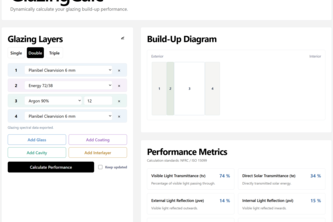
GlazingCalc is a self-reported web-based prototype tool for early-stage glazing option exploration in building facade design. The author describes it as an interactive tool that allows users to build custom glazing systems, calculate optical and thermal performance, compare product options, and visualize facade appearance.
What changed
The project description shows a transition from a technical calculation script to a presentable demo, reportedly enabled by AI assistance (Codex). It represents the author's attempt to bridge domain knowledge with software engineering capabilities to address a perceived market gap in glazing decision-making tools.
Single most important open question
Is there evidence of any traction, revenue, or customer adoption beyond the self-reported prototype? The description provides no information about users, customers, or commercial activity.
What The Product Actually Is
The description states that GlazingCalc is a "web-based prototype for early-stage glazing option exploration." It allows users to:
- Assemble custom glazing build-ups from layers (glass, coatings, cavities, interlayers)
- Validate whether the build-up is physically meaningful
- Send build-ups to a Python backend for optical and thermal calculation
- View spectral data output for transmission and reflection
- See angular optical data for facade visualization
- Compare candidate glazing systems via scatter plots
- Visualize facade appearance under different lighting and viewing conditions
The tool uses Flask for the backend and WebGL2 for visualization. The author notes it supports "interactive drag-and-drop glazing build-up configuration" and "precomputed static assets for faster deployed performance."
Evidence Self-reported by the author.
Inference This appears to be a technical demonstration rather than a commercial product, based on the lack of any mention of sales, customers or revenue.
Positioning & Claim Evolution
The author claims GlazingCalc is:
- An "interactive glazing specification tool"
- A "step toward a shared glazing decision interface"
- A tool that helps stakeholders "see both numbers and appearance" in one place
- Designed to address "the trade-off between performance, cost, daylight, comfort, reflectance, color, procurement and architectural appearance"
The author positions it as filling a gap between existing tools (which are either too technical or tied to manufacturers) and the need for a neutral, visual, collaborative tool that connects custom glazing build-up, performance values, and realistic appearance in one workflow.
Evidence Self-reported by the author.
Inference The positioning suggests an intent to serve multiple stakeholders in the building design process, but no evidence of actual stakeholder engagement or adoption is provided.
Target Customer & ICP
The description states that GlazingCalc targets:
- Facade designers and engineers
- Architects
- Clients and developers
- Building performance engineers
- Contractors
It is intended for use by "the client, architect, facade engineer and building performance engineer" who need to make glazing decisions early in the design process.
Evidence Self-reported by the author.
Inference The tool appears aimed at professionals in the construction industry, but there is no evidence of actual customer segmentation or targeting beyond self-description.
Business Model & Pricing Evidence
The description does not provide any information about pricing, monetization, or business model. There are no mentions of revenue streams, subscription models, licensing fees, or commercial partnerships.
Evidence Not evidenced.
Technical & Delivery Signals
The project is built with:
- Flask (Python backend)
- WebGL2 (for visualization)
- Web-based interface
- Precomputed static assets for performance
- Deployment-ready workflow for Vercel
The author notes that Codex helped in building the frontend state, connecting APIs, preparing static assets, and documenting calculation rules.
Evidence Self-reported by the author.
Inference The tool is a prototype with technical capabilities but lacks evidence of production-grade delivery or scalability.
Traction & Maturity Signals
The description states that GlazingCalc is a "web-based prototype" and that it was submitted to the OpenAI 2026 hackathon. There is no mention of:
- Customers
- Revenue
- Users
- Adoption
- Product-market fit
- Commercial traction
Evidence Not evidenced.
Competitive Context
The author identifies several existing tools in the market, including:
- LBNL WINDOW, THERM, Optics and IGDB software tools
- Guardian Glass Analytics and Performance Calculator
- Saint-Gobain Calumen and GlassPro
- AGC Glass Configurator
- Vitro Construct and VitroSphere
- Pilkington Spectrum
- Sisecam GlassTool
- WINSLT by Sommer Informatik
- WINISO and Sommer Informatik portfolio
- Flixo thermal bridge software
The author claims that current tools are either too technical for fast visual comparison or tied to specific manufacturers, leaving a gap for a neutral tool that connects custom glazing build-up, performance values, and realistic appearance.
Evidence Self-reported by the author.
Open Questions & Risks
- No traction evidence: The project is described as a prototype with no revenue, customers, or adoption.
- Single-person team: Only one member (Xiaoming Yang) is listed.
- Unverified claims: All descriptions are self-reported and unverified.
- Prototype status: No indication of product maturity or commercial readiness.
- No pricing or monetization strategy: The business model remains undefined.
Evidence Self-reported by the author.
Questions the description leaves open
- What is the actual market need for this tool, and how did you validate it?
- Are there any existing customers or pilot users of GlazingCalc?
- How do you plan to monetize this tool in a commercial setting?
- What are the technical limitations of the current prototype that would prevent scaling?
- Have you considered integrating with existing BIM or CAD tools?
- What is the roadmap for expanding the product database and adding more manufacturers?
Overall Assessment
Not evidenced.
The description provides no information about revenue, customers, traction, or commercial viability. The project is described as a prototype submitted to a hackathon, with no indication of any business development beyond its initial creation.
This is a self-reported technical demonstration with no evidence of product-market fit, customer adoption, or commercial readiness. Any investment or partnership decision would require further due diligence into actual usage, market validation, and scalability.
Confidence Low — based entirely on unverified self-reporting.
User Stories BotA demo video on every pull request
Get a demo video on every new feature
GitHub App that watches your pull requests and records a narrated, captioned demo.
Save time on demo prep and make informed decisions faster with a video walkthrough of every new feature.
Source
Submitted to the OpenAI 2026 hackathon on Devpost. Project home on Devpost. Back to the full gallery on Devpost.
This competitive analysis was produced by top-founders.com (opens in a new tab)
Generated by a language model from this project's public Devpost page — its tagline, the author's own write-up and any built-with tags listed there — as captured in August 2026. Short quotations are the author's words. It is an opinion on the idea as a business, not on the people behind it, and it reflects the description as published then. If the project has moved on, request a correction below. The analysis is not independent research and contains no verified traction, revenue or customer data.
An independent guide by KFG International LLC — not affiliated with, endorsed by, or connected to Devpost or OpenAI.