

Archive position — measured, not model output
1 like on Devpost
505 of the 7,850 archived projects have more likes, and 1,758 share exactly 1 — so this project's #1,122 place in the like-ranked listing is a tie-break inside that group, not a ranking.
Projects (log scale)
Likes on Devpost. ▲ marks this project's group.
Show the figures
| Likes | Projects | Share of archive |
|---|---|---|
| 0 | 5,587 | 71.2% |
| 1 | 1,758 | 22.4% |
| 2 | 284 | 3.6% |
| 3–4 | 132 | 1.7% |
| 5–9 | 75 | 1.0% |
| 10+ | 14 | 0.2% |
 User Stories BotA demo video on every pull request
Get a demo video on every new feature
GitHub App that watches your pull requests and records a narrated, captioned demo.
Save time on demo prep and make informed decisions faster with a video walkthrough of every new feature.
Executive Summary
What the company appears to be
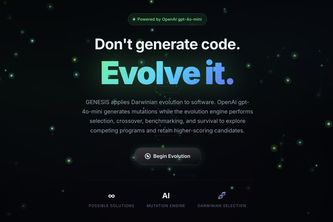
GENESIS — Darwinian Code Evolution Engine is a self-reported tool that simulates evolutionary processes in software development using AI-generated code candidates. It uses OpenAI models for mutation and novel candidate generation, with AST-aware crossover and performance benchmarking.
What changed
The project description reflects an author-driven exploration of how AI coding tools could evolve beyond single-response outputs to mimic iterative engineering practices. It is presented as a hackathon submission with no evidence of commercial traction or product-market fit.
Single most important open question
Is there any evidence that this system has been used in practice, or that it produces better software than traditional AI code generation methods?
What The Product Actually Is
The description states that GENESIS is a "Darwinian Code Evolution Engine" that creates executable program candidates through evolutionary processes. It uses:
- OpenAI gpt-4o-mini for mutation and new candidate generation
- AST-aware crossover via Acorn and Astring
- Browser Web Workers for execution with timeout protection
- D3.js for lineage visualization
The system evaluates candidates on correctness and performance, retains history in a lineage graph, and preserves the best verified programs in a "Hall of Fame."
Inference This is an experimental or proof-of-concept tool built using web technologies (Next.js, React) and AI APIs. It does not appear to be a commercial product with users or revenue.
Positioning & Claim Evolution
The author claims GENESIS mirrors how experienced engineers improve code — through iteration, testing, benchmarking, and combining ideas. The system is positioned as an alternative to single-response AI tools that stop after one output.
It also states:
- GENESIS uses LLMs primarily for variation, not decision-making
- Correctness tests and deterministic benchmarks are central to its evaluation
- Elitism and lineage retention ensure strong candidates are preserved
Inference The positioning is aspirational — it aims to simulate human-like software evolution but lacks evidence of real-world application or impact.
Target Customer & ICP
Not evidenced.
The description does not identify any specific customer segment, target user group, or buyer persona. It is framed as a personal project by one individual (nikita sharma) submitted to a hackathon.
Business Model & Pricing Evidence
Not evidenced.
There is no mention of pricing, monetization strategy, or business model in the description. The project is presented as an experimental tool without commercial intent.
Technical & Delivery Signals
The system is built with:
- Next.js and React
- OpenAI API (gpt-4o-mini for runtime)
- Acorn and Astring for AST parsing and regeneration
- D3.js for visualization
- Browser Web Workers for execution isolation
- Codex with GPT-5.6 Terra during development
It includes features like:
- Evolutionary lineage graph
- Hall of Fame
- Fitness history tracking
- Operation logs
Inference The technical stack is typical for a frontend-heavy web application using AI APIs and browser-based execution. It shows engineering effort but no indication of scalability or production readiness.
Traction & Maturity Signals
Not evidenced.
There is no evidence of:
- Revenue
- Customers
- Usage metrics
- Product adoption
- Iteration beyond the hackathon submission
The project is described as a single-person effort submitted to a hackathon, with no indication of further development or deployment.
Competitive Context
Not evidenced.
No mention of competitors, market landscape, or competitive positioning. The description does not reference existing tools for AI code generation or evolutionary algorithms in software engineering.
Open Questions & Risks
- Unproven value proposition: The system is described as experimental and lacks evidence of real-world utility.
- Single-person development: No team, no external validation, no product-market fit signals.
- No commercialization path: No pricing, monetization or customer data to suggest a viable business model.
- Hackathon origin: The project was submitted to a hackathon, indicating it is likely a prototype or proof-of-concept.
Questions the description leaves open
- What specific problems in software development does GENESIS aim to solve, and how do you plan to validate that?
- Have you tested the system on real-world codebases or benchmarks? If so, what were the results?
- Is there any evidence of performance improvements over traditional AI code generation tools?
- How do you intend to scale this beyond a single-user prototype?
- What is your long-term vision for monetization or product-market fit?
Overall Assessment
Not evidenced.
There is no evidence of revenue, customers, traction, or any commercial viability. The project is described as a hackathon submission by one individual with no indication of business development or market validation. It cannot be evaluated for investment or partnership potential based on the provided information.
User Stories BotA demo video on every pull request
Get a demo video on every new feature
GitHub App that watches your pull requests and records a narrated, captioned demo.
Save time on demo prep and make informed decisions faster with a video walkthrough of every new feature.
Source
Submitted to the OpenAI 2026 hackathon on Devpost. Project home on Devpost. Back to the full gallery on Devpost.
This competitive analysis was produced by top-founders.com (opens in a new tab)
Generated by a language model from this project's public Devpost page — its tagline, the author's own write-up and any built-with tags listed there — as captured in August 2026. Short quotations are the author's words. It is an opinion on the idea as a business, not on the people behind it, and it reflects the description as published then. If the project has moved on, request a correction below. The analysis is not independent research and contains no verified traction, revenue or customer data.
An independent guide by KFG International LLC — not affiliated with, endorsed by, or connected to Devpost or OpenAI.