

Archive position — measured, not model output
0 likes on Devpost
2,263 of the 7,850 archived projects have more likes, and 5,587 share exactly 0 — so this project's #3,085 place in the like-ranked listing is a tie-break inside that group, not a ranking.
Projects (log scale)
Likes on Devpost. ▲ marks this project's group.
Show the figures
| Likes | Projects | Share of archive |
|---|---|---|
| 0 | 5,587 | 71.2% |
| 1 | 1,758 | 22.4% |
| 2 | 284 | 3.6% |
| 3–4 | 132 | 1.7% |
| 5–9 | 75 | 1.0% |
| 10+ | 14 | 0.2% |
 User Stories BotA demo video on every pull request
Get a demo video on every new feature
GitHub App that watches your pull requests and records a narrated, captioned demo.
Save time on demo prep and make informed decisions faster with a video walkthrough of every new feature.
Executive Summary
What the company appears to be
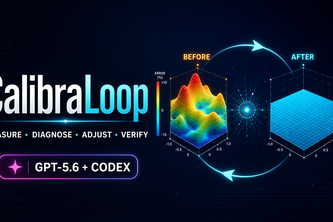
CalibraLoop is a self-reported closed-loop calibration agent for optical fields, built using GPT-5.6 and deterministic Python code. It claims to automate quality goal calibration through synthetic data, with an auditable decision trail.
What changed
The project was submitted as part of an OpenAI hackathon. No prior version or evolution is described; this is a new self-contained submission.
Single most important open question
Is there any evidence of real-world adoption, traction, or commercial viability beyond the author’s own demonstration?
Analysis basis: This report is based entirely on the self-reported description provided by the author. It contains no external corroboration, revenue data, customer names, or third-party validation.
What The Product Actually Is
The description states that CalibraLoop:
- Turns a natural-language quality goal into a bounded, auditable calibration loop over a fully synthetic optical field.
- Uses GPT-5.6 to decide what to inspect and adjust.
- Employs deterministic Python code for every measurement, safety limit, pass/fail decision, state transition, and report.
- Includes a default scenario involving uneven illumination, soft focus, power constraints, and hidden spectral-efficiency faults.
- Executes a workflow: goal → measure → diagnose → probe or adjust → verify → audit report.
Inference: The product appears to be a proof-of-concept tool for automated calibration in optical systems, designed to demonstrate how an AI agent can provide flexible judgment while deterministic software enforces safety and acceptance criteria.
Evidence strength: Based on the author’s own description. No external verification or demonstration of actual use beyond the codebase.
Positioning & Claim Evolution
The author states:
- CalibraLoop is a "GPT-5.6-guided closed-loop calibration agent."
- It provides deterministic safety checks and an auditable report.
- It bridges the gap between operator intent and specialized measurements.
- The system demonstrates how AI can be used for judgment while maintaining auditability.
Inference: The positioning appears to be that of a hybrid system combining generative AI with deterministic control logic, aimed at improving calibration workflows in technical domains like optics.
Evidence strength: All claims are self-reported. No evidence of prior versions or evolution in positioning is provided.
Target Customer & ICP
The description does not state:
- Who the target customer is.
- Whether there is a defined ideal customer profile (ICP).
- If this product targets specific industries, roles, or use cases beyond the author’s own demonstration.
Evidence strength: Not evidenced. No mention of customers, industry verticals, or user personas.
Business Model & Pricing Evidence
The description does not state:
- How the product would be monetized.
- Whether there is a pricing model.
- If there are any commercial plans or revenue streams beyond the author’s own development.
Evidence strength: Not evidenced. No indication of business model, pricing, or monetization strategy.
Technical & Delivery Signals
The description states:
- Built with: codex, github, gpt-5.6, html, python.
- Uses GPT-5.6 to interpret goals and select actions.
- Deterministic Python code handles all safety-critical elements.
- Includes a standalone HTML report showing before/after heatmaps, metrics, adjustments, and decision trail.
- Synthetic data and no-key smoke path allow judges to reproduce the project without hardware or proprietary files.
- MIT licensed.
- Requires only Python 3.10+.
Inference: The system is built as a self-contained tool with synthetic data support, designed for reproducibility and auditability. It uses a hybrid architecture of generative AI and deterministic code.
Evidence strength: Based on the author’s own account. No evidence of production deployment or delivery beyond the demo.
Traction & Maturity Signals
The description does not state:
- Any revenue, ARR, or funding.
- Customer adoption or usage metrics.
- Product maturity (e.g., number of iterations, release history).
- Whether the product has moved beyond prototype or hackathon stage.
Evidence strength: Not evidenced. No signs of traction or commercial development are mentioned.
Competitive Context
The description does not state:
- Who the competitors are.
- How this compares to existing calibration tools or AI agents in similar domains.
- Whether there is a defined competitive landscape.
Evidence strength: Not evidenced. No mention of competition or market positioning beyond the author’s own claims.
Open Questions & Risks
Key risks
- The product is presented as a hackathon submission with no evidence of commercial traction or adoption.
- The use of GPT-5.6 implies reliance on an external model, which may not be stable or scalable.
- No evidence of real-world validation or integration into existing systems.
- The system is described as synthetic-only, raising questions about generalizability to real hardware.
Open questions
- Lack of any mention of customers, revenue, or business model.
- No indication of scalability beyond a single developer’s environment.
- No evidence of product-market fit or market demand.
Evidence strength: Inferences based on the lack of evidence for commercial viability and traction.
Questions the description leaves open
- What is the intended use case for CalibraLoop in real-world applications?
- How does this system integrate with existing calibration workflows or tools?
- Are there any plans to move beyond a prototype or hackathon submission?
- What are the limitations of using synthetic data versus real-world testing?
- Is there any evidence of internal or external validation of the system’s performance?
- What is the long-term vision for this product, and how does it plan to monetize?
Note: These questions are based on the lack of evidence in the description.
Overall Assessment
The description states that CalibraLoop was submitted to an OpenAI 2026 hackathon. There is no evidence of:
- Revenue or ARR.
- Customers or adoption.
- Funding rounds or valuation.
- Product maturity beyond a prototype.
- Commercial viability or scalability.
Assessment: Not evidenced. The project appears to be a self-contained demonstration with no commercial traction, revenue, or customer data. It lacks the signals typically required for investment or partnership consideration.
Confidence level: Low. This is a single author’s account of a hackathon submission with no external validation or evidence of real-world use.
User Stories BotA demo video on every pull request
Get a demo video on every new feature
GitHub App that watches your pull requests and records a narrated, captioned demo.
Save time on demo prep and make informed decisions faster with a video walkthrough of every new feature.
Source
Submitted to the OpenAI 2026 hackathon on Devpost. Project home on Devpost. Back to the full gallery on Devpost.
This competitive analysis was produced by top-founders.com (opens in a new tab)
Generated by a language model from this project's public Devpost page — its tagline, the author's own write-up and any built-with tags listed there — as captured in August 2026. Short quotations are the author's words. It is an opinion on the idea as a business, not on the people behind it, and it reflects the description as published then. If the project has moved on, request a correction below. The analysis is not independent research and contains no verified traction, revenue or customer data.
An independent guide by KFG International LLC — not affiliated with, endorsed by, or connected to Devpost or OpenAI.