

Archive position — measured, not model output
0 likes on Devpost
2,263 of the 7,850 archived projects have more likes, and 5,587 share exactly 0 — so this project's #7,474 place in the like-ranked listing is a tie-break inside that group, not a ranking.
Projects (log scale)
Likes on Devpost. ▲ marks this project's group.
Show the figures
| Likes | Projects | Share of archive |
|---|---|---|
| 0 | 5,587 | 71.2% |
| 1 | 1,758 | 22.4% |
| 2 | 284 | 3.6% |
| 3–4 | 132 | 1.7% |
| 5–9 | 75 | 1.0% |
| 10+ | 14 | 0.2% |
 User Stories BotA demo video on every pull request
Get a demo video on every new feature
GitHub App that watches your pull requests and records a narrated, captioned demo.
Save time on demo prep and make informed decisions faster with a video walkthrough of every new feature.
Executive Summary
Company: URLedger
Self-reported basis: The description is entirely self-reported and unverified; no third-party corroboration or archived evidence exists.
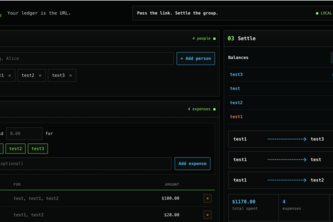
What the company appears to be: A browser-based tool for splitting expenses that runs without sign-ups, accounts, or server-side data storage. It uses a single URL as a ledger, with updates shared via link exchange.
What changed: The project is presented as a hackathon submission (Devpost, OpenAI 2026) and is described as an attempt to simplify expense splitting by removing the need for sign-ups or group setup.
Single most important open question: Is there any evidence of real-world usage or user feedback beyond the author's own description?
What The Product Actually Is
The description states that URLedger is a browser-based tool for splitting expenses. It uses a single URL as a ledger, and all data is stored in the URL fragment (i.e., the part after #). Each browser reconstructs and calculates the ledger locally. Sharing the ledger is done by sharing the link itself.
- Product functionality: Add, share, update, and settle expenses.
- No sign-up or account required.
- No server-side data storage.
- Runs entirely in the browser.
- Uses JavaScript for implementation.
- No ads or limits.
The author describes it as a tool that avoids traditional expense-splitting workflows by eliminating group setup, sign-ups, and backend infrastructure. The system is serial: one person updates the ledger, then passes the new link to others.
Inference: The product is a lightweight, client-side solution for managing shared expenses using only browser capabilities.
Positioning & Claim Evolution
The author positions URLedger as an alternative to traditional expense-splitting tools that require sign-ups, group creation, and often involve ads or limits. It claims to be simple, privacy-preserving, and self-contained in the browser.
- Core positioning: A no-frills, no-sign-up way to split expenses.
- Key claim: “Splitting a dinner bill should not require onboarding.”
- Evolution of claim: The author frames it as a response to frustration with existing tools, suggesting a shift toward simplicity and privacy.
Claim vs. Fact: The description states the tool is built for simplicity and privacy, but no evidence of adoption or user feedback exists.
Target Customer & ICP
The description does not explicitly define a target customer or ideal customer profile (ICP). It implies a general audience that wants to split expenses without account creation or group setup.
- Implicit customer: Individuals or small groups splitting shared costs (e.g., dinner, travel).
- No stated segmentation.
- No evidence of specific use cases or personas.
Inference: The tool likely targets casual users who want a quick and private way to settle shared expenses, but no explicit ICP is defined.
Business Model & Pricing Evidence
The description does not mention any business model or pricing. It emphasizes that the tool is free, with no ads, sign-ups, or limits.
- No pricing structure.
- No monetization strategy.
- No indication of paid features or tiers.
- No evidence of revenue or funding rounds.
Inference: The tool appears to be a free, ad-free utility. No business model is evident from the description.
Technical & Delivery Signals
The author describes building URLedger with vanilla JavaScript and using URL fragments as the data store.
- Technology stack: JavaScript.
- Data storage mechanism: URL fragment (
#). - No backend or server-side components.
- Local computation in browser.
- No real-time collaboration — updates are passed via link sharing.
- No external dependencies.
Inference: The tool is a lightweight, client-side application with no server infrastructure. It avoids complexity by not supporting concurrent edits or shared storage.
Traction & Maturity Signals
The description provides no evidence of traction, users, or adoption beyond the author’s own account.
- No customer base.
- No revenue or ARR.
- No user feedback or reviews.
- No product usage metrics.
- No growth data.
- Submitted to a hackathon, not yet in production.
Inference: The project is at the prototype or hackathon stage. No evidence of real-world usage or traction exists.
Competitive Context
The description does not mention competitors or a competitive landscape.
- No comparison to existing tools.
- No mention of similar products.
- No indication of market positioning relative to others.
Inference: The author does not reference the broader expense-splitting market, so no competitive context is evident.
Open Questions & Risks
Several risks and open questions emerge from the lack of evidence and design choices:
- No server-side data storage: This limits scalability and collaboration.
- Serial workflow: Only one person can update at a time; not suitable for real-time group use.
- No sign-up or account system: Limits tracking, history, or user-specific features.
- No monetization model: Unclear how the tool will be sustained.
- No user feedback or usage data: No evidence of real-world demand or adoption.
- Hackathon submission: Likely not production-ready.
Inference: The tool is experimental and may not scale or meet real-world needs without significant development.
Questions the description leaves open
- What specific use cases have you tested the tool with?
- Have you received any feedback from users beyond yourself?
- How do you plan to handle edge cases like multiple people trying to update at once?
- Are there any privacy or data integrity concerns with storing data in URL fragments?
- Do you have plans to monetize the product, and if so, how?
- What is your roadmap for development beyond this prototype?
Overall Assessment
The description presents a hackathon project that is not yet proven in the market. It lacks evidence of traction, revenue, or even user feedback. The tool is described as a simple browser-based utility with no backend or monetization strategy.
- Not evidenced: No revenue, customers, or adoption.
- Not evidenced: No business model or funding.
- Not evidenced: No competitive analysis or market positioning.
- Not evidenced: No technical scalability or long-term roadmap.
Assessment: The project is an experimental idea with no commercial due-diligence evidence to support investment or partnership. It is not yet a viable product in any meaningful sense, and further development or validation would be required before considering it for investment or strategic interest.
User Stories BotA demo video on every pull request
Get a demo video on every new feature
GitHub App that watches your pull requests and records a narrated, captioned demo.
Save time on demo prep and make informed decisions faster with a video walkthrough of every new feature.
Source
Submitted to the OpenAI 2026 hackathon on Devpost. Project home on Devpost. Back to the full gallery on Devpost.
This competitive analysis was produced by top-founders.com (opens in a new tab)
Generated by a language model from this project's public Devpost page — its tagline, the author's own write-up and any built-with tags listed there — as captured in August 2026. Short quotations are the author's words. It is an opinion on the idea as a business, not on the people behind it, and it reflects the description as published then. If the project has moved on, request a correction below. The analysis is not independent research and contains no verified traction, revenue or customer data.
An independent guide by KFG International LLC — not affiliated with, endorsed by, or connected to Devpost or OpenAI.