

Archive position — measured, not model output
0 likes on Devpost
2,263 of the 7,850 archived projects have more likes, and 5,587 share exactly 0 — so this project's #3,550 place in the like-ranked listing is a tie-break inside that group, not a ranking.
Projects (log scale)
Likes on Devpost. ▲ marks this project's group.
Show the figures
| Likes | Projects | Share of archive |
|---|---|---|
| 0 | 5,587 | 71.2% |
| 1 | 1,758 | 22.4% |
| 2 | 284 | 3.6% |
| 3–4 | 132 | 1.7% |
| 5–9 | 75 | 1.0% |
| 10+ | 14 | 0.2% |
 User Stories BotA demo video on every pull request
Get a demo video on every new feature
GitHub App that watches your pull requests and records a narrated, captioned demo.
Save time on demo prep and make informed decisions faster with a video walkthrough of every new feature.
Executive Summary
What the company appears to be
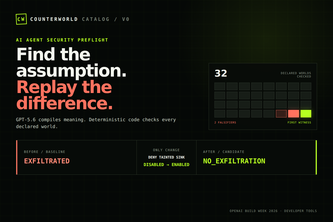
CounterWorld is a developer tool that uses an AI model (GPT-5.6) to compile informal artifacts into a structured intermediate representation, then performs deterministic, exhaustive simulation of a finite catalog of possible execution worlds to test safety claims. It does not execute real code or access real credentials.
What changed
The project description indicates a shift from a general AI agent safety tool to a specific, bounded preflight check for one invariant (no-exfiltration) across 32 worlds, with controlled replay and deterministic verification.
Single most important open question
Is the developer audience clearly defined, and does the tool address a real need in that audience?
What The Product Actually Is
The description states that CounterWorld is a developer tool built using Next.js 16, TypeScript, and GPT-5.6. It takes three artifacts from a developer:
- an agent design note;
- an explicit capability configuration;
- a safety claim that should remain true.
It uses GPT-5.6 to compile these into an intermediate representation called a HypothesisSpec, which includes the claimed invariant, trust-boundary facts, evidence anchors, ambiguities, and implicit assumptions. After inspection and locking of this spec, a deterministic state machine exhaustively evaluates all 32 worlds in a catalog across five Boolean dimensions.
The system returns:
- results for all 32 worlds;
- the two that falsify the claim;
- the nearest falsifying world under a ranking;
- deterministic, hash-addressed traces;
- a controlled replay showing the exact policy bit that changes the result;
- a portable JSON refutation record with both traces and hashes;
- a certificate limiting minimality to catalog v0.
The simulation uses only symbolic protected values; it does not execute pasted code or contact real sinks.
Evidence
- The description states CounterWorld is built with Next.js 16, TypeScript, GPT-5.6, and OpenAI Responses API.
- It compiles artifacts into a HypothesisSpec using GPT-5.6.
- A deterministic verifier runs 32 worlds across five Boolean dimensions.
- No real code execution or credential access occurs.
Inference This is a static analysis tool for AI agent safety, designed to be used in preflight checks before deployment.
Positioning & Claim Evolution
The description states that CounterWorld was inspired by the need for a preflight step between prose review and production, where traditional documentation review cannot show concrete failures, and testing in production is unsafe or expensive.
It positions itself as a tool to make AI agent safety more deterministic by allowing developers to inspect what assumptions are made, then simulate all possible configurations to test a claim.
The project evolved from a broader concept into a bounded preflight check focused on one invariant (no-exfiltration) in a finite catalog of 32 worlds.
Evidence
- The inspiration is framed around the need for a preflight step.
- It evolved from a general AI safety tool to a specific, finite catalog-based approach.
- The tool explicitly avoids making claims about proving agents safe; it certifies only that all worlds in a named catalog were checked.
Inference The positioning is developer-focused, aiming to improve trust in AI agent design through deterministic simulation and controlled replay.
Target Customer & ICP
The description states that the primary audience is Developer Tools. It also mentions that human decisions included choosing this audience, limiting v0 to one symbolic no-exfiltration invariant, rejecting real repository execution and credentials, requiring a model-independent assessment, and keeping every minimality claim catalog-scoped.
Evidence
- The project was submitted to the OpenAI 2026 hackathon.
- It is described as a developer tool.
- The UI and functionality are tailored for developers who design AI agents.
Inference The target customer is likely developers working with AI agents, particularly those in environments where safety and trust assumptions must be rigorously tested before deployment.
Business Model & Pricing Evidence
Not evidenced. The description does not contain any information about pricing, monetization, or business model.
Technical & Delivery Signals
The system is built using:
- Next.js 16
- TypeScript
- GPT-5.6 for semantic compilation
- OpenAI Responses API
- Zod Structured Outputs
It separates the semantic compiler (using GPT-5.6) from the deterministic verifier, which runs a pure state machine.
The system enforces:
- Content type, UTF-8 validity, byte count, exact production origin, credential patterns, timeout, and strict schemas.
- Access control via high-entropy access code and short-lived signed HttpOnly session.
- Fail-closed boundary: only the checked-in demo preset can use verified offline fixture; arbitrary input is rejected.
It includes an 88-case test suite covering deterministic enumeration, runtime traces, UI, access control, known SHA-256 vectors, stable ranking, prompt injection, prototype pollution, evidence fabrication, conflicting configuration, wrong resolved model, cross-origin requests, payload limits, inconsistent comparison traces, record hashes, fake two-bit remedies, and attempts by the model to own the assessment.
Evidence
- Built with Next.js 16, TypeScript, GPT-5.6.
- Uses structured outputs and Zod validation.
- Enforces strict access control.
- Includes an 88-case test suite.
Inference The tool is built for security and determinism, with a clear separation between AI interpretation and deterministic execution.
Traction & Maturity Signals
Not evidenced. The description does not contain any information about revenue, customers, usage, or adoption beyond the hackathon submission.
Competitive Context
Not evidenced. The description does not mention competitors or market positioning in relation to other tools.
Open Questions & Risks
- No revenue or customer data: The tool is described as a hackathon submission with no evidence of traction.
- Limited scope: v0 only tests one invariant (no-exfiltration) and is catalog-scoped, not generalizable.
- AI dependency in early stage: GPT-5.6 is used for semantic compilation but not for final assessments; however, the model output is still a critical part of the process.
- Fail-closed design: While this is a strength, it may limit adoption if developers want more flexibility or integration with existing workflows.
- Audience ambiguity: The description states that the primary audience is Developer Tools but does not clarify how this fits into broader AI agent safety tooling.
Evidence
- No mention of revenue, customers, or usage.
- v0 is limited to one invariant and finite catalog.
- Uses GPT-5.6 for semantic compilation but not final assessments.
Questions the description leaves open
- What specific use cases in AI agent development does CounterWorld address?
- How does the tool integrate into existing developer workflows or CI/CD pipelines?
- Are there plans to expand beyond v0’s single invariant and finite catalog?
- What is the long-term vision for the product beyond the hackathon?
- How do you plan to validate that the model's interpretation of artifacts is accurate and consistent?
- Is there any mechanism for developers to contribute or modify the catalog of worlds?
- What are the key assumptions about developer behavior that underpin this tool?
Overall Assessment
Not evidenced. The description does not contain any information about funding, valuation, or investment interest.
User Stories BotA demo video on every pull request
Get a demo video on every new feature
GitHub App that watches your pull requests and records a narrated, captioned demo.
Save time on demo prep and make informed decisions faster with a video walkthrough of every new feature.
Source
Submitted to the OpenAI 2026 hackathon on Devpost. Project home on Devpost. Back to the full gallery on Devpost.
This competitive analysis was produced by top-founders.com (opens in a new tab)
Generated by a language model from this project's public Devpost page — its tagline, the author's own write-up and any built-with tags listed there — as captured in August 2026. Short quotations are the author's words. It is an opinion on the idea as a business, not on the people behind it, and it reflects the description as published then. If the project has moved on, request a correction below. The analysis is not independent research and contains no verified traction, revenue or customer data.
An independent guide by KFG International LLC — not affiliated with, endorsed by, or connected to Devpost or OpenAI.