

Archive position — measured, not model output
0 likes on Devpost
2,263 of the 7,850 archived projects have more likes, and 5,587 share exactly 0 — so this project's #3,551 place in the like-ranked listing is a tie-break inside that group, not a ranking.
Projects (log scale)
Likes on Devpost. ▲ marks this project's group.
Show the figures
| Likes | Projects | Share of archive |
|---|---|---|
| 0 | 5,587 | 71.2% |
| 1 | 1,758 | 22.4% |
| 2 | 284 | 3.6% |
| 3–4 | 132 | 1.7% |
| 5–9 | 75 | 1.0% |
| 10+ | 14 | 0.2% |
 User Stories BotA demo video on every pull request
Get a demo video on every new feature
GitHub App that watches your pull requests and records a narrated, captioned demo.
Save time on demo prep and make informed decisions faster with a video walkthrough of every new feature.
Executive Summary
What the company appears to be
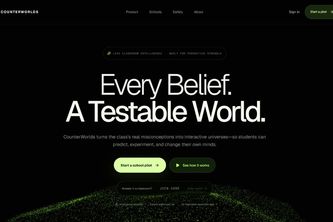
CounterWorlds is a self-reported educational platform built for STEM classrooms that turns student misconceptions into interactive, competing worlds. The author states it uses AI to generate sandboxed experiments where students can test their incorrect beliefs against accepted scientific models.
What changed
The project evolved from an idea about using AI as a thinking partner into a tool that allows students to explore and revise misconceptions through playable simulations. It is described as having moved beyond concept or chatbot wrapper into a working prototype with teacher and student flows, real-time data collection, and generated interactive worlds.
Single most important open question
Is there evidence of traction, revenue, or adoption by teachers or students that would validate the utility of this approach?
This analysis is based entirely on the self-reported project description provided. No external verification or historical data are available. All claims are attributed to the author’s own account and should be treated as unverified.
What The Product Actually Is
The description states that CounterWorlds:
- Turns student misconceptions into interactive, competing worlds.
- Allows students to make predictions, experiment in both a misconception world and a canonical model world, record evidence, and revise explanations.
- Provides two synchronized worlds: one following the student's misconception and another governed by accepted scientific or mathematical laws.
- Includes a teacher workspace for creating classrooms, reviewing anonymous explanations, generating CounterWorlds, and inspecting belief revision.
- Offers an anonymous student experience for predicting, experimenting, recording evidence, and revising an explanation.
- Uses AI (GPT-5.6 Sol) to generate structured manifests and self-contained interactive experiments.
- Runs within sandboxed iframes with restrictive Content Security Policy (CSP).
- Stores data using Supabase, authenticates via Better Auth and Google OAuth, and deploys on Vercel.
The product is described as a classroom-based educational tool that uses AI-generated simulations to help students discover why their misconceptions fail through evidence-based experimentation.
Positioning & Claim Evolution
The author states:
- The project was inspired by wanting to build something “genuinely different” from typical AI tutors or dashboards.
- It aims to move away from simply telling students the correct answer and instead let them test their own mental models.
- The core belief is that a wrong answer isn’t random — it reflects a coherent but incorrect mental model.
- The platform does not immediately correct misconceptions; it lets students explore and revise their thinking through evidence.
This positioning evolved from a vague ambition to a specific educational thesis: using AI-generated simulations to enable discovery-based learning rather than authority-based correction. It is claimed to be experimental and out-of-the-box, though no external validation of this claim exists.
Target Customer & ICP
The description states:
- The primary users are teachers and students in STEM classrooms.
- Teachers create questions, learning objectives, and canonical models; students participate anonymously.
- The system supports anonymous student participation without account creation or email sharing.
- The focus is on helping students revise misconceptions through experimentation.
No explicit segmentation beyond “teachers” and “students” is provided. The ICP appears to be educators working with STEM concepts where misconception-based learning is relevant, but no further targeting or customer personas are described.
Business Model & Pricing Evidence
Not evidenced.
There is no mention of pricing, monetization strategy, or business model in the description. No indication whether this is intended for free use, subscription, institutional licensing, or other commercial arrangements.
Technical & Delivery Signals
The description states:
- Built with Next.js, TypeScript, React, Supabase, Better Auth, Vercel Workflows, Vertex AI, GPT-5.6 Sol, and OpenAI Codex SDK.
- Uses structured output contracts to define worlds and validate generated content.
- Implements sandboxed iframes with CSP to prevent unsafe access.
- Includes automated tests covering generation contracts, sandbox boundaries, identity, encryption, and school-pilot behavior.
- Supports encrypted storage of teacher-provided OpenAI keys.
- Avoids fake classrooms or fabricated data in demos.
Technical architecture shows a focus on safety, privacy, and AI integration. The use of structured generation, sandboxing, and testing suggests attention to robustness and security, but no evidence of production-scale delivery or deployment history is provided.
Traction & Maturity Signals
The description states:
- Includes a complete teacher and anonymous-student classroom flow.
- Supports realtime collection of student explanations.
- Has structured misconception clustering.
- Generates two synchronized, interactive worlds.
- Records prediction, evidence, reveal, and belief-revision sequences.
- Features durable AI generation workflows.
- Uses schema-constrained model output.
- Implements sandboxed and CSP-restricted generated experiments.
- Includes automated tests covering various aspects of the system.
- Deploys using real persistence rather than mock data.
The project is described as a working prototype with full functionality, including real-time interaction and privacy controls. However, there is no evidence of adoption, user feedback, or performance metrics beyond the author’s own account.
Competitive Context
Not evidenced.
No mention of competitors, market positioning, or competitive landscape is provided in the description. The author does not reference existing tools or platforms in this space.
Open Questions & Risks
Inferences based on self-reported claims:
- The project is described as a hackathon submission, suggesting it may be early-stage and unproven.
- There is no evidence of real-world testing, user feedback, or adoption by teachers.
- The author explicitly notes that the Model Context Protocol (MCP) integration is planned but not yet implemented — this could indicate incomplete functionality or premature feature claims.
- The system avoids fake data, which may limit early demo appeal but also suggests limited initial traction.
- The reliance on AI for generating content raises questions about consistency and scalability without further validation.
Risks include lack of real-world testing, unproven market demand, and potential overstatement of features like MCP integration. The absence of any revenue or customer data is a major open question for commercial viability.
Questions the description leaves open
- What specific STEM domains or misconceptions does CounterWorlds currently support?
- How many teachers or classrooms have been involved in pilot testing, if any?
- Are there any real student outcomes or feedback from early users?
- What is the current status of the MCP integration? Is it planned for immediate release or further development?
- Has the platform undergone any formal educational research or validation studies?
- How does CounterWorlds handle edge cases in student explanations that might break the AI generation pipeline?
- What are the long-term plans for scaling beyond a single developer’s effort?
- Are there any known technical limitations in terms of browser compatibility, device support, or accessibility?
Overall Assessment
Not evidenced.
There is no indication of funding rounds, valuation, or investment interest. No evidence exists to assess whether this project has attracted investors or partners. The description does not suggest a clear path to monetization or market traction that would justify further due diligence or investment consideration.
User Stories BotA demo video on every pull request
Get a demo video on every new feature
GitHub App that watches your pull requests and records a narrated, captioned demo.
Save time on demo prep and make informed decisions faster with a video walkthrough of every new feature.
Source
Submitted to the OpenAI 2026 hackathon on Devpost. Project home on Devpost. Back to the full gallery on Devpost.
This competitive analysis was produced by top-founders.com (opens in a new tab)
Generated by a language model from this project's public Devpost page — its tagline, the author's own write-up and any built-with tags listed there — as captured in August 2026. Short quotations are the author's words. It is an opinion on the idea as a business, not on the people behind it, and it reflects the description as published then. If the project has moved on, request a correction below. The analysis is not independent research and contains no verified traction, revenue or customer data.
An independent guide by KFG International LLC — not affiliated with, endorsed by, or connected to Devpost or OpenAI.