

Archive position — measured, not model output
0 likes on Devpost
2,263 of the 7,850 archived projects have more likes, and 5,587 share exactly 0 — so this project's #4,263 place in the like-ranked listing is a tie-break inside that group, not a ranking.
Projects (log scale)
Likes on Devpost. ▲ marks this project's group.
Show the figures
| Likes | Projects | Share of archive |
|---|---|---|
| 0 | 5,587 | 71.2% |
| 1 | 1,758 | 22.4% |
| 2 | 284 | 3.6% |
| 3–4 | 132 | 1.7% |
| 5–9 | 75 | 1.0% |
| 10+ | 14 | 0.2% |
 User Stories BotA demo video on every pull request
Get a demo video on every new feature
GitHub App that watches your pull requests and records a narrated, captioned demo.
Save time on demo prep and make informed decisions faster with a video walkthrough of every new feature.
Executive Summary
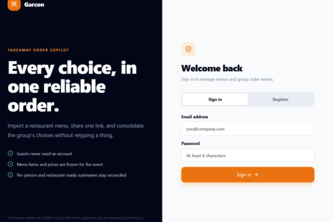
What the company appears to be: Garcon is a self-reported tool for managing group takeaway orders, built as a hackathon project using AI tools (ChatGPT, Codex). It allows an organiser to create and review a menu, then share a secure link with guests who can order without registration. The system tracks submissions, generates packing lists, and supports editing until the event closes.
What changed: The author states that Garcon was developed during OpenAI Build Week as a working prototype, using AI tools for product planning, implementation, and deployment. It is presented as an evolution from a personal problem (group ordering chaos) into a functional application.
Single most important open question: Is there any evidence of actual usage or traction beyond the hackathon demo? The description contains no data on customers, revenue, or adoption.
What The Product Actually Is
The description states that Garcon is a React and TypeScript application built with Vite, Tailwind CSS and Zod. It uses Supabase for authentication and persistence, and is deployed using ChatGPT Sites. The system allows organisers to:
- Paste or manually enter a menu
- Review items and prices before publishing
- Create events with deadlines
- Share secure links with guests
- Monitor submitted orders in real time
- Export final results as CSV
Guests can order without registration by entering a display name, selecting quantities, adding notes, reviewing their order, and submitting it. The system supports both restaurant menus and homemade dishes.
The product is described as not being a marketplace but rather a coordination layer between a group and an organiser-reviewed menu.
Evidence: Self-reported from the author's own write-up.
Inference: This is a web-based tool for managing shared ordering events, built with modern frontend/backend stack and AI-assisted development tools.
Positioning & Claim Evolution
The description states that Garcon was inspired by the frustration of group takeaway orders being managed through chat messages. It positions itself as a solution to avoid duplication, confusion, and errors in group ordering.
It claims to be a "coordination layer" between a group and an organiser-reviewed menu, distinct from marketplace platforms.
The author also notes that Garcon removes stress from group meals by simplifying order management compared to chat-based systems.
Evidence: Self-reported from the author's own write-up.
Inference: The positioning evolved from a personal pain point into a product idea, with claims focused on reducing friction in group ordering rather than competing with existing platforms.
Target Customer & ICP
The description states that Garcon targets informal groups such as families, friends, and watch parties where takeaway orders are coordinated. It is designed for use cases like football watch parties or family dinners where people want to avoid the chaos of chat-based ordering.
It also mentions that it supports homemade dishes, desserts, and portions, indicating a broad range of potential users beyond just restaurant orders.
Evidence: Self-reported from the author's own write-up.
Inference: The target customer is likely casual group organizers who value simplicity and reliability in managing shared food orders.
Business Model & Pricing Evidence
The description does not state anything about pricing, business model, monetization strategy or revenue streams. It focuses entirely on functionality and user experience.
Evidence: Not evidenced.
Inference: No commercial structure is described; the project appears to be a prototype with no indication of how it would generate value or income.
Technical & Delivery Signals
The description states that Garcon was built using:
- React, TypeScript, Vite, Tailwind CSS, Zod
- Supabase for authentication and persistence
- PostgreSQL database with Row Level Security
- Edge Functions
- ChatGPT Sites for deployment
Security features include:
- Immutable menu snapshots
- Event-scoped bearer links instead of accounts
- Hashed token secrets
- Atomic and idempotent submissions
- Server-owned price calculations
- Tenant isolation
Development process involved:
- Use of ChatGPT for idea generation and documentation
- Use of Codex with GPT-5.6 Sol for implementation, testing, debugging, etc.
- Deployment via ChatGPT Sites
Evidence: Self-reported from the author's own write-up.
Inference: The technical stack suggests a modern full-stack web application built with security in mind, using AI tools for rapid development.
Traction & Maturity Signals
The description does not provide any evidence of traction, revenue, customers, or adoption beyond the hackathon submission. It mentions that it was submitted to the OpenAI 2026 hackathon and that the team is small (1 member).
Evidence: Not evidenced.
Inference: There is no indication of real-world usage or product-market fit beyond the prototype phase.
Competitive Context
The description states that Garcon is not another restaurant marketplace. It positions itself as a coordination layer between a group and an organiser-reviewed menu, distinct from platforms like Uber Eats or DoorDash.
It also notes that it supports homemade dishes and desserts, suggesting it may compete with informal ordering tools or apps used in social settings rather than traditional delivery services.
Evidence: Self-reported from the author's own write-up.
Inference: The competitive context is unclear due to lack of data on existing solutions or market positioning; however, it seems to target a niche within group coordination rather than marketplace competition.
Open Questions & Risks
- No traction or revenue evidence: The project is described as a hackathon submission with no indication of real-world usage.
- Unverified claims: All statements are self-reported and unverified; there's no third-party validation.
- Single founder: Only one team member is listed, which may limit scalability or execution capacity.
- AI dependency: Heavy reliance on AI tools (ChatGPT, Codex) raises questions about long-term maintainability and control over the product.
- No pricing model: No indication of how the tool would be monetized if developed further.
Evidence: Self-reported from the author's own write-up.
Inference: These are potential structural risks that could hinder future development or commercial viability without additional evidence.
Questions the description leaves open
- Has Garcon been used beyond the hackathon context? Are there any users or feedback?
- What is the plan for scaling beyond a single developer and prototype?
- How would you monetize this product if it were to become a commercial offering?
- Can you explain how the AI tools were used in practice, and what role they played in actual development?
- Are there any plans to integrate with existing delivery platforms or APIs?
- What are the key assumptions underlying the product design that might need testing?
Overall Assessment
The description states that Garcon is a hackathon project submitted to OpenAI Build Week, built by one developer using AI tools. There is no evidence of revenue, customers, traction or commercial viability beyond the prototype stage.
Evidence: Self-reported from the author's own write-up.
Inference: At this point, there is insufficient evidence to support an investment or partnership decision. The project shows technical capability and a clear problem-solution fit but lacks any demonstration of market demand or scalability.
User Stories BotA demo video on every pull request
Get a demo video on every new feature
GitHub App that watches your pull requests and records a narrated, captioned demo.
Save time on demo prep and make informed decisions faster with a video walkthrough of every new feature.
Source
Submitted to the OpenAI 2026 hackathon on Devpost. Project home on Devpost. Back to the full gallery on Devpost.
This competitive analysis was produced by top-founders.com (opens in a new tab)
Generated by a language model from this project's public Devpost page — its tagline, the author's own write-up and any built-with tags listed there — as captured in August 2026. Short quotations are the author's words. It is an opinion on the idea as a business, not on the people behind it, and it reflects the description as published then. If the project has moved on, request a correction below. The analysis is not independent research and contains no verified traction, revenue or customer data.
An independent guide by KFG International LLC — not affiliated with, endorsed by, or connected to Devpost or OpenAI.