

Archive position — measured, not model output
0 likes on Devpost
2,263 of the 7,850 archived projects have more likes, and 5,587 share exactly 0 — so this project's #4,264 place in the like-ranked listing is a tie-break inside that group, not a ranking.
Projects (log scale)
Likes on Devpost. ▲ marks this project's group.
Show the figures
| Likes | Projects | Share of archive |
|---|---|---|
| 0 | 5,587 | 71.2% |
| 1 | 1,758 | 22.4% |
| 2 | 284 | 3.6% |
| 3–4 | 132 | 1.7% |
| 5–9 | 75 | 1.0% |
| 10+ | 14 | 0.2% |
 User Stories BotA demo video on every pull request
Get a demo video on every new feature
GitHub App that watches your pull requests and records a narrated, captioned demo.
Save time on demo prep and make informed decisions faster with a video walkthrough of every new feature.
Executive Summary
What the company appears to be
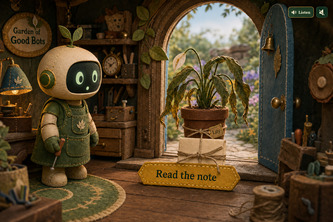
Garden of Good Bots is a self-reported educational game project built by one person (Jane Arandelovic) for the OpenAI 2026 hackathon. It is described as an interactive story-game where players teach an AI agent (Good Bot) how to care for a plant named Lily, using real-world sensor data and AI tools like Codex and GPT-5.6.
What changed
The project was submitted as part of the OpenAI Build Week hackathon. It represents a one-off creative effort combining AI tooling with a hands-on STEM learning experience involving soil sensors and game development.
Single most important open question
Is there any evidence that this project has moved beyond a prototype or demo, or whether it will be developed further into a product with users or revenue?
This analysis is based entirely on the self-reported description provided by the author. No external verification, traction data, or financials are available.
What The Product Actually Is
The description states that Garden of Good Bots is:
- A story-game where children and adults interact with an AI agent called "Good Bot"
- The game teaches users how to build a basic AI agent while helping a virtual plant (Lily)
- Players guide Good Bot through tasks such as testing soil, alerting grown-ups if watering is needed, and logging results
- Good Bot uses evidence, memory, and safety rules, but always defers final decisions to humans
It includes:
- An isometric story game built using Three.js and WebGL
- A real-world soil sensor setup connected to a GPT-5.6 API path
- A demo version that uses pre-recorded soil readings instead of live data due to time constraints
- A separate Agent Lab designed to send real-time sensor data to GPT-5.6
The product is described as a prototype/demo, not a commercial offering.
Positioning & Claim Evolution
The author states:
- The project aims to provide a child-friendly way to learn about AI agents
- It combines fun gameplay with real-world sensor data and AI tools
- The goal is to show how AI can interpret environmental clues (like soil moisture) without relying only on visual observation
- The game emphasizes safety-first design: Good Bot observes and alerts, but humans decide what actions to take
These claims are self-reported and reflect the author's intent. There is no evidence of prior positioning or market traction.
Target Customer & ICP
The description states:
- The target audience includes older children and grown-ups
- It is designed as an educational tool for teaching AI concepts
- The game is framed as a story-game, suggesting it appeals to users who enjoy narrative-based learning
No specific customer segments, personas, or usage patterns are detailed beyond general age groups.
Business Model & Pricing Evidence
Not evidenced.
There is no mention of pricing, monetization strategy, or business model in the description.
Technical & Delivery Signals
The author states:
- Built using Codex and GPT-5.6 Sol Ultra & Extra High
- Game built with Three.js, WebGL, JavaScript, TypeScript, CSS
- Uses a real soil sensor (Adafruit) connected to a Feather microcontroller
- The project involved parallel AI-assisted workflows across multiple chats
- A separate Agent Lab was built to interface with GPT-5.6 via API
These technical choices suggest a prototype built in a short timeframe, likely for demonstration purposes.
Traction & Maturity Signals
Not evidenced.
No data on user adoption, engagement, revenue, or product maturity beyond the hackathon submission is provided.
Competitive Context
Not evidenced.
There is no mention of competitors or market positioning beyond the author’s own framing.
Open Questions & Risks
- The project is described as a single-person hackathon effort, with no indication of ongoing development or team expansion
- It is a demo/prototype and not yet a product with users or revenue
- The use of AI tools like Codex and GPT-5.6 suggests the work was done in a short timeframe, possibly limiting depth or scalability
- No evidence of any product-market fit, user feedback, or iteration history
- The project is not commercialized or monetized, and there is no indication it will be
This is a one-off creative effort, not a scalable business.
Questions the description leaves open
- What is the long-term vision for Garden of Good Bots beyond this hackathon prototype?
- Are you planning to develop this into a full product or platform with users?
- Have you tested the game with children or educators? If so, what feedback did you receive?
- How do you plan to scale beyond the current demo version and real-time sensor integration?
- What are your thoughts on monetization or commercial partnerships?
Overall Assessment
Not evidenced.
There is no evidence of a business model, traction, or investment-ready product. The project is described as a hackathon submission with no indication of commercial viability or future development beyond the demo phase.
User Stories BotA demo video on every pull request
Get a demo video on every new feature
GitHub App that watches your pull requests and records a narrated, captioned demo.
Save time on demo prep and make informed decisions faster with a video walkthrough of every new feature.
Source
Submitted to the OpenAI 2026 hackathon on Devpost. Project home on Devpost. Back to the full gallery on Devpost.
This competitive analysis was produced by top-founders.com (opens in a new tab)
Generated by a language model from this project's public Devpost page — its tagline, the author's own write-up and any built-with tags listed there — as captured in August 2026. Short quotations are the author's words. It is an opinion on the idea as a business, not on the people behind it, and it reflects the description as published then. If the project has moved on, request a correction below. The analysis is not independent research and contains no verified traction, revenue or customer data.
An independent guide by KFG International LLC — not affiliated with, endorsed by, or connected to Devpost or OpenAI.