

Archive position — measured, not model output
0 likes on Devpost
2,263 of the 7,850 archived projects have more likes, and 5,587 share exactly 0 — so this project's #4,246 place in the like-ranked listing is a tie-break inside that group, not a ranking.
Projects (log scale)
Likes on Devpost. ▲ marks this project's group.
Show the figures
| Likes | Projects | Share of archive |
|---|---|---|
| 0 | 5,587 | 71.2% |
| 1 | 1,758 | 22.4% |
| 2 | 284 | 3.6% |
| 3–4 | 132 | 1.7% |
| 5–9 | 75 | 1.0% |
| 10+ | 14 | 0.2% |
 User Stories BotA demo video on every pull request
Get a demo video on every new feature
GitHub App that watches your pull requests and records a narrated, captioned demo.
Save time on demo prep and make informed decisions faster with a video walkthrough of every new feature.
Executive Summary
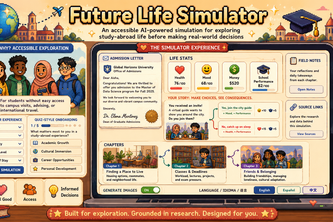
What the company appears to be: Future Life Simulator is a self-reported AI-powered simulation tool that allows users to explore study-abroad experiences through an interactive, branching narrative. It is described as a social good project aimed at making international education more accessible.
What changed: The project was built during the OpenAI 2026 hackathon and is presented as a working prototype with a defined user flow, AI integration, and multilingual support. No evidence of prior development or commercial traction exists beyond its submission to the hackathon.
Single most important open question: Is there any evidence that this project has moved beyond a hackathon prototype into a product with real users, revenue, or adoption?
What The Product Actually Is
The description states that Future Life Simulator is a personalized study-abroad life simulation tool. It allows users to select a country, city, university, degree level, and length of stay to generate a simulated life experience.
Key features include:
- A quiz-style onboarding flow
- Personalized admission letters
- Branching choices with consequences
- Life stats (health, mood, money, school performance)
- Academic and everyday life challenges
- AI-generated illustrations for each chapter
- Multilingual UI support (English, Spanish, Chinese)
- Source links for verification
The system uses a multi-step pipeline involving:
- A research layer gathering context about the selected university and location
- A design layer structuring story elements
- An image layer creating consistent chapter illustrations
- A cache layer storing generated stories and assets
The frontend is built with React, TypeScript, and Vite. The backend uses Node.js and Express, with OpenAI APIs powering research, story generation, and image generation.
Inference: This appears to be a prototype or proof-of-concept, not a commercial product, based on its description as a hackathon submission.
Positioning & Claim Evolution
The project is positioned as:
- A social good initiative aimed at increasing access to study-abroad experiences for people who cannot afford or access them.
- An immersive and human-centered simulation tool, not a replacement for reality but a way to imagine and prepare for international education.
It claims to:
- Help users “try before deciding” about studying abroad
- Make study-abroad exploration more accessible, immersive, and human
- Provide research-grounded content with source links
The project evolved from an idea focused on accessibility to a working prototype that includes:
- Branching narratives
- Visual storytelling
- Multilingual support
- Image generation
Inference: The positioning is consistent with a non-commercial, educational or exploratory tool, not a monetized product.
Target Customer & ICP
The description states the target audience includes:
- Students who cannot afford campus visits, consulting services, or international travel
- People without access to reliable information about studying abroad
- Individuals who may never be able to study abroad but still want to imagine that world
It also mentions:
- Families and educators who might use it for counseling or decision-making
- Users with limited API access or financial constraints
Inference: The ICP is likely students, families, and educational counselors, with a focus on accessibility and inclusivity rather than monetization.
Business Model & Pricing Evidence
The description does not state any business model, pricing, or monetization strategy. It is presented as a social good tool without evidence of revenue streams or paid features.
Inference: No evidence of a business model exists beyond the self-reported intent to support accessibility and education.
Technical & Delivery Signals
The project is built with:
- Frontend: React, TypeScript, Vite
- Backend: Node.js, Express
- AI tools: OpenAI APIs (GPT-4o, image generation)
- Other technologies: CSS, live-search
It uses a multi-step pipeline including:
- Research layer
- Design layer
- Image layer
- Cache layer
The system supports:
- Multilingual UI
- Toggle for image generation
- Source verification links
Inference: The technical stack is standard for a modern web application with AI integration. It shows some sophistication in handling AI-generated content and caching, but no evidence of production-grade infrastructure or scalability.
Traction & Maturity Signals
The project was built during the OpenAI 2026 hackathon and is described as a working prototype. There is no evidence of:
- Revenue
- Customers
- User adoption
- Product-market fit
- Prior versions or iterations
It is presented as a first iteration, with plans for future expansion.
Inference: The project is at the early prototype stage, not a mature product or service.
Competitive Context
The description does not mention any competitors. It is unclear whether similar tools exist in the market, as no competitive analysis is provided.
Inference: No evidence of existing competitors or market positioning beyond the self-reported intent to support accessibility and education.
Open Questions & Risks
- No traction or revenue: The project is described only as a hackathon prototype with no evidence of users or monetization.
- Unverified claims: All features, goals, and impact are self-reported without external validation.
- Limited commercial viability: The focus on social good and accessibility may not translate into a sustainable business model.
- AI dependency risks: Heavy reliance on OpenAI APIs raises concerns about cost, availability, and scalability.
- No product-market fit evidence: No data or feedback from users is provided.
Inference: The project lacks commercial viability indicators and is likely in an early exploratory phase.
Questions the description leaves open
- What is the intended path to monetization or scaling beyond a hackathon prototype?
- Have you tested this with real users, and what feedback did you receive?
- How do you plan to handle content accuracy and source verification at scale?
- Are there any plans for partnerships with educational institutions or study-abroad agencies?
- What are the technical limitations of the current pipeline that might prevent scaling?
- How do you intend to manage API costs and performance as usage increases?
Overall Assessment
Not evidenced: There is no evidence of revenue, customers, traction, or a clear path to monetization. The project is described as a hackathon prototype, not a product with commercial potential.
Confidence level: Low — based entirely on self-reported information and no external validation.
Assessment: This is an early-stage idea with a social good focus. It does not yet demonstrate the commercial viability or traction required for investment or partnership consideration.
User Stories BotA demo video on every pull request
Get a demo video on every new feature
GitHub App that watches your pull requests and records a narrated, captioned demo.
Save time on demo prep and make informed decisions faster with a video walkthrough of every new feature.
Source
Submitted to the OpenAI 2026 hackathon on Devpost. Project home on Devpost. Back to the full gallery on Devpost.
This competitive analysis was produced by top-founders.com (opens in a new tab)
Generated by a language model from this project's public Devpost page — its tagline, the author's own write-up and any built-with tags listed there — as captured in August 2026. Short quotations are the author's words. It is an opinion on the idea as a business, not on the people behind it, and it reflects the description as published then. If the project has moved on, request a correction below. The analysis is not independent research and contains no verified traction, revenue or customer data.
An independent guide by KFG International LLC — not affiliated with, endorsed by, or connected to Devpost or OpenAI.