

Archive position — measured, not model output
2 likes on Devpost
221 of the 7,850 archived projects have more likes, and 284 share exactly 2 — so this project's #322 place in the like-ranked listing is a tie-break inside that group, not a ranking.
Projects (log scale)
Likes on Devpost. ▲ marks this project's group.
Show the figures
| Likes | Projects | Share of archive |
|---|---|---|
| 0 | 5,587 | 71.2% |
| 1 | 1,758 | 22.4% |
| 2 | 284 | 3.6% |
| 3–4 | 132 | 1.7% |
| 5–9 | 75 | 1.0% |
| 10+ | 14 | 0.2% |
 User Stories BotA demo video on every pull request
Get a demo video on every new feature
GitHub App that watches your pull requests and records a narrated, captioned demo.
Save time on demo prep and make informed decisions faster with a video walkthrough of every new feature.
Executive Summary
What the company appears to be
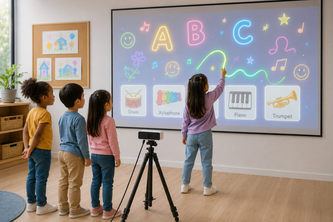
Finger Wand is an AI-assisted, embodied AR playground for young children, built by a single educator using ChatGPT and Codex. It uses a standard camera and screen to enable gesture-based interaction for drawing, letter tracing, and musical play—without requiring devices or reading instructions.
What changed
The author, Sarah Li, describes building this prototype in less than one week as part of a hackathon submission. She positions the project as an experiment in how educators can use AI tools to translate classroom needs into interactive learning experiences.
The single most important open question
Is there evidence that the author’s vision for educational impact and product development has traction or commercial viability beyond a prototype?
Note: This analysis is based solely on the self-reported, unverified description provided by the author. No third-party verification, revenue data, customer feedback, or prior performance exists in this universe of evidence.
What The Product Actually Is
The description states that Finger Wand:
- Turns an ordinary camera and screen into an embodied learning playground
- Uses real-time hand tracking to allow children to control on-screen activities through gestures
- Enables drawing, letter tracing, musical play, and visual interaction without touching a device or reading instructions
- Operates via short visual demonstrations rather than text-heavy tutorials
- Is browser-based and requires no specialized hardware
Inference: The product is described as a prototype built using AI-assisted development tools (ChatGPT and Codex), not a commercial offering.
Positioning & Claim Evolution
The author claims:
- Finger Wand bridges the gap between educators who understand classroom needs and those who can build tech solutions
- It supports “embodied learning” where children move, create, and participate together
- AI works behind the scenes to support design and content creation, not directly with children
- The experience is designed for classroom use, encouraging shared participation
Inference: The positioning is rooted in educational innovation and accessibility, but it does not yet demonstrate adoption or traction.
Target Customer & ICP
The description states:
- The primary users are young children (K–12)
- The product is intended for classroom settings
- It supports educators who want to create more interactive and creative learning experiences
Inference: The target customer segment is educators and early learners, with a focus on K–12 environments. No evidence of specific customer personas or user segmentation beyond age groups.
Business Model & Pricing Evidence
Not evidenced.
The description does not mention:
- Revenue streams
- Pricing models
- Monetization strategy
- Customer acquisition plans
- Distribution channels
Inference: There is no indication that a business model has been developed or tested beyond the prototype stage.
Technical & Delivery Signals
The description states:
- Built using ChatGPT and Codex for rapid prototyping
- Uses real-time hand tracking via camera input
- Browser-based, requiring only standard camera and screen
- Designed iteratively through observation → design → build → test cycles
Inference: The technical approach relies on AI-assisted development tools and basic computer vision techniques. No evidence of scalability, performance metrics, or infrastructure architecture.
Traction & Maturity Signals
Not evidenced.
The description does not provide:
- Customer data
- Usage statistics
- Product adoption rates
- Market validation
- Feedback from users or educators
Inference: The project is described as a prototype built in under a week. It has no demonstrated traction or maturity beyond initial concept and testing.
Competitive Context
Not evidenced.
The description does not mention:
- Competitors
- Market size
- Existing solutions in the space of embodied learning or educational AR
- Differentiation from similar tools
Inference: No competitive landscape is described, nor any evidence of market positioning or prior competition.
Open Questions & Risks
Key risks and open questions inferred from the description:
- The project is a prototype built by one person in less than a week; no evidence of long-term development or scalability
- Reliance on AI tools (ChatGPT, Codex) may limit control over product quality or future evolution
- No mention of user testing, accessibility considerations, or classroom integration beyond general claims
- The author is a single individual with no team or external support, raising questions about execution capability
Inference: The lack of traction, business model, and team structure raises concerns about viability as a scalable product or venture.
Questions the description leaves open
- What specific classroom needs did you observe that led to this idea?
- How do you plan to validate the educational value of the interactions with children and teachers?
- Have you tested any versions of this with actual students or educators?
- What are your plans for expanding beyond the current prototype?
- Are there any technical limitations or trade-offs in using AI-assisted development tools like ChatGPT and Codex?
- How do you intend to monetize or scale this product if it proves useful?
Overall Assessment
Not evidenced.
The description does not contain:
- Financials
- Valuation
- Funding history
- Strategic partnerships
- Exit potential
Inference: Based on the self-reported, unverified information, there is no evidence of a viable commercial opportunity or investment-ready product. The project remains in early prototype phase with no demonstrated traction or business model.
User Stories BotA demo video on every pull request
Get a demo video on every new feature
GitHub App that watches your pull requests and records a narrated, captioned demo.
Save time on demo prep and make informed decisions faster with a video walkthrough of every new feature.
Source
Submitted to the OpenAI 2026 hackathon on Devpost. Project home on Devpost. Back to the full gallery on Devpost.
This competitive analysis was produced by top-founders.com (opens in a new tab)
Generated by a language model from this project's public Devpost page — its tagline, the author's own write-up and any built-with tags listed there — as captured in August 2026. Short quotations are the author's words. It is an opinion on the idea as a business, not on the people behind it, and it reflects the description as published then. If the project has moved on, request a correction below. The analysis is not independent research and contains no verified traction, revenue or customer data.
An independent guide by KFG International LLC — not affiliated with, endorsed by, or connected to Devpost or OpenAI.