

Archive position — measured, not model output
0 likes on Devpost
2,263 of the 7,850 archived projects have more likes, and 5,587 share exactly 0 — so this project's #4,235 place in the like-ranked listing is a tie-break inside that group, not a ranking.
Projects (log scale)
Likes on Devpost. ▲ marks this project's group.
Show the figures
| Likes | Projects | Share of archive |
|---|---|---|
| 0 | 5,587 | 71.2% |
| 1 | 1,758 | 22.4% |
| 2 | 284 | 3.6% |
| 3–4 | 132 | 1.7% |
| 5–9 | 75 | 1.0% |
| 10+ | 14 | 0.2% |
 User Stories BotA demo video on every pull request
Get a demo video on every new feature
GitHub App that watches your pull requests and records a narrated, captioned demo.
Save time on demo prep and make informed decisions faster with a video walkthrough of every new feature.
Executive Summary
What the company appears to be
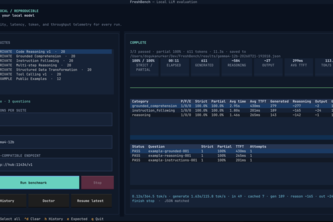
FreshBench is a terminal-based benchmarking tool for local language models (LLMs) that allows users to create and run private question suites. It is built as a Python CLI application, published on PyPI, and designed for use with OpenAI-compatible APIs such as those from local LLM servers like llama-server.
What changed
The project was self-submitted by one developer (Doğukan Mete Ürker) to the OpenAI 2026 hackathon. It is described as alpha software, not yet having any revenue or customer data.
Single most important open question
Is there evidence of traction or adoption beyond the author’s own use case?
Note
This analysis is based entirely on the self-reported description provided by the author. No external verification, funding rounds, headcount, customers, or financials are available. All claims are treated as stated by the author and not proven.
What The Product Actually Is
The description states that FreshBench is a fully terminal-based benchmarking tool for local language models exposed through an OpenAI-compatible API. It supports both command-line and interactive TUI interfaces.
Key technical features include:
- Support for running one or multiple benchmark suites
- Deterministic grading using Python-based graders (exact text, accepted answers, substring, regex, numeric values, JSON, JSON Schema, structured tool calls)
- Measurement of latency, time to first token, throughput, token usage, and retries
- Display of model reasoning when supported by the endpoint
- Checkpointing and resume capability for interrupted runs
- Diagnostics for endpoint capabilities such as streaming, tool calling, usage data, and tokenization
It is built in Python using tools like Textual (for TUI), Typer (CLI), Rich (terminal reporting), and uv (packaging). It communicates with OpenAI-compatible endpoints and supports streaming responses.
Inference The product is a developer-facing tool aimed at local LLM users who want to benchmark models they control, not public or commercial services.
Positioning & Claim Evolution
The author positions FreshBench as:
- A local-first benchmarking solution
- Designed for private question suites
- Focused on freshness, deterministic grading, and reproducibility
It is presented as a way to avoid public benchmarks that may reflect memorization rather than true capability, because users can control their own questions and refresh them over time.
The tool explicitly avoids using an LLM as a judge, instead relying on strict pass/fail scoring with optional partial diagnostics.
Claim
The author claims FreshBench reduces the risk of training data exposure by enabling private question sets and versioning.
Not evidenced No evidence that this approach is widely adopted or validated by others.
Target Customer & ICP
The description indicates that FreshBench targets:
- Users who run local language models
- Developers working with OpenAI-compatible APIs
- Individuals or teams seeking to benchmark models they control
- People interested in reproducible, deterministic evaluation
It is not described as targeting commercial customers or end-users directly.
Inference The ICP likely includes developers, researchers, and engineers using local LLMs for testing or research purposes.
Not evidenced No evidence of specific customer segments, personas, or use cases beyond the author’s own.
Business Model & Pricing Evidence
The description does not mention any business model or pricing structure. It is presented as a free, open-source tool published on PyPI.
Claim
The tool is available for installation via
piporuvx.Not evidenced No indication of monetization, subscriptions, or paid features.
Technical & Delivery Signals
The project is built in Python and uses:
- Textual for TUI
- Typer and Rich for CLI and terminal output
- Astral's uv for packaging
- OpenAI-compatible API clients
- YAML-based benchmark suites
- Versioned fingerprints to ensure compatibility between runs
It supports:
- Streaming responses
- Tool call reconstruction
- Checkpointing and resuming
- Validation of questions, graders, and schemas before execution
Inference The tool is designed for developers who value reproducibility, control, and extensibility.
Not evidenced No evidence of scalability, performance benchmarks, or integration with larger platforms.
Traction & Maturity Signals
The project is described as:
- Submitted to the OpenAI 2026 hackathon
- Currently in alpha stage
- Built by a single developer (Doğukan Mete Ürker)
- Not yet having any revenue, customers, or adoption metrics
Not evidenced No evidence of downloads, usage statistics, user feedback, or community engagement.
Competitive Context
The description does not reference competitors directly. However, it implies that existing benchmarks rely on static public question sets and may suffer from memorization issues.
Inference FreshBench aims to differentiate itself by offering private, regularly updated question sets and deterministic scoring.
Not evidenced No mention of existing tools or how FreshBench compares technically or functionally.
Open Questions & Risks
- The tool is alpha software, not yet mature
- It is single-developer in scope, raising questions about long-term maintenance
- No evidence of traction or adoption beyond the author’s own use case
- The tool does not claim to prevent memorization entirely, only reduce its risk through private question sets
- It is not a commercial product, so no revenue model or customer base exists
Open question
Lack of external validation, user feedback, or community traction suggests limited market readiness.
Questions the description leaves open
- What specific use cases are you seeing from early adopters?
- How do you plan to evolve the tool beyond its current alpha stage?
- Are there any plans for monetization or commercial partnerships?
- Have you received feedback from other developers using the tool?
- What is your roadmap for expanding support for different types of grading or model formats?
Overall Assessment
Not evidenced.
There is no evidence of revenue, customers, traction, or financials to assess viability for investment or partnership.
Assessment This is an early-stage developer tool with a clear niche but no demonstrated market impact or commercial traction. It may be suitable for incubation or strategic interest if the author plans to build out a productized offering, but currently lacks signals of scalability or demand.
User Stories BotA demo video on every pull request
Get a demo video on every new feature
GitHub App that watches your pull requests and records a narrated, captioned demo.
Save time on demo prep and make informed decisions faster with a video walkthrough of every new feature.
Source
Submitted to the OpenAI 2026 hackathon on Devpost. Project home on Devpost. Back to the full gallery on Devpost.
This competitive analysis was produced by top-founders.com (opens in a new tab)
Generated by a language model from this project's public Devpost page — its tagline, the author's own write-up and any built-with tags listed there — as captured in August 2026. Short quotations are the author's words. It is an opinion on the idea as a business, not on the people behind it, and it reflects the description as published then. If the project has moved on, request a correction below. The analysis is not independent research and contains no verified traction, revenue or customer data.
An independent guide by KFG International LLC — not affiliated with, endorsed by, or connected to Devpost or OpenAI.