

Archive position — measured, not model output
0 likes on Devpost
2,263 of the 7,850 archived projects have more likes, and 5,587 share exactly 0 — so this project's #6,198 place in the like-ranked listing is a tie-break inside that group, not a ranking.
Projects (log scale)
Likes on Devpost. ▲ marks this project's group.
Show the figures
| Likes | Projects | Share of archive |
|---|---|---|
| 0 | 5,587 | 71.2% |
| 1 | 1,758 | 22.4% |
| 2 | 284 | 3.6% |
| 3–4 | 132 | 1.7% |
| 5–9 | 75 | 1.0% |
| 10+ | 14 | 0.2% |
 User Stories BotA demo video on every pull request
Get a demo video on every new feature
GitHub App that watches your pull requests and records a narrated, captioned demo.
Save time on demo prep and make informed decisions faster with a video walkthrough of every new feature.
Executive Summary
What the company appears to be
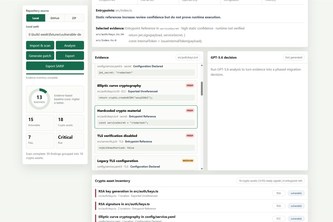
Quantum Readiness Copilot is a self-reported developer tool built as a local Node.js application that scans repositories for cryptographic assets vulnerable to quantum attacks. It uses static analysis and GPT-5.6 through Codex to explain risks, prioritize work, and generate reviewable patches.
What changed
The author states they built this tool to bridge the gap between strategic post-quantum cryptography planning and repository-level evidence. They describe it as a "local developer-security tool with a browser-based dashboard" that focuses on actionable findings rather than broad certification claims.
Single most important open question
Does the tool actually function as described, or is this a conceptual prototype? The description states it's built for local use only, but there's no evidence of deployment, testing, or operational readiness beyond the author's own benchmarking.
Analysis basis
This report is based entirely on the self-reported project description provided by the caller. No external verification, traction data, revenue figures, customer names, or third-party sources are available. All claims are treated as unverified statements made by the author.
What The Product Actually Is
The description states that Quantum Readiness Copilot:
- Scans local repositories, public GitHub repositories, or ZIP archives for cryptographic implementations and dependencies
- Groups findings into actionable cryptographic assets
- Distinguishes confidentiality risks from authenticity and signature risks
- Calculates an explainable readiness score
- Evaluates harvest-now-decrypt-later exposure using the Mosca inequality
- Builds a dependency-aware migration plan
- Validates repository-owned evidence for ML-KEM, ML-DSA, SLH-DSA, and hybrid constructions
- Uses GPT-5.6 through Codex to explain risks and prioritize work
- Generates reviewable patches for selected findings
- Applies proposed patches only to an isolated copy, rescans it, and reports impact without modifying the original repository
- Exports Markdown and SARIF evidence for review and CI workflows
The tool is described as a "local Node.js developer-security tool with a browser-based dashboard" that uses deterministic rules for repository traversal, cryptographic discovery, evidence grouping, scoring, policy enforcement, and SARIF generation.
Inference The product appears to be a proof-of-concept or early-stage prototype rather than a production-ready tool. It's built as a local application with no mention of cloud deployment, multi-user support, or enterprise features.
Positioning & Claim Evolution
The description states that the author built Quantum Readiness Copilot to "connect that strategic question to repository-level evidence" and to give developers "a practical and technically honest starting point for planning the transition."
The tool is positioned as:
- A bridge between strategic post-quantum cryptography planning and repository-level evidence
- Not a tool to label codebases as "quantum-safe"
- A way to provide developers with actionable findings rather than broad certification claims
Inference The positioning suggests this is an early-stage developer tool aimed at helping teams understand their current cryptographic posture before making migration decisions. It's positioned as a planning and evidence-gathering tool rather than a certification or compliance tool.
Target Customer & ICP
The description states that Quantum Readiness Copilot is built for:
- Developers working with cryptographic implementations
- Teams needing to plan post-quantum cryptography migrations
- Organizations wanting to understand their current cryptographic posture
It's described as a "local developer-security tool" and "browser-based dashboard," suggesting it targets individual developers or small teams rather than large enterprises.
Inference The target customer appears to be technical teams within organizations that have existing codebases with cryptographic dependencies, particularly those considering post-quantum cryptography migration. The tool seems designed for early-stage planning rather than production deployment.
Business Model & Pricing Evidence
Not evidenced.
The description does not contain any information about pricing models, revenue streams, or business model assumptions. There's no mention of commercial licensing, subscription fees, or monetization strategies.
Technical & Delivery Signals
The description states that:
- The application is built as a local Node.js developer-security tool with a browser-based dashboard
- It uses deterministic rules for repository traversal, cryptographic discovery, evidence grouping, scoring, policy enforcement, and SARIF generation
- Static call-site analysis, repository-owned migration policies, baseline tracking, exposure-horizon modelling, and dependency graph are included
- Model responses are constrained by structured schemas and checked against deterministic evidence before acceptance
- The scanner remains the source of observed facts; GPT-5.6 adds context but cannot silently change scores or claim completion
- Codex runs in a read-only repository context with generated changes remaining proposals until user review
- Implementation includes reproducible Node and Python interoperability checks covering ML-KEM-768, ML-DSA-65, and X25519 + ML-KEM-768 hybrid
- The tool includes automated suite covering scanner, exposure logic, redaction, repository intake, model schemas, patch verification, network failures, and HTTP behaviour
Inference The technical approach appears to be a hybrid deterministic/static analysis + AI reasoning system. The tool is designed with safety mechanisms to prevent AI from overriding factual evidence, suggesting a cautious approach to AI integration.
Traction & Maturity Signals
Not evidenced.
The description contains no information about:
- Revenue or funding
- Customer adoption or usage metrics
- Product deployment or operational history
- Market traction or user feedback
- Any form of commercial success or market validation
Competitive Context
Not evidenced.
The description does not contain any information about:
- Direct competitors in the post-quantum cryptography scanning space
- Market positioning relative to existing tools
- Competitive advantages or differentiators
- Industry benchmarks or standards
Open Questions & Risks
Risk 1
The tool is described as a local Node.js application with no mention of cloud deployment, multi-user support, or enterprise features. This suggests it's not designed for production use or commercial deployment.
Risk 2
The author states the tool is built for "local single-user environment" and that "for use beyond a local single-user environment, I would also add hosted authentication, tenant isolation, durable storage, stricter resource controls, and deployment-specific security configuration." This indicates the current version is incomplete or experimental.
Risk 3
The description mentions that "Codex runs in a read-only repository context" and that generated changes remain proposals until user review. This suggests the tool may not be fully automated or integrated into CI/CD workflows.
Risk 4
The author states they are "proud that the project produces evidence that can be inspected and reproduced instead of relying on a polished AI answer." This could indicate limitations in usability or integration with existing development practices.
Questions the description leaves open
- What specific cryptographic assets does the tool identify, and how does it distinguish between different types of risks?
- How does the tool handle false positives in its static analysis?
- What is the accuracy rate of the GPT-5.6 model-assisted explanations compared to manual verification?
- Has the tool been tested on real-world repositories beyond the author's own benchmark?
- What are the limitations of the current implementation that would prevent it from being used at scale?
- How does the tool handle edge cases in cryptographic implementations or complex dependency chains?
- What is the expected timeline for moving from this prototype to a production-ready version?
- How does the tool integrate with existing CI/CD pipelines and security platforms?
Overall Assessment
Not evidenced.
The description contains no information about:
- Financial metrics or performance indicators
- Market opportunity size or competitive positioning
- Founders' track record or team experience
- Strategic fit for potential investors or partners
- Any form of commercial viability assessment
Inference Based on the self-reported description alone, this appears to be an early-stage prototype or proof-of-concept rather than a mature product ready for investment or partnership. The tool is described as built for local use only with no indication of deployment, testing, or operational readiness beyond the author's own benchmarking.
User Stories BotA demo video on every pull request
Get a demo video on every new feature
GitHub App that watches your pull requests and records a narrated, captioned demo.
Save time on demo prep and make informed decisions faster with a video walkthrough of every new feature.
Source
Submitted to the OpenAI 2026 hackathon on Devpost. Project home on Devpost. Back to the full gallery on Devpost.
This competitive analysis was produced by top-founders.com (opens in a new tab)
Generated by a language model from this project's public Devpost page — its tagline, the author's own write-up and any built-with tags listed there — as captured in August 2026. Short quotations are the author's words. It is an opinion on the idea as a business, not on the people behind it, and it reflects the description as published then. If the project has moved on, request a correction below. The analysis is not independent research and contains no verified traction, revenue or customer data.
An independent guide by KFG International LLC — not affiliated with, endorsed by, or connected to Devpost or OpenAI.