

Archive position — measured, not model output
0 likes on Devpost
2,263 of the 7,850 archived projects have more likes, and 5,587 share exactly 0 — so this project's #4,237 place in the like-ranked listing is a tie-break inside that group, not a ranking.
Projects (log scale)
Likes on Devpost. ▲ marks this project's group.
Show the figures
| Likes | Projects | Share of archive |
|---|---|---|
| 0 | 5,587 | 71.2% |
| 1 | 1,758 | 22.4% |
| 2 | 284 | 3.6% |
| 3–4 | 132 | 1.7% |
| 5–9 | 75 | 1.0% |
| 10+ | 14 | 0.2% |
 User Stories BotA demo video on every pull request
Get a demo video on every new feature
GitHub App that watches your pull requests and records a narrated, captioned demo.
Save time on demo prep and make informed decisions faster with a video walkthrough of every new feature.
Executive Summary
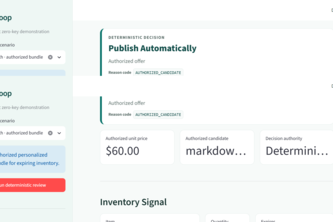
FreshLoop is a self-reported AI-powered retail operations prototype designed to manage near-expiry inventory by generating dynamic offers through an AI agent, while enforcing strict business rules via deterministic logic. The system uses GPT-5.6 for offer generation and applies policy checks before any customer-facing action.
The author states that the project was built as part of a hackathon submission and is not yet deployed in production or integrated with real retail systems. It includes a demo interface, structured data contracts, and a zero-key safe mode to evaluate workflows without exposing API keys.
Key commercial due-diligence question: Is there evidence of traction, customer feedback, or business model viability beyond the prototype stage?
What The Product Actually Is
The description states that FreshLoop is a policy-enforced AI retail operations prototype for near-expiry inventory. It uses GPT-5.6 to propose structured offers in JSON format, which are then validated by deterministic Python rules before being displayed.
It is described as a system where:
- Retail inventory and customer context are loaded as structured data.
- GPT-5.6 proposes an offer in JSON.
- Deterministic logic evaluates the proposal for:
- Inventory eligibility
- Expiry conditions
- Pricing and margin rules
- Dietary constraints
- Customer consent
- Output schema validity
- Unauthorized or invalid outputs are rejected.
The system includes a zero-key safe mode to evaluate workflows without exposing API keys.
This is a self-reported prototype, not a production-ready product. It was built using Python, Streamlit, OpenAI API (GPT-5.6), Codex, Git, GitHub, and pytest.
Positioning & Claim Evolution
The author states that the project was inspired by the problem of near-expiry food waste in retail, where pricing, inventory, customer consent, and dietary constraints are handled in separate systems.
It positions itself as a solution to this problem using AI-generated offers, but with strict policy enforcement to avoid unrestricted model authority over business-critical actions like pricing or customer-facing decisions.
The author claims that the system enforces a clear boundary between probabilistic AI generation and deterministic business authorization.
This is a self-reported positioning, not validated in market or customer feedback. The claim of turning near-expiry inventory into dynamic offers is made, but no evidence of adoption, revenue, or real-world use exists.
Target Customer & ICP
The description states that the system targets retail environments where near-expiry inventory is a problem and where there are separate systems for pricing, consent, and dietary constraints.
It implies a retail operator or convenience store as the likely user. The author mentions future development could include integration with point-of-sale systems and multi-store policy management.
However, no specific customer segments, personas, or buyer profiles are defined in the description.
Business Model & Pricing Evidence
The description does not state any business model or pricing structure. It is a self-reported prototype, not a commercial offering.
There is no evidence of:
- Revenue streams
- Customer acquisition costs
- Pricing tiers
- Monetization strategy
The system is described as a demo and a proof-of-concept, not a product with a monetized business model.
Technical & Delivery Signals
The system is built using:
- Python
- Streamlit (for UI)
- OpenAI API (GPT-5.6)
- Codex
- Git and GitHub
- pytest
It uses JSON-based data contracts, deterministic validation logic, and a closed-loop rejection of unauthorized outputs.
The author notes that the system was designed to prevent malformed or non-compliant model outputs from being silently accepted.
There is no evidence of:
- Production deployment
- Scalability considerations
- API integrations
- Infrastructure or hosting details
Traction & Maturity Signals
The description states that this is a prototype built for a hackathon. It includes a demo interface but lacks any evidence of:
- Real-world deployment
- Customer feedback
- Revenue
- Product-market fit
- Adoption metrics
It is described as a self-reported project, not a product with traction or maturity.
Competitive Context
The description does not mention any competitors or existing solutions in the market for managing near-expiry inventory through AI.
There is no evidence of:
- Market analysis
- Competitor offerings
- Differentiation from existing tools
- Industry trends or benchmarks
This is a self-reported project, not a product with competitive positioning or market presence.
Open Questions & Risks
- Prototype only: The system is a hackathon demo, not a production-ready product.
- No traction or revenue: No evidence of customers, adoption, or monetization.
- Unverified claims: All features and functionality are self-reported.
- Limited scope: The project does not include live integration, demand forecasting, or multi-store systems beyond stated future plans.
- No validation: There is no evidence of real-world testing or feedback from retail operators.
Questions the description leaves open
- What specific retail use cases have you identified for this system?
- Have you tested the system with actual retail data or operators?
- How do you plan to scale beyond a single-store demo?
- What are your plans for monetization and customer acquisition?
- Are there any real-world constraints or limitations that were not addressed in the prototype?
- What is the timeline for moving from prototype to production?
Overall Assessment
The description states that FreshLoop is a prototype built for a hackathon, with no evidence of traction, revenue, or customer adoption.
It is a self-reported concept with no independent validation or market proof. The author describes it as a technical demonstration of AI in retail operations, but does not provide any indication of commercial viability or business model development.
Assessment: Not evidenced for investment or partnership consideration at this stage. This is a pre-product prototype, not a product with demonstrated value or traction.
User Stories BotA demo video on every pull request
Get a demo video on every new feature
GitHub App that watches your pull requests and records a narrated, captioned demo.
Save time on demo prep and make informed decisions faster with a video walkthrough of every new feature.
Source
Submitted to the OpenAI 2026 hackathon on Devpost. Project home on Devpost. Back to the full gallery on Devpost.
This competitive analysis was produced by top-founders.com (opens in a new tab)
Generated by a language model from this project's public Devpost page — its tagline, the author's own write-up and any built-with tags listed there — as captured in August 2026. Short quotations are the author's words. It is an opinion on the idea as a business, not on the people behind it, and it reflects the description as published then. If the project has moved on, request a correction below. The analysis is not independent research and contains no verified traction, revenue or customer data.
An independent guide by KFG International LLC — not affiliated with, endorsed by, or connected to Devpost or OpenAI.