

Archive position — measured, not model output
1 like on Devpost
505 of the 7,850 archived projects have more likes, and 1,758 share exactly 1 — so this project's #1,105 place in the like-ranked listing is a tie-break inside that group, not a ranking.
Projects (log scale)
Likes on Devpost. ▲ marks this project's group.
Show the figures
| Likes | Projects | Share of archive |
|---|---|---|
| 0 | 5,587 | 71.2% |
| 1 | 1,758 | 22.4% |
| 2 | 284 | 3.6% |
| 3–4 | 132 | 1.7% |
| 5–9 | 75 | 1.0% |
| 10+ | 14 | 0.2% |
 User Stories BotA demo video on every pull request
Get a demo video on every new feature
GitHub App that watches your pull requests and records a narrated, captioned demo.
Save time on demo prep and make informed decisions faster with a video walkthrough of every new feature.
Executive Summary
What the company appears to be
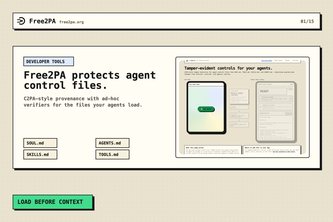
Free2PA is a self-reported developer tool that implements a C2PA-inspired verification system for agent control files. It provides cryptographic signing and verification of text-based files used in AI agent frameworks, such as SOUL.md or AGENTS.md, before those files are loaded into model context. The system allows developers to maintain local trust networks and supports guarded repair when unauthorized changes occur.
What changed
During Build Week, Free2PA evolved from a research idea into an installable developer tool with CLI, Node API, HTTP API, GitHub Action, and Codex integration. It added GPT-5.6 behavioral auditing and automated testing.
Single most important open question
Is there any evidence of adoption or usage beyond the author’s own development and demo?
What The Product Actually Is
The description states that Free2PA is a verifier-local trust system for agent control files, using cryptographic signing and verification to ensure only authorized changes are read. It operates at the file-read boundary, checking:
- Signature validity
- File hash match
- Certificate current status
- Publisher membership in local trust network
It supports multiple developer interfaces including CLI, Node API, HTTP API, GitHub Action, and a Codex skill for retrofitting existing agents.
The system is described as not conforming to C2PA Content Credentials, but inspired by C2PA principles. It uses a custom receipt format and integrates with the Model Context Protocol (MCP) and OpenAI’s GPT-5.6 for optional behavioral audits.
Inference The tool functions as a runtime control mechanism that enforces trust decisions before agent inputs are processed, not a general-purpose PKI or supply-chain tool.
Positioning & Claim Evolution
The author claims Free2PA addresses AI agent security concerns, particularly around the files that precede model execution — which they argue are just as critical as model behavior itself. It positions itself as a practical solution for developers who want to avoid adopting public PKI or manually inspecting receipts.
Key claims
- Verifier-local trust is sufficient for real-world collaboration (classes, hackathons, contractors, open-source teams).
- The tool supports guarded repair, allowing safe fallbacks when unsigned edits are detected.
- It integrates with existing agent frameworks like OpenClaw and can retrofit them via Codex.
Inference Free2PA is positioned as a lightweight, developer-centric solution for securing agent control files in ad-hoc or short-lived teams — not a large-scale enterprise trust infrastructure.
Target Customer & ICP
The description states that Free2PA targets developers working with AI agents, especially those using frameworks like OpenClaw. It is intended for:
- Class projects
- Hackathon teams
- Contractors
- Open-source maintainers
- Short-lived project groups
It is described as a tool for verifier-local trust, meaning it’s designed to be used by individuals or small teams who control their own trust decisions.
Inference The ICP likely includes developers building or maintaining AI agents in environments where trust is managed locally and not through centralized systems.
Business Model & Pricing Evidence
Not evidenced.
The description does not mention any pricing, monetization strategy, or business model beyond the author’s own use case and demo.
Technical & Delivery Signals
Evidence
- Built with Node.js 20, Express, native crypto/X.509 APIs, OpenSSL, MCP SDK, OpenAI Responses API
- Uses SHA-256 hashing, ES256 signatures (ECDSA-P256), and X.509 certificates
- Supports CLI, HTTP API, Node.js load-gate, GitHub Actions, Codex skill
- Includes guarded repair flow, test suite covering signing, trust admission/revocation, tamper detection, etc.
- GPT-5.6 used for optional behavioral audit (not part of core gate)
Inference The tool is built with a clear technical stack and supports multiple integration points, suggesting it’s designed to be modular and developer-friendly.
Traction & Maturity Signals
Not evidenced.
There is no mention of revenue, customers, usage metrics, or adoption beyond the author's own development and demo.
Competitive Context
Not evidenced.
The description does not reference competitors or similar tools in the market for agent control file verification or provenance systems.
Open Questions & Risks
- No evidence of traction or usage — the tool appears to be a prototype or proof-of-concept, not yet adopted by users.
- Self-reported only — no independent validation or third-party audits are mentioned.
- Limited scope — it is designed for local trust and does not address broader PKI or enterprise-level supply chain issues.
- GPT-5.6 audit is optional — the core verification relies on cryptography, not AI for decision-making.
- No commercialization strategy — no indication of plans to monetize or scale beyond personal or small-team use.
Questions the description leaves open
- Has Free2PA been used in any real-world agent projects beyond this demo?
- Are there any known integrations with popular AI agent frameworks (e.g., OpenClaw, LangChain)?
- What are the plans for expanding beyond local trust to support broader trust models or enterprise use cases?
- How does Free2PA handle certificate revocation and lifecycle management in practice?
- Is there a roadmap for additional behavioral auditing features or integration with other AI safety tools?
Overall Assessment
Not evidenced.
The description provides no information on financials, traction, or commercial viability. It is unclear whether this represents a viable product or just an experimental tool. The author states that Free2PA was built during a hackathon and has not yet been adopted beyond personal use.
Confidence level Low — based entirely on self-reported claims with no external validation or evidence of adoption.
User Stories BotA demo video on every pull request
Get a demo video on every new feature
GitHub App that watches your pull requests and records a narrated, captioned demo.
Save time on demo prep and make informed decisions faster with a video walkthrough of every new feature.
Source
Submitted to the OpenAI 2026 hackathon on Devpost. Project home on Devpost. Back to the full gallery on Devpost.
This competitive analysis was produced by top-founders.com (opens in a new tab)
Generated by a language model from this project's public Devpost page — its tagline, the author's own write-up and any built-with tags listed there — as captured in August 2026. Short quotations are the author's words. It is an opinion on the idea as a business, not on the people behind it, and it reflects the description as published then. If the project has moved on, request a correction below. The analysis is not independent research and contains no verified traction, revenue or customer data.
An independent guide by KFG International LLC — not affiliated with, endorsed by, or connected to Devpost or OpenAI.