

Archive position — measured, not model output
1 like on Devpost
505 of the 7,850 archived projects have more likes, and 1,758 share exactly 1 — so this project's #2,226 place in the like-ranked listing is a tie-break inside that group, not a ranking.
Projects (log scale)
Likes on Devpost. ▲ marks this project's group.
Show the figures
| Likes | Projects | Share of archive |
|---|---|---|
| 0 | 5,587 | 71.2% |
| 1 | 1,758 | 22.4% |
| 2 | 284 | 3.6% |
| 3–4 | 132 | 1.7% |
| 5–9 | 75 | 1.0% |
| 10+ | 14 | 0.2% |
 User Stories BotA demo video on every pull request
Get a demo video on every new feature
GitHub App that watches your pull requests and records a narrated, captioned demo.
Save time on demo prep and make informed decisions faster with a video walkthrough of every new feature.
Executive Summary
Company: Wingspan Command Center
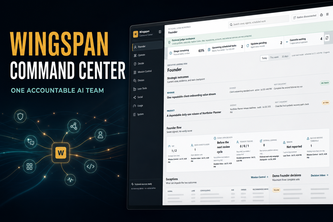
Self-reported purpose: A command center interface for managing GPT-5.6-powered Codex agents, designed to improve visibility into AI agent work, coordination, and decision-making for founders.
What changed: The project is a hackathon submission describing an interface that aggregates multiple views of AI agent activity (e.g., task execution, roundtables, usage analytics) into one local shell. It is not a production product or service.
Single most important open question: Is there any evidence of traction, revenue, or real-world adoption beyond the author’s own description?
This analysis is based only on the self-reported project description provided by the caller, which is unverified and contains no data on customers, revenue, usage, or product-market fit. The project is described as a hackathon submission with fictional sample data and an isolated runtime adapter.
What The Product Actually Is
The description states that Wingspan Command Center is a local shell interface with nine connected views for managing Codex agents powered by GPT-5.6. It includes:
- A Founder view for strategic outcomes and human decisions;
- An Operate view for one-to-one Codex task conversations;
- A Decide view for staged approvals and delivery receipts;
- A Mission Control view for work, ownership, progress, and source-control review;
- A Discuss view for multi-agent roundtables;
- A Lean Tools view for flow exceptions and bounded improvements;
- A Social view for evidence-aware campaign learning;
- A Usage view for model, reasoning, speed, and token-demand analysis;
- A System view for visible runtime boundaries and settings.
The interface is built using React, Vite, Express, and a replaceable local runtime adapter. The submission package uses a fictional judge mode with an isolated in-memory task adapter that does not connect to real Codex or external services.
Inference: The product appears to be a conceptual UI prototype for managing AI agents, not a functioning tool used by customers. It is described as a hackathon project with no real-world integration or live data.
Positioning & Claim Evolution
The author states that the product addresses the problem of AI agent coordination cost, where work becomes fragmented across tasks and approvals lose context. The goal is to make agent work observable without becoming another source of truth.
The positioning claims:
- It turns GPT-5.6-powered Codex agents into one visible, accountable AI team.
- It helps founders coordinate work, surface risks, and make faster, evidence-backed decisions.
These are claims about intent and positioning, not proof of traction or adoption.
Inference: The product is positioned as a tool for improving visibility and governance in AI agent workflows, but the description does not indicate that it has been used beyond the author’s own development environment.
Target Customer & ICP
The description states that Wingspan Command Center is intended for founders, who are described as needing to coordinate work, surface risks, and make faster decisions. It also mentions that the interface supports human decisions with recipient-specific delivery receipts.
There is no evidence of a defined customer segment beyond "founders", nor any indication of how many such users exist or what their needs are outside of the author’s own experience.
Inference: The target customer is likely a founder or executive managing AI agent workflows, but there is no evidence of market validation or user research.
Business Model & Pricing Evidence
There is no evidence in the description of any business model, pricing strategy, monetization approach, or revenue streams. The project is described as a hackathon submission with no commercial activity.
Inference: No business model or pricing information is provided; it cannot be inferred from the self-reported description.
Technical & Delivery Signals
The product is built using:
- Frontend: React, Vite
- Backend: Express.js
- AI/Agent Interface: GPT-5.6 Sol, OpenAI Codex, Playwright
- Runtime Adapter: Replaceable local adapter; judge mode uses isolated in-memory task adapter
- Other Technologies: Server-sent events, local JSON fixtures
The description states that the judge build uses only fictional sample data and an isolated in-memory task adapter. It does not contact native Codex, local files, repositories, accounts, or external services.
The author also notes that the primary task ran on GPT-5.6 Sol, and that Codex helped implement durable operating state, direct task conversations, recovery, decision receipts, attachments, diff review, and handoff controls.
Inference: The product is a prototype with a technical architecture that supports local runtime adapters and simulated agent behavior. It is not connected to real systems or live data.
Traction & Maturity Signals
There is no evidence of traction, customers, revenue, or adoption beyond the author’s own description. The project is described as a hackathon submission with no production use or user feedback.
The product uses fictional sample data, and its judge mode is isolated and non-functional in real-world contexts.
Inference: No traction or maturity signals are evident; this is a conceptual prototype, not a live product.
Competitive Context
There is no evidence of competitors or market positioning beyond the author’s own description. The project does not reference existing tools or platforms for managing AI agents or orchestration.
Inference: No competitive context can be inferred from the self-reported description.
Open Questions & Risks
- No real-world use or adoption: The product is described as a hackathon submission with no production deployment.
- Fictional data and isolated runtime: Judge mode uses fictional sample data and an in-memory adapter, not real systems.
- No business model or pricing: No indication of how the product would be monetized or sold.
- Unproven market need: The description does not include any customer research or validation.
Inference: The project is a prototype with no evidence of commercial viability or traction. It is not a product in development, but a conceptual design.
Questions the description leaves open
- Is this project intended to be a production tool, or is it purely experimental?
- Has the interface been tested with real users or teams?
- What are the plans for integrating with actual Codex or other AI agents?
- Are there any commercial partnerships or early adopters in mind?
- How does the product plan to scale beyond the current prototype?
Overall Assessment
Not evidenced: There is no evidence of revenue, customers, traction, or a clear business model to support an investment or partnership decision.
The project is described as a hackathon submission, not a product in development. It uses fictional data and an isolated runtime adapter, with no indication of real-world use or commercial viability.
Confidence: Low — based entirely on self-reported description with no external validation or evidence of traction, adoption, or revenue.
User Stories BotA demo video on every pull request
Get a demo video on every new feature
GitHub App that watches your pull requests and records a narrated, captioned demo.
Save time on demo prep and make informed decisions faster with a video walkthrough of every new feature.
Source
Submitted to the OpenAI 2026 hackathon on Devpost. Project home on Devpost. Back to the full gallery on Devpost.
This competitive analysis was produced by top-founders.com (opens in a new tab)
Generated by a language model from this project's public Devpost page — its tagline, the author's own write-up and any built-with tags listed there — as captured in August 2026. Short quotations are the author's words. It is an opinion on the idea as a business, not on the people behind it, and it reflects the description as published then. If the project has moved on, request a correction below. The analysis is not independent research and contains no verified traction, revenue or customer data.
An independent guide by KFG International LLC — not affiliated with, endorsed by, or connected to Devpost or OpenAI.