

Archive position — measured, not model output
0 likes on Devpost
2,263 of the 7,850 archived projects have more likes, and 5,587 share exactly 0 — so this project's #4,203 place in the like-ranked listing is a tie-break inside that group, not a ranking.
Projects (log scale)
Likes on Devpost. ▲ marks this project's group.
Show the figures
| Likes | Projects | Share of archive |
|---|---|---|
| 0 | 5,587 | 71.2% |
| 1 | 1,758 | 22.4% |
| 2 | 284 | 3.6% |
| 3–4 | 132 | 1.7% |
| 5–9 | 75 | 1.0% |
| 10+ | 14 | 0.2% |
 User Stories BotA demo video on every pull request
Get a demo video on every new feature
GitHub App that watches your pull requests and records a narrated, captioned demo.
Save time on demo prep and make informed decisions faster with a video walkthrough of every new feature.
Executive Summary
What the company appears to be
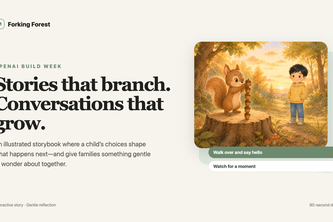
Forking Forest (두갈래숲) is a self-reported generative AI-powered storybook experience for children ages 4–9, designed to allow child readers to make meaningful choices that branch the plot and affect endings. The system uses structured planning, writing agents, validation, and repair stages to maintain narrative continuity across branching paths. It is built with OpenAI models, LangChain, LangGraph, Next.js, React, TypeScript, Supabase, and Vercel.
What changed
The project was submitted as part of the OpenAI 2026 hackathon. The description indicates it is a proof-of-concept or early-stage prototype, not yet commercially launched or monetized.
The single most important open question
Is there evidence that Forking Forest has achieved any traction, revenue, or customer adoption beyond its own author’s self-report?
What The Product Actually Is
The description states that Forking Forest is an agent-generated, illustrated storybook experience for children ages 4–9. It allows the child to become the protagonist and make choices that affect the story's direction.
- Choices can lead to short variations or genuinely different paths and endings.
- The system uses a chapter-level story DAG (Directed Acyclic Graph) to manage branching.
- Each choice is associated with:
- An observational dimension (e.g., curiosity, caution)
- A value-related theme (e.g., empathy, honesty)
- The product includes a visual authoring studio for inspecting and editing stories as graphs.
- It is built using OpenAI models, LangChain, LangGraph, Next.js, React, TypeScript, Supabase, and Vercel.
This is a self-reported prototype of an AI-powered interactive storybook with branching narrative structure and educational intent.
Positioning & Claim Evolution
The description claims that Forking Forest aims to:
- Use generative AI to create thoughtful, age-appropriate experiences for children and families, rather than open-ended chatbots.
- Provide a safe space where children reveal curiosity, caution, empathy, imagination, and values through play.
- Avoid being a diagnosis or personality test, instead offering non-diagnostic insights for parents.
- Not turn the story into a disguised questionnaire or moral lesson, but help children consider consequences and perspectives.
The positioning evolves from:
- A child-safe AI experience that avoids traditional chatbot interaction.
- To an educational tool that uses storytelling to explore values and emotions.
- To a creative partner for families, not a prescriptive or developmental tool.
This is a self-reported claim, not independently verified.
Target Customer & ICP
The description states:
- The primary audience is children ages 4–9.
- The experience is designed for parents who read with them.
- It also targets writers and educators through its visual authoring studio.
No evidence of actual customers, user segments, or market research beyond the self-report is provided. The ICP appears to be based on a conceptual model rather than data.
Business Model & Pricing Evidence
There is no evidence in the description of:
- A business model
- Pricing structure
- Revenue streams
- Monetization strategy
The project is described as a hackathon submission, not a commercial product. The authors state they plan to explore printed editions and localized versions, but do not describe how these would be monetized.
Technical & Delivery Signals
The description indicates:
- The system uses LangChain, LangGraph, OpenAI Codex for structured planning, writing, validation, repair, and illustration.
- It is built with Next.js, React, TypeScript, Supabase.
- A chapter-level story DAG is used to manage branching.
- The system includes validation and repair stages to ensure narrative consistency.
- There is a visual authoring studio for inspecting and editing stories.
These are technical claims, not evidence of delivery or product maturity.
Traction & Maturity Signals
The description states:
- This is a hackathon submission (OpenAI 2026).
- It is described as a proof-of-concept or early-stage prototype.
- No evidence of:
- Revenue
- Customers
- Product adoption
- Market traction
- User feedback or usage data
There is no evidence of any traction or commercial maturity.
Competitive Context
The description does not mention:
- Competitors
- Existing products in the space
- Market positioning relative to others
No competitive signals are provided. The project appears to be independent and unanchored in a known market landscape.
Open Questions & Risks
- Unverified claims: All descriptions are self-reported, with no independent corroboration.
- No traction or revenue: No evidence of customers, monetization, or adoption.
- Prototype status: The project is described as a hackathon submission, not a product in the market.
- Ethical boundary concerns: The system aims to avoid assessment but may still raise questions about data use and child privacy.
- Lack of clarity on scalability: No evidence that the current architecture can support large-scale or long-term usage.
Questions the description leaves open
- What is the current status of Forking Forest? Is it a prototype, alpha, or beta?
- Have you conducted any user testing with children or parents?
- How do you plan to monetize this product if at all?
- What are your plans for scaling beyond the hackathon submission?
- How do you ensure that the AI-generated content remains age-appropriate and emotionally safe?
- Are there any partnerships or pilot programs in place?
- What is the long-term vision for the visual authoring studio?
Overall Assessment
The description indicates Forking Forest is a self-reported hackathon project, not yet a commercial product or venture. There is no evidence of traction, revenue, customers, or business model.
- The idea is conceptually interesting, with potential in the children’s educational and storytelling space.
- However, it is not evidenced as having moved beyond prototype stage.
- No clear path to market or monetization is described.
- The project is not ready for investment or partnership based on this description alone.
Assessment: Not evidenced.
User Stories BotA demo video on every pull request
Get a demo video on every new feature
GitHub App that watches your pull requests and records a narrated, captioned demo.
Save time on demo prep and make informed decisions faster with a video walkthrough of every new feature.
Source
Submitted to the OpenAI 2026 hackathon on Devpost. Project home on Devpost. Back to the full gallery on Devpost.
This competitive analysis was produced by top-founders.com (opens in a new tab)
Generated by a language model from this project's public Devpost page — its tagline, the author's own write-up and any built-with tags listed there — as captured in August 2026. Short quotations are the author's words. It is an opinion on the idea as a business, not on the people behind it, and it reflects the description as published then. If the project has moved on, request a correction below. The analysis is not independent research and contains no verified traction, revenue or customer data.
An independent guide by KFG International LLC — not affiliated with, endorsed by, or connected to Devpost or OpenAI.