

Archive position — measured, not model output
0 likes on Devpost
2,263 of the 7,850 archived projects have more likes, and 5,587 share exactly 0 — so this project's #4,131 place in the like-ranked listing is a tie-break inside that group, not a ranking.
Projects (log scale)
Likes on Devpost. ▲ marks this project's group.
Show the figures
| Likes | Projects | Share of archive |
|---|---|---|
| 0 | 5,587 | 71.2% |
| 1 | 1,758 | 22.4% |
| 2 | 284 | 3.6% |
| 3–4 | 132 | 1.7% |
| 5–9 | 75 | 1.0% |
| 10+ | 14 | 0.2% |
 User Stories BotA demo video on every pull request
Get a demo video on every new feature
GitHub App that watches your pull requests and records a narrated, captioned demo.
Save time on demo prep and make informed decisions faster with a video walkthrough of every new feature.
Executive Summary
What the company appears to be
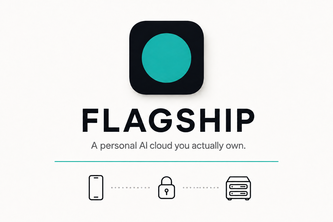
Flagship is a self-reported personal cloud platform built by one developer (Harry W), designed to run on user-owned hardware. The system uses a phone as the sole key for access, with encryption and TLS termination occurring locally on the user’s device or hardware. It leverages AI tools like Codex to generate synthetic data for app development without accessing real user records.
What changed
The project was built in seven days during an OpenAI hackathon, using AI-assisted coding (Codex) and a range of open-source technologies. The author states that this is the first time they have shipped a product alone after years of theoretical work.
Single most important open question
Is there any evidence of traction, revenue, or customer adoption beyond the single developer’s own use case?
What The Product Actually Is
The description states that Flagship is a personal cloud you actually own. It runs on user hardware (e.g., a spare machine via USB or as an encrypted VM on Mac/PC), with the phone acting as the only key stored in the Secure Enclave. TLS terminates locally, so network traffic cannot be read by intermediaries. Services are deployed using AI that works against fake data rather than real records.
- Claimed functionality:
- Personal cloud hosted on user hardware
- Phone-based authentication via Secure Enclave
- Local TLS termination
- AI-powered service development using synthetic data
- Inferred technical architecture:
- Uses Cloudflare Worker for identity, Fly app as a stateless pipe
- Daemon runs ACME and serves content
- Crypto implemented in TypeScript, Swift, Kotlin with Ed25519/X25519
- Synthetic data engine generates fake rows preserving structure but not real people
- Not evidenced
- No actual product demo or live deployment
- No customer base or usage metrics
- No pricing model or monetization strategy
Positioning & Claim Evolution
The author positions Flagship as a solution to surveillance and data control, emphasizing user sovereignty over their own data. The project is framed not just as a tool but as a movement toward reclaiming autonomy through open standards and AI.
- Self-reported positioning:
- “Your cloud should live on your hardware and answer to your keys — not to a company that can read it.”
- Aims to be an open standard for escaping censorship and surveillance
- Uses frontier models like Codex to empower users
- Evolution of claims:
- Started with theoretical designs in thesis
- Transitioned into practical implementation via AI-assisted development
- Evolved from idea to working prototype within a week
- Inferred intent:
- To build a decentralized, secure personal cloud infrastructure
- To enable broader adoption through open-source contribution and equity-based incentives
- Not evidenced
- No prior product or market traction
- No evidence of community interest or developer engagement beyond the author
Target Customer & ICP
The description implies Flagship targets individuals who value privacy, security, and autonomy over their data. It is positioned for users with technical knowledge to run it on personal hardware.
- Self-reported target customer:
- Tech-savvy individuals who own hardware and want full control over their digital lives
- People concerned about surveillance and data misuse by companies
- Inferred ICP:
- Early adopters of privacy-focused tools
- Developers or power users interested in decentralized systems
- Not evidenced
- No defined customer segments beyond general privacy advocates
- No evidence of market size, demand, or competitive positioning
Business Model & Pricing Evidence
There is no mention of a business model or pricing structure in the description.
- Self-reported claims:
- Patent-pending and open to contributions for equity
- Open to developers who want to contribute
- Not evidenced
- No revenue streams, monetization plans, or pricing tiers
- No indication of whether Flagship will be sold, licensed, or offered as a service
Technical & Delivery Signals
The project was built rapidly using AI (Codex) and a suite of open-source technologies. It includes cryptographic components and synthetic data generation.
- Self-reported technical stack:
- Built with Cloudflare, Codex, Debian, Docker, Fly.io, Kotlin, Let’s Encrypt, MinIO, Node.js, PostgreSQL, Redis, Swift, TypeScript, WebAuthn
- Inferred delivery signals:
- Fast development cycle (7 days)
- Use of AI for code generation and testing
- Strong focus on security and cryptography
- Includes over 7,000 passing tests
- Not evidenced
- No live deployment or performance data
- No scalability or reliability metrics
- No documentation or support infrastructure
Traction & Maturity Signals
There is no evidence of traction, revenue, or customer adoption beyond the author’s own use case.
- Self-reported accomplishments:
- Real green padlock on server running at home
- Live vibe-code run where AI built and deployed a service without exposing API keys
- Synthetic data idea went from sketch to tested code
- Not evidenced
- No user base or customer feedback
- No revenue, ARR, or monetization
- No product roadmap or long-term vision beyond the hackathon
Competitive Context
No direct competitors are named in the description. The project is described as a personal cloud solution focused on security and autonomy.
- Self-reported context:
- Not explicitly compared to other personal clouds or privacy tools
- Positions itself as a structural alternative to traditional cloud services
- Inferred competitive space:
- Likely competes with decentralized storage platforms, secure cloud solutions, and privacy-focused tools
- May overlap with projects like Tails, IPFS, or self-hosted solutions
- Not evidenced
- No competitive analysis or market positioning
- No evidence of existing users or competitors
Open Questions & Risks
Several key risks and open questions emerge from the lack of traction, unclear business model, and limited evidence of real-world usage.
- Risk: Lack of traction
- No customers, revenue, or adoption beyond the author’s own use case
- Risk: Unclear monetization strategy
- No pricing, licensing, or revenue model described
- Open question: Single-person team
- Only one developer involved; no indication of team expansion or support structure
- Open question: Limited testing across platforms
- Only iPhone and Mac versions are solid; Android, Windows, Linux untested
- Not evidenced
- No risk assessment or mitigation plans
- No evidence of legal or compliance considerations
Questions the description leaves open
- What is the actual user experience like for someone trying to set up and run Flagship on their own hardware?
- How do you plan to scale beyond a single developer’s capabilities?
- Are there any known security vulnerabilities or limitations in the current implementation?
- What are your plans for monetization, if any?
- How do you intend to attract and retain users beyond personal interest?
- Can you provide more details on how synthetic data is generated and validated?
- Have you considered legal or regulatory implications of running such a system?
Overall Assessment
This project appears to be a proof-of-concept built during a hackathon, with no evidence of traction, revenue, or customer adoption. It is described as a personal cloud solution focused on user sovereignty and security, but lacks any commercial viability indicators.
- Confidence level: Low
- Based entirely on self-reported description
- No third-party validation or external data
- Assessment:
- Not suitable for investment or partnership at this stage
- May be of interest if it evolves into a scalable, secure platform with clear monetization and user demand
User Stories BotA demo video on every pull request
Get a demo video on every new feature
GitHub App that watches your pull requests and records a narrated, captioned demo.
Save time on demo prep and make informed decisions faster with a video walkthrough of every new feature.
Source
Submitted to the OpenAI 2026 hackathon on Devpost. Project home on Devpost. Back to the full gallery on Devpost.
This competitive analysis was produced by top-founders.com (opens in a new tab)
Generated by a language model from this project's public Devpost page — its tagline, the author's own write-up and any built-with tags listed there — as captured in August 2026. Short quotations are the author's words. It is an opinion on the idea as a business, not on the people behind it, and it reflects the description as published then. If the project has moved on, request a correction below. The analysis is not independent research and contains no verified traction, revenue or customer data.
An independent guide by KFG International LLC — not affiliated with, endorsed by, or connected to Devpost or OpenAI.