

Archive position — measured, not model output
1 like on Devpost
505 of the 7,850 archived projects have more likes, and 1,758 share exactly 1 — so this project's #1,071 place in the like-ranked listing is a tie-break inside that group, not a ranking.
Projects (log scale)
Likes on Devpost. ▲ marks this project's group.
Show the figures
| Likes | Projects | Share of archive |
|---|---|---|
| 0 | 5,587 | 71.2% |
| 1 | 1,758 | 22.4% |
| 2 | 284 | 3.6% |
| 3–4 | 132 | 1.7% |
| 5–9 | 75 | 1.0% |
| 10+ | 14 | 0.2% |
 User Stories BotA demo video on every pull request
Get a demo video on every new feature
GitHub App that watches your pull requests and records a narrated, captioned demo.
Save time on demo prep and make informed decisions faster with a video walkthrough of every new feature.
Executive Summary
What the company appears to be
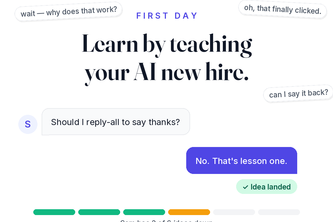
First Day is a self-reported AI-powered learning platform that inverts traditional tutoring by having an AI "new hire" teach users through conversation. The system uses GPT-5.6 to simulate a junior colleague who asks targeted questions based on misconceptions, and evaluates user explanations via a hidden grading mechanism.
What changed
The author states they built this as a solo project after years of managing telecom infrastructure projects and onboarding juniors. They claim to have flipped the typical AI tutor model so that users teach an AI rather than receive instruction from it.
Single most important open question
Is there any evidence of traction, revenue, or customer adoption beyond the author’s own account? The description contains no data about usage, customers, or monetization — only claims and self-assessment.
What The Product Actually Is
The description states that First Day is a platform where:
- An AI "new hire" (GPT-5.6) plays the role of a junior employee.
- Users teach this AI colleague through conversation.
- Before each session, the model builds a "trap map" of subject misconceptions.
- The AI asks questions targeting those traps.
- A hidden GPT-5.6 call — the Examiner — grades every explanation given by the user.
- Progress is tracked visually in a ramp-up chart and office plan.
- Users can upload documents (e.g., PDFs, process guides), share subjects via link, and export teaching reports as markdown.
Inference This appears to be an experimental or prototype tool designed for knowledge transfer and personal learning, not a commercial product with defined customers or revenue streams. It is described as a solo-built hackathon submission.
Positioning & Claim Evolution
The author claims:
- The platform uses the "protégé effect" — learning best by teaching.
- It inverts the AI tutor model: instead of receiving answers, users give them.
- The AI behaves like a real new teammate who is trying to learn from the user.
- This makes learning more active, personal, and fun.
Inference The positioning seems to be rooted in pedagogy and experiential learning theory. It is not positioned as a tool for enterprise or mass adoption but rather as an innovative educational experience.
Target Customer & ICP
The description states:
- The platform targets individuals who want to learn by teaching.
- It was built with onboarding juniors in mind, particularly those managing teams.
- Users can create subjects and teach others through shared links.
- The tool supports both personal learning and knowledge transfer within organizations.
Inference There is no clear ICP defined beyond "people who want to learn by teaching" or "managers onboarding new hires." No specific segment, persona, or use case beyond the author’s own experience is evidenced.
Business Model & Pricing Evidence
Not evidenced.
The description does not mention:
- Any pricing structure.
- Monetization strategy.
- Subscription tiers.
- Revenue model.
- Customer acquisition costs.
- Sales process or go-to-market plan.
Inference There is no evidence of a business model beyond the author’s own project. The tool appears to be a prototype, not a commercial offering.
Technical & Delivery Signals
The description states:
- Built solo using Codex (AI agent).
- Stack includes: Next.js 14, TypeScript, Prisma, Neon, Tailwind, Vercel.
- Uses GPT-5.6 for runtime calls.
- Features include private sessions, shareable templates, and exportable reports.
- The system handles conversation flow, progress tracking, and session state.
Inference The technical architecture is minimal but functional for a prototype. It uses modern web stack and AI orchestration tools. However, there is no evidence of scalability or production-grade infrastructure beyond the author’s solo build.
Traction & Maturity Signals
Not evidenced.
The description does not include:
- Any user base.
- Customer data.
- Revenue figures.
- Product usage metrics.
- Growth indicators.
- Market validation.
Inference This is a self-reported prototype, likely built for a hackathon. No signs of traction or product maturity are evident.
Competitive Context
Not evidenced.
The description does not reference:
- Competitors.
- Market size.
- Existing solutions in the AI tutoring or onboarding space.
- Differentiation from similar tools.
Inference No competitive landscape is described, and no evidence suggests awareness of existing players or market positioning.
Open Questions & Risks
- No traction or revenue: The project is presented as a solo-built hackathon submission with no signs of adoption or monetization.
- Unverified claims: All descriptions are self-reported; no third-party validation exists.
- Unclear commercial viability: No evidence of a sustainable business model, pricing, or customer acquisition strategy.
- Limited scalability: Built as a prototype by one person; no indication of team, infrastructure, or product development beyond initial build.
- AI agent dependency: The author notes challenges managing Codex itself, suggesting potential instability in AI-driven workflows.
Questions the description leaves open
- What is the actual user journey and experience for someone using this tool?
- How do you plan to scale beyond a single developer’s prototype?
- Have you tested this with any real users or organizations?
- Is there a clear path from prototype to commercial product?
- What are your plans for monetization, if any?
- How do you intend to differentiate from existing AI tutoring platforms?
Overall Assessment
Not evidenced.
There is no evidence of:
- Revenue.
- Customers.
- Product-market fit.
- Team strength.
- Financials or funding history.
- Strategic partnerships or use cases beyond the author’s own experience.
Inference This appears to be an experimental, solo-built prototype submitted for a hackathon. It lacks any commercial due-diligence signals and should not be considered a viable investment or partnership opportunity without further evidence of traction, product development, or market validation.
User Stories BotA demo video on every pull request
Get a demo video on every new feature
GitHub App that watches your pull requests and records a narrated, captioned demo.
Save time on demo prep and make informed decisions faster with a video walkthrough of every new feature.
Source
Submitted to the OpenAI 2026 hackathon on Devpost. Project home on Devpost. Back to the full gallery on Devpost.
This competitive analysis was produced by top-founders.com (opens in a new tab)
Generated by a language model from this project's public Devpost page — its tagline, the author's own write-up and any built-with tags listed there — as captured in August 2026. Short quotations are the author's words. It is an opinion on the idea as a business, not on the people behind it, and it reflects the description as published then. If the project has moved on, request a correction below. The analysis is not independent research and contains no verified traction, revenue or customer data.
An independent guide by KFG International LLC — not affiliated with, endorsed by, or connected to Devpost or OpenAI.