

Archive position — measured, not model output
1 like on Devpost
505 of the 7,850 archived projects have more likes, and 1,758 share exactly 1 — so this project's #1,072 place in the like-ranked listing is a tie-break inside that group, not a ranking.
Projects (log scale)
Likes on Devpost. ▲ marks this project's group.
Show the figures
| Likes | Projects | Share of archive |
|---|---|---|
| 0 | 5,587 | 71.2% |
| 1 | 1,758 | 22.4% |
| 2 | 284 | 3.6% |
| 3–4 | 132 | 1.7% |
| 5–9 | 75 | 1.0% |
| 10+ | 14 | 0.2% |
 User Stories BotA demo video on every pull request
Get a demo video on every new feature
GitHub App that watches your pull requests and records a narrated, captioned demo.
Save time on demo prep and make informed decisions faster with a video walkthrough of every new feature.
Executive Summary
What the company appears to be
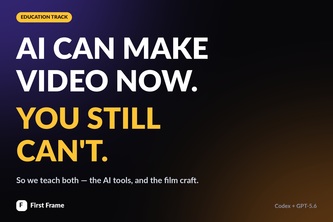
First Frame is a self-reported educational platform that uses AI to teach users how to make video — both the tools and the craft behind it. It presents itself as a tool that helps people learn filmmaking through structured AI-generated plans, critique loops, and a library of craft concepts tied to AI video production.
What changed
The author states they built this platform to address two distinct groups: those with film training who are overwhelmed by rapidly changing AI tools, and those without formal training who lack foundational storytelling knowledge. The product aims to bridge both gaps by combining toolchain explanation with craft instruction in one place.
Single most important open question
Is there any evidence of real user engagement or adoption beyond the author’s own development and testing? The description contains no data on users, usage, revenue, or customer traction — only claims about intent and design.
What The Product Actually Is
The description states that First Frame is a platform with seven core components:
- Concept Lab – generates a structured five-act blueprint from an idea using GPT-5.6.
- Creator’s Room – critiques the blueprint via a five-role AI crew (Director, Writer, Cinematographer, Editor, Test Audience), showing before/after revisions and re-scoring.
- Film School – contains 111 craft concepts explained in traditional and AI video contexts with citations.
- AI Tools – catalogues 53 tools with verified or unverified information (e.g., pricing, commercial use).
- Footage Lab – performs local-only technical analysis of videos using browser APIs.
- Showcase – displays real AI films by credited creators, including their workflows and craft concepts.
- Three Tracks – different user interfaces for children, beginners, and film students.
The platform is built entirely with vanilla JavaScript, static HTML pages, and Vercel serverless functions — no framework or build step.
The description states: “Every line of this was built with Codex, driven by GPT-5.6, and the product itself runs on GPT-5.6 in production.”
The description states: “No build step, no runtime dependencies. 14 static HTML pages, vanilla JavaScript, Vercel serverless functions.”
Positioning & Claim Evolution
The author claims that First Frame is not a tool that makes films for people, but rather one that teaches users how to make films themselves by showing reasoning behind every choice.
It positions itself as solving two problems:
- For trained filmmakers: lack of clarity on which AI tools to use and how they work.
- For untrained individuals: lack of understanding of storytelling fundamentals.
The platform is described as teaching both the toolchain and the craft, which it says most other products ignore.
The description states: “I did not want to build a tool that makes films for people. I wanted to build the thing that stands next to you and explains what it is doing, so that after using it you can do more of it yourself.”
The description states: “The first group needs the toolchain explained. The second group needs the craft explained.”
Target Customer & ICP
The author describes three distinct user groups:
- Children – served via a bright, one-decision-per-screen interface ending in a printable AI storybook.
- Adult beginners – served via a “Weekend Film” track for those with no prior film education.
- Film students or media professionals – served via “The Dark Room,” a technical, timecode-and-waveform environment.
There is no explicit mention of revenue customers, B2B clients, or specific personas beyond these three tracks.
The description states: “Three tracks. The same platform speaks differently to three audiences…”
Business Model & Pricing Evidence
No evidence of pricing, monetization, or business model is provided in the description.
The description states: “There is no revenue, customer or traction data is available beyond what they state.”
Technical & Delivery Signals
The product is built with:
- GPT-5.6 (both for generation and critique)
- Vanilla JavaScript
- Static HTML pages
- Vercel serverless functions
- Browser APIs like Canvas and WebAudio
- No build step or runtime dependencies
It uses strict JSON schemas to constrain AI output, enforce citations from an allowlist, and prevent hallucinations.
The system has deterministic fallbacks for AI failures and includes CI tests to ensure data integrity.
The description states: “No build step, no runtime dependencies. 14 static HTML pages, vanilla JavaScript, Vercel serverless functions.”
The description states: “Hallucinated citations are impossible by construction. Craft references are constrained to an allowlist…”
Traction & Maturity Signals
There is no evidence of traction or user adoption in the description.
The author mentions:
- 14 static HTML pages
- 6 Node test suites
- CI testing
- A demo that “cannot break” due to fallbacks
- No revenue, customers, or usage metrics
The description states: “Everything above is the authors' own account. It is not independently verified, and no revenue, customer or traction data is available beyond what they state.”
Competitive Context
The author does not name competitors, nor does the description provide any competitive positioning.
It is implied that First Frame aims to fill a gap in AI video education — specifically where other tools teach either the toolchain or the craft, but not both.
The description states: “Almost every product I found teaches one and ignores the other.”
Open Questions & Risks
- No evidence of traction or adoption – This is a self-reported project with no data on users or usage.
- Unverified claims about AI behavior – While it says the system enforces constraints, there is no independent verification of how well this works in practice.
- Self-contained tooling – The platform does not appear to integrate with any external services or APIs beyond OpenAI and Vercel.
- No monetization strategy – No pricing, subscriptions, or revenue model is described.
The description states: “There is no evidence of traction or user adoption in the description.”
Questions the description leaves open
- What are the actual use cases or scenarios where users would engage with this platform?
- How does the team plan to scale beyond a single developer’s vision and execution?
- Are there any plans for monetization, partnerships, or user acquisition strategies?
- Has the platform been tested with real users outside of the author's own development?
- What is the long-term strategy for maintaining the 111 craft concepts and tool catalog?
Overall Assessment
Not evidenced.
The description is entirely self-reported and lacks any data on revenue, customers, traction, or business model. It does not indicate whether this is a product in development, a prototype, or a launched service.
The description states: “Everything above is the authors' own account. It is not independently verified, and no revenue, customer or traction data is available beyond what they state.”
User Stories BotA demo video on every pull request
Get a demo video on every new feature
GitHub App that watches your pull requests and records a narrated, captioned demo.
Save time on demo prep and make informed decisions faster with a video walkthrough of every new feature.
Source
Submitted to the OpenAI 2026 hackathon on Devpost. Project home on Devpost. Back to the full gallery on Devpost.
This competitive analysis was produced by top-founders.com (opens in a new tab)
Generated by a language model from this project's public Devpost page — its tagline, the author's own write-up and any built-with tags listed there — as captured in August 2026. Short quotations are the author's words. It is an opinion on the idea as a business, not on the people behind it, and it reflects the description as published then. If the project has moved on, request a correction below. The analysis is not independent research and contains no verified traction, revenue or customer data.
An independent guide by KFG International LLC — not affiliated with, endorsed by, or connected to Devpost or OpenAI.