

Archive position — measured, not model output
0 likes on Devpost
2,263 of the 7,850 archived projects have more likes, and 5,587 share exactly 0 — so this project's #4,187 place in the like-ranked listing is a tie-break inside that group, not a ranking.
Projects (log scale)
Likes on Devpost. ▲ marks this project's group.
Show the figures
| Likes | Projects | Share of archive |
|---|---|---|
| 0 | 5,587 | 71.2% |
| 1 | 1,758 | 22.4% |
| 2 | 284 | 3.6% |
| 3–4 | 132 | 1.7% |
| 5–9 | 75 | 1.0% |
| 10+ | 14 | 0.2% |
 User Stories BotA demo video on every pull request
Get a demo video on every new feature
GitHub App that watches your pull requests and records a narrated, captioned demo.
Save time on demo prep and make informed decisions faster with a video walkthrough of every new feature.
Executive Summary
What the company appears to be
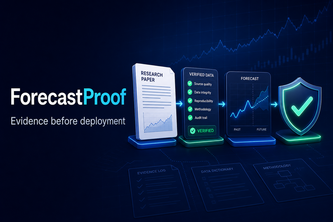
ForecastProof is a self-reported research-support system designed to validate financial forecasting papers using deterministic checks and LLM-assisted synthesis. The author states it runs an end-to-end workflow that includes analyzing, verifying, challenging, and generating audited decisions on forecasting models.
What changed
The project was built for the OpenAI 2026 hackathon. It is described as a Python/Streamlit application using GPT-5.6 and various ML libraries to create an evidence-first agent for validating forecasting papers.
Single most important open question
Is there any evidence of real-world usage, adoption or traction beyond this single hackathon submission?
What The Product Actually Is
The description states that ForecastProof is:
- A Python and Streamlit application
- Built with codex, gpt-5.6, numpy, openai, pandas, python, pytorch, responses-api, scikit-learn, streamlit, structured-outputs
- An evidence-first agent that validates forecasting papers
- Designed to run one governed next experiment after validation
The author claims it takes an evidence-backed forecasting paper through:
- Analyze the paper
- Verify on a common task
- Challenge the result
- Generate an audited decision memo
- Run one governed iteration
It is described as a "research-support system" not investment advice, and never authorizes trading.
Confidence: Low — This is entirely self-reported with no evidence of actual product usage or performance beyond the demo.
Positioning & Claim Evolution
The description states:
- ForecastProof turns questions about financial forecasting papers into an executable, auditable workflow
- It replaces asking an AI to declare whether a paper "works" with deterministic evidence gates
- GPT-5.6 handles language reasoning while deterministic code owns decision authority
- The system refuses to turn uncertainty into a confident-looking recommendation
The author claims the product:
- Makes "evidence-bound proposals may change only allow-listed parameters"
- Uses "deterministic code—not the model—owns every pass/fail gate, promotion decision, and deployment hold"
- Is designed to be "more trustworthy when its authority is deliberately narrow"
Confidence: Low — These are claims about positioning and intent, not verified outcomes or traction.
Target Customer & ICP
The description states:
- ForecastProof is a research-support system for financial forecasting papers
- It targets researchers working with forecasting models
- The demo contains three S&P-related papers and three genuinely executed model families
- It runs on frozen SPY next-day-direction dataset with identical 12-lag features, 41 purged walk-forward folds, etc.
No explicit customer segment or ICP is defined beyond "researchers" or "papers." No mention of institutional users, finance teams, or commercial customers.
Confidence: Very low — No evidence of target customer identification or commercial use cases beyond the hackathon demo.
Business Model & Pricing Evidence
The description states:
- The default experience is a verified replay, so judges can run the complete golden path without an API key or model cost
- Live mode is opt-in, capped, uses low reasoning, sets store=false, and records usage telemetry without storing the key
- It's described as a "research-support system" not investment advice
There is no mention of pricing, monetization, revenue streams, or commercial licensing.
Confidence: Very low — No evidence of any business model or pricing structure.
Technical & Delivery Signals
The description states:
- Built with Python, Streamlit, pandas, NumPy, scikit-learn, PyTorch
- Uses GPT-5.6 Luna through the OpenAI Responses API
- Implements deterministic checks and structured outputs
- Has 131 automated tests including real training smoke tests for all three model families
- Includes read-only tools like get_evidence_brief and get_verification_result
It is described as:
- A frozen research-suite artifact keeping all paper cases on one comparable protocol
- Reproduction tiers distinguishing strict reproduction from paper-inspired adaptation
- Using a "bounded iteration loop" that changes parameters, trains, evaluates reserved folds, and retains the parent when guardrails fail
Confidence: Medium — Some technical details are provided, but no evidence of production deployment or scalability.
Traction & Maturity Signals
The description states:
- Demo contains three S&P-related papers and three genuinely executed model families
- All cases share exactly 656 aligned out-of-fold targets and pass four comparison-integrity gates
- The UI separates “adaptation succeeded” from “forecast skill is established”
- 131 automated tests pass, including real training smoke tests for all three model families
- A live GPT-5.6 Luna acceptance run called both tools and passed all eight memo audits at 100/100 while preserving deployment HOLD
However:
- No mention of actual users or customers
- No revenue data or adoption metrics
- No evidence of real-world usage beyond the hackathon demo
- No mention of any product in production or commercial use
Confidence: Very low — The only "traction" is from a hackathon demo.
Competitive Context
The description does not provide:
- Any information about competitors
- Market positioning relative to existing tools
- Mention of similar products or platforms
No evidence of competitive landscape analysis or differentiation strategy.
Confidence: Very low — No competitive context provided.
Open Questions & Risks
Key claims in the description raise concerns:
- Unproven commercial viability: The system is described as a research tool, not a product for sale
- No revenue or customer evidence: No signs of monetization or real-world adoption
- Limited scope: Only three papers and three model families tested in demo
- Hackathon origin: Built for a single hackathon event with no indication of further development
- Self-reported maturity: No evidence of production-grade reliability or scalability
Confidence: Medium to High — These are inferred risks from the lack of evidence.
Questions the description leaves open
- What is the actual intended commercial use case for ForecastProof?
- Has there been any real-world testing beyond this hackathon demo?
- Are there plans to monetize or scale this beyond a research prototype?
- How does the system handle edge cases or failures in the verification process?
- What are the limitations of the current implementation that would prevent production use?
- Is there any plan for integrating with existing financial research platforms or workflows?
Overall Assessment
The description states that ForecastProof is a "research-support system, not investment advice, and never authorizes trading." It was built for a hackathon.
There is no evidence of:
- Revenue
- Customers
- Product-market fit
- Commercial traction
- Any business model beyond the demo
Confidence: Very low — This appears to be an experimental prototype with no demonstrated commercial potential or market readiness. The author states it is not investment advice, and there is no indication that it has moved beyond a proof-of-concept stage.
Assessment Not ready for investment or partnership consideration based on the provided evidence.
User Stories BotA demo video on every pull request
Get a demo video on every new feature
GitHub App that watches your pull requests and records a narrated, captioned demo.
Save time on demo prep and make informed decisions faster with a video walkthrough of every new feature.
Source
Submitted to the OpenAI 2026 hackathon on Devpost. Project home on Devpost. Back to the full gallery on Devpost.
This competitive analysis was produced by top-founders.com (opens in a new tab)
Generated by a language model from this project's public Devpost page — its tagline, the author's own write-up and any built-with tags listed there — as captured in August 2026. Short quotations are the author's words. It is an opinion on the idea as a business, not on the people behind it, and it reflects the description as published then. If the project has moved on, request a correction below. The analysis is not independent research and contains no verified traction, revenue or customer data.
An independent guide by KFG International LLC — not affiliated with, endorsed by, or connected to Devpost or OpenAI.