

Archive position — measured, not model output
0 likes on Devpost
2,263 of the 7,850 archived projects have more likes, and 5,587 share exactly 0 — so this project's #4,188 place in the like-ranked listing is a tie-break inside that group, not a ranking.
Projects (log scale)
Likes on Devpost. ▲ marks this project's group.
Show the figures
| Likes | Projects | Share of archive |
|---|---|---|
| 0 | 5,587 | 71.2% |
| 1 | 1,758 | 22.4% |
| 2 | 284 | 3.6% |
| 3–4 | 132 | 1.7% |
| 5–9 | 75 | 1.0% |
| 10+ | 14 | 0.2% |
 User Stories BotA demo video on every pull request
Get a demo video on every new feature
GitHub App that watches your pull requests and records a narrated, captioned demo.
Save time on demo prep and make informed decisions faster with a video walkthrough of every new feature.
Executive Summary
What the company appears to be
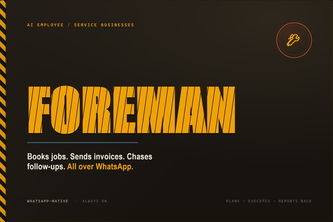
Foreman is an AI-powered WhatsApp assistant for small service businesses (e.g., plumbers, electricians) that automates tasks like scheduling, invoicing, follow-ups and CRM functions through natural language input.
What changed
The project was built as a hackathon submission using AI tools including Codex + GPT-5.6 for development and Groq Llama 3.3 70B for runtime planning. It is described as an "AI employee" that operates on WhatsApp, with a modular architecture supporting multi-turn conversations and real-time dashboards.
Single most important open question
Is there any evidence of actual business traction or customer adoption beyond the hackathon prototype?
Analysis basis
This report is based entirely on the self-reported project description provided by the author. No external verification, revenue data, customer names, or traction metrics are available. All claims are treated as stated by the author and not independently confirmed.
What The Product Actually Is
The description states that Foreman is an AI employee that lives on WhatsApp. It processes natural language requests from business owners and performs operations such as:
- Planning tasks
- Looking up customers
- Generating PDF invoices
- Sending emails
- Scheduling appointments
- Creating payment reminders
- Updating customer history
- Streaming actions to a live dashboard
- Confirming outcomes via WhatsApp
It supports multi-turn conversations, allowing users to reference previous customers without repeating context.
The system uses a two-phase execution model: first, an AI planner creates a structured plan; then, tools execute the plan and only after successful completion does the final WhatsApp response get sent.
Evidence The author's own write-up describes Foreman’s functionality in detail. No independent corroboration or demonstration of actual product behavior is provided.
Positioning & Claim Evolution
The author positions Foreman as an “AI foreman” — an AI employee that works over WhatsApp, enabling business owners to send simple instructions like:
"Schedule Rahul for Friday at 3 PM, invoice him after the job."
This implies a shift from traditional CRM or task management tools toward a conversational interface for daily operations.
The project evolved from a hackathon idea into a modular system designed to support future integrations and workflows. The team notes they moved away from serverless architecture due to reliability issues with persistent connections and background tasks.
Inference The positioning suggests Foreman aims to become an automated assistant for small trades, not just a chatbot or tool. However, the claim of being an “AI employee” is unverified without evidence of real-world usage or performance.
Target Customer & ICP
The description identifies small service businesses such as HVAC technicians, plumbers, electricians, and similar trades as primary users. These businesses reportedly do not use expensive CRM software; instead, they rely on WhatsApp, spreadsheets, and memory for managing operations.
Evidence The author explicitly names these industries and describes their current practices (WhatsApp + spreadsheets). No data on customer segments or personas beyond this is provided.
Business Model & Pricing Evidence
There is no mention of pricing, monetization strategy, or business model in the description. The project is presented as a hackathon prototype with no indication of commercial viability or revenue streams.
Not evidenced No information about how Foreman would be sold, whether it's freemium, subscription-based, or one-time purchase.
Technical & Delivery Signals
Foreman was built using:
- AI development tools: Codex + GPT-5.6 (for scaffolding, debugging, testing)
- Runtime AI: Groq Llama 3.3 70B
- Frontend: Next.js 15, Tailwind CSS, shadcn/ui
- Backend: FastAPI, SQLAlchemy, PostgreSQL (Supabase)
- Integrations: WhatsApp Business Cloud API, ReportLab, Resend/Gmail, Supabase Storage
Key technical decisions include:
- Provider-agnostic PlannerLLM interface for switching models
- Two-phase execution model to prevent hallucinations and ensure verified results
- Modular architecture supporting easy addition of new tools
Evidence The write-up includes a detailed tech stack and architectural choices. No evidence of production deployment, scalability, or performance data is included.
Traction & Maturity Signals
The project was submitted as part of the OpenAI 2026 hackathon on Devpost. There is no evidence of:
- Revenue
- Customers
- User adoption
- Product-market fit
- Deployment in real-world settings
Not evidenced No traction data, user feedback, or live usage metrics are reported.
Competitive Context
No competitive analysis or market positioning relative to existing solutions (e.g., CRM platforms like HubSpot, Zoho, or niche tools for trades) is included in the description. The author does not reference competitors or explain how Foreman differentiates from them.
Not evidenced No mention of existing alternatives or competitive advantages.
Open Questions & Risks
- Unverified claims: The project is described as an AI employee, but there is no evidence of real-world performance or user testing.
- No commercial viability: No pricing model, monetization strategy, or business plan is evident.
- Prototype-only status: Built for a hackathon; no indication of production readiness or long-term roadmap implementation.
- AI hallucination risk: While mitigated through validation, the system still relies heavily on AI interpretation — a known challenge in real-world applications.
- Limited scope: Only one team member worked on it, suggesting limited development capacity.
Inference These points are based on the lack of evidence for traction or commercialization, combined with the prototype nature of the project.
Questions the description leaves open
- What specific business problems does Foreman solve today? How do you know?
- Have any real customers used Foreman beyond the hackathon?
- Is there a plan to monetize this product? If so, what is it?
- How are you handling data privacy and compliance (especially around customer information)?
- What are the technical limitations of the current system that would prevent scaling?
- Are there any plans for integrating with accounting or ERP systems beyond what’s mentioned?
- How do you intend to onboard users and train them to use Foreman effectively?
Overall Assessment
There is no evidence of traction, revenue, or customer adoption beyond the hackathon prototype. The project is described as a proof-of-concept with no indication of commercial viability or scalability.
Assessment Not suitable for investment or partnership at this stage. A significant gap exists between the self-reported ambition and demonstrated execution. Further due diligence would require evidence of early users, product-market fit, and clear monetization strategy.
User Stories BotA demo video on every pull request
Get a demo video on every new feature
GitHub App that watches your pull requests and records a narrated, captioned demo.
Save time on demo prep and make informed decisions faster with a video walkthrough of every new feature.
Source
Submitted to the OpenAI 2026 hackathon on Devpost. Project home on Devpost. Back to the full gallery on Devpost.
This competitive analysis was produced by top-founders.com (opens in a new tab)
Generated by a language model from this project's public Devpost page — its tagline, the author's own write-up and any built-with tags listed there — as captured in August 2026. Short quotations are the author's words. It is an opinion on the idea as a business, not on the people behind it, and it reflects the description as published then. If the project has moved on, request a correction below. The analysis is not independent research and contains no verified traction, revenue or customer data.
An independent guide by KFG International LLC — not affiliated with, endorsed by, or connected to Devpost or OpenAI.