

Archive position — measured, not model output
0 likes on Devpost
2,263 of the 7,850 archived projects have more likes, and 5,587 share exactly 0 — so this project's #4,090 place in the like-ranked listing is a tie-break inside that group, not a ranking.
Projects (log scale)
Likes on Devpost. ▲ marks this project's group.
Show the figures
| Likes | Projects | Share of archive |
|---|---|---|
| 0 | 5,587 | 71.2% |
| 1 | 1,758 | 22.4% |
| 2 | 284 | 3.6% |
| 3–4 | 132 | 1.7% |
| 5–9 | 75 | 1.0% |
| 10+ | 14 | 0.2% |
 User Stories BotA demo video on every pull request
Get a demo video on every new feature
GitHub App that watches your pull requests and records a narrated, captioned demo.
Save time on demo prep and make informed decisions faster with a video walkthrough of every new feature.
Executive Summary
What the company appears to be
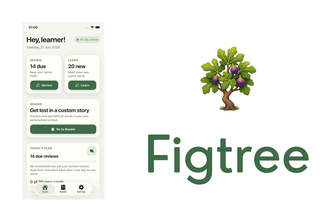
Figtree is a self-reported language-learning app focused on Spanish vocabulary acquisition through spaced-repetition flashcards and personalized story generation using LLMs. It is described as a personal project built by one developer (Gabriel Bedaiwi) during a hackathon, with no evidence of revenue, customers or product-market fit.
What changed
The author reports building a functional prototype in one week, including core features like flashcard-based vocabulary learning and a new "Reader" feature that generates personalized stories using GPT-5.6 and Codex. The app uses local storage for user data and integrates LLMs to tailor content based on the learner's current vocabulary state and reading preferences.
Single most important open question
Is there any evidence of real-world usage, user feedback or product-market traction beyond the author’s own account?
Note
This analysis is based entirely on self-reported information from the project description. No external verification or historical data is available. All claims are attributed to the author's own submission and should be treated as unverified.
What The Product Actually Is
The description states that Figtree is a language-learning app focused on Spanish vocabulary acquisition using spaced-repetition flashcards and personalized story generation. It includes:
- A pre-curated flashcard deck for learning new words.
- Spaced-repetition review system to reinforce memory.
- A "Reader" feature that generates stories tailored to the user’s current vocabulary knowledge and reading preferences.
- Stories are composed primarily of known words, with 8 target words (new or difficult) included in a longer-form context to improve comprehension.
The app is built using:
- Codex + GPT-5.6 for core functionality
- Expo.io and React Native for mobile development
- Local SQL database on iOS for storing flashcard states
Inference The product appears to be an experimental prototype, likely built in a short timeframe (a hackathon), rather than a mature commercial offering.
Positioning & Claim Evolution
The author positions Figtree as:
- A tool that improves language learning efficiency by combining spaced-repetition with personalized storytelling.
- An alternative to traditional graded readers or video content, which they claim do not adapt to the learner’s actual vocabulary level or personal interests.
- A solution enabled by LLMs that allows for truly customized reading experiences.
The evolution of claims suggests:
- Initial focus on flashcards and spaced repetition (a well-established method).
- Addition of a novel "Reader" feature leveraging AI to generate stories based on user data.
- Iteration toward improving story variety, cost, and generation speed — indicating early experimentation with LLM integration.
Claim
The author states that the app aims to “solve” the problem of lack of personalization in existing language learning tools.
Not evidenced No evidence of actual market positioning, branding or differentiation from competitors.
Target Customer & ICP
The description indicates:
- The primary audience is learners of Spanish.
- Users are assumed to already be using spaced-repetition systems (e.g., Anki) and want more engaging ways to apply their vocabulary.
- The app targets individuals who value both efficiency and enjoyment in language learning.
Inference Based on the author’s own experience, the ICP seems to be self-directed learners with some prior knowledge of flashcards or spaced repetition methods.
Not evidenced No data on actual users, demographics, or specific learner personas.
Business Model & Pricing Evidence
The description does not contain any information about:
- Revenue streams
- Pricing models
- Monetization strategy
- Subscription plans or in-app purchases
Not evidenced There is no indication of how the product intends to make money or whether it has a monetization plan.
Technical & Delivery Signals
Key technical details from the description:
- Built using Codex + GPT-5.6 for AI-driven features.
- Uses Expo.io and React Native for mobile app development.
- Stores user data locally via SQL database on iOS.
- Integrates LLMs to generate stories based on flashcard states and reading preferences.
- Implemented a pipeline that balances story variety, cost, and generation time.
Inference The project shows early-stage experimentation with AI-assisted content creation, suggesting technical capability but not scalability or production readiness.
Not evidenced No information about backend architecture, cloud infrastructure, or performance metrics.
Traction & Maturity Signals
The description states:
- The app was built in one week during a hackathon.
- It is the author’s first fully working app.
- Plans include releasing a beta version of the flashcard system and expanding the Reader feature.
- Future goals involve full public release with support for multiple language pairs.
Not evidenced No evidence of:
- User adoption or retention
- Customer feedback or usage analytics
- Product maturity beyond prototype stage
- Any form of monetization or revenue
Competitive Context
The description does not mention:
- Competitors in the language-learning space
- Direct substitutes for spaced-repetition flashcards or personalized reading tools
- Market share or competitive positioning
Not evidenced No competitive analysis, market size estimates, or comparison to existing products.
Open Questions & Risks
Potential risks and open questions based on the description:
- Single-person development team: The entire product was built by one individual (Gabriel Bedaiwi), raising questions about scalability and long-term maintenance.
- Prototype nature: Built in a hackathon setting, likely not production-ready or tested with real users.
- Dependency on LLMs: Heavy reliance on Codex and GPT-5.6 may pose risks related to availability, cost, and consistency of outputs.
- No monetization strategy: No indication of how the product will generate revenue or sustain itself.
- Lack of traction data: No evidence of user engagement, feedback, or adoption beyond the author’s own claims.
Inference The project is in an exploratory phase and lacks commercial viability indicators.
Questions the description leaves open
- What specific problems are you solving for users that existing tools don’t?
- How do you plan to scale beyond a single developer?
- Have you tested the app with real users? If so, what were their reactions?
- What is your path to monetization or revenue generation?
- Can you explain how the LLM integration works in practice — especially around consistency and cost?
- How do you intend to expand beyond Spanish into other languages?
- What are the key assumptions behind the Reader feature, and how have they been validated?
Overall Assessment
Not evidenced There is no evidence of:
- Revenue or financial performance
- Customer base or user traction
- Product-market fit or competitive advantage
- Scalable business model or team structure
Assessment This is a self-reported prototype built by one person during a hackathon. It shows early-stage innovation in AI-assisted language learning but lacks any commercial due-diligence signals. The project does not yet demonstrate viability as an investment or partnership opportunity.
Confidence Level Low — based on minimal evidence and high reliance on author’s own claims.
User Stories BotA demo video on every pull request
Get a demo video on every new feature
GitHub App that watches your pull requests and records a narrated, captioned demo.
Save time on demo prep and make informed decisions faster with a video walkthrough of every new feature.
Source
Submitted to the OpenAI 2026 hackathon on Devpost. Project home on Devpost. Back to the full gallery on Devpost.
This competitive analysis was produced by top-founders.com (opens in a new tab)
Generated by a language model from this project's public Devpost page — its tagline, the author's own write-up and any built-with tags listed there — as captured in August 2026. Short quotations are the author's words. It is an opinion on the idea as a business, not on the people behind it, and it reflects the description as published then. If the project has moved on, request a correction below. The analysis is not independent research and contains no verified traction, revenue or customer data.
An independent guide by KFG International LLC — not affiliated with, endorsed by, or connected to Devpost or OpenAI.