

Archive position — measured, not model output
1 like on Devpost
505 of the 7,850 archived projects have more likes, and 1,758 share exactly 1 — so this project's #1,047 place in the like-ranked listing is a tie-break inside that group, not a ranking.
Projects (log scale)
Likes on Devpost. ▲ marks this project's group.
Show the figures
| Likes | Projects | Share of archive |
|---|---|---|
| 0 | 5,587 | 71.2% |
| 1 | 1,758 | 22.4% |
| 2 | 284 | 3.6% |
| 3–4 | 132 | 1.7% |
| 5–9 | 75 | 1.0% |
| 10+ | 14 | 0.2% |
 User Stories BotA demo video on every pull request
Get a demo video on every new feature
GitHub App that watches your pull requests and records a narrated, captioned demo.
Save time on demo prep and make informed decisions faster with a video walkthrough of every new feature.
Executive Summary
What the company appears to be
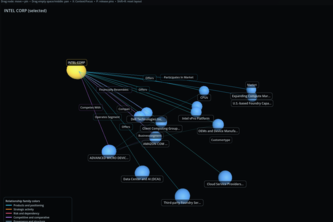
Fathom is a self-reported desktop application that presents financial and market intelligence as an interactive relational map built from SEC filings. The author describes it as a tool for exploring relationships between facts, entities, and derived indicators in a structured knowledge graph.
What changed
The project was initially conceived as a broader "relational research environment" but was adapted during OpenAI Build Week to focus on market intelligence using SEC data. It now presents a static, offline-ready dataset of eight companies with 2,504 nodes and 8,397 relationships.
Single most important open question
Is there evidence that Fathom has traction or adoption beyond the author’s own development environment? The description states no revenue, customers, or usage data are available.
Note: This analysis is based entirely on the self-reported project description provided by the author. No independent verification, historical data, or third-party sources were used. All claims are labeled as “the description states” and should be treated as unverified assertions.
What The Product Actually Is
The description states that Fathom is a desktop application built with Godot Engine, using Python, FastAPI, and PostgreSQL, among other technologies. It presents financial facts, companies, products, markets, dependencies, risks, strategic events, filings, and derived indicators in an interactive relational map.
It includes:
- 2,504 nodes
- 8,397 relationships
- 82 explanatory cards
- 137 SEC source records
- Seven relational lenses for exploring different questions
The system allows users to begin with a company and apply different investigative lenses (e.g., Financial Reporting, Competitive Position) to narrow the graph around specific questions.
It distinguishes between:
- Directly reported facts from SEC filings
- Computed or derived relationships
- Explanations and links to supporting observations
The interface includes synchronized maps, cards, and detail panels. The Evidence and Provenance panel exposes filing metadata, excerpts, review status, limitations, and optional links to original documents.
Inference: The product is described as a static offline application, not a live or cloud-based system. It does not require backend services or network connectivity at runtime.
Positioning & Claim Evolution
The description states that Fathom began as a broader relational research environment for scientific and conceptual collections, but was adapted during OpenAI Build Week to focus on market intelligence using SEC filings.
It positions itself as:
- A tool for turning fragmented evidence into an explorable map of relationships
- An alternative to traditional formats like lists, documents, or dashboards
- A system that makes the structure of evidence inspectable, rather than producing black-box recommendations
The author emphasizes that Fathom is not about generating new facts but about organizing existing ones in a way that supports investigation and reasoning.
Claim: The tool aims to help users move beyond isolated facts to explore larger structures.
Inference: This is a positioning shift from general-purpose research tools to a niche market intelligence application focused on financial data.
Target Customer & ICP
The description does not explicitly name target customers or personas.
However, it implies:
- Users interested in financial research and market intelligence
- Professionals who work with SEC filings
- Researchers or analysts who need to understand interdependencies between entities
It also suggests a focus on:
- Investigative workflows where users ask questions and explore answers through relationships
- A self-contained, offline experience, which may appeal to users concerned with data privacy or access control
Inference: The ICP likely includes financial analysts, compliance officers, or researchers working in regulated industries who want structured access to SEC data.
Business Model & Pricing Evidence
There is no evidence of a business model or pricing structure in the description.
The project is described as:
- A static offline build
- Not requiring backend services or API keys
- Not connected to any live data ingestion or subscription system
Claim: No commercial model, revenue streams, or pricing information are provided.
Inference: If this were a commercial product, it would likely be sold as either:
- A SaaS offering with subscriptions
- An on-premise desktop license
- A consulting service for custom integrations
Technical & Delivery Signals
The description states that Fathom uses:
- Godot Engine (for frontend)
- Python and FastAPI
- PostgreSQL
- GPT-5.6 as a coding assistant during development
- Deterministic pipelines for data normalization and graph construction
- Automated testing, validation, and clean-clone checks
It is described as:
- A fully offline application
- Not requiring network connection or external databases
- Built with responsive layout behavior
- Designed to handle large graphs (thousands of nodes and relationships)
- Capable of bounded rendering and filtering
Inference: The technical stack suggests a strong emphasis on performance, data integrity, and user experience in a desktop environment.
Traction & Maturity Signals
The description does not provide any traction or maturity signals:
- No customer base
- No revenue figures
- No usage metrics
- No product roadmap beyond the current submission
- No mention of external testing, feedback loops, or production deployment
It is described as a static dataset for an eight-company calibration set, not a live platform.
Claim: No evidence of traction or adoption.
Inference: The project appears to be in early-stage development or prototyping, with no indication of real-world usage or market validation.
Competitive Context
The description does not mention competitors or direct substitutes.
However, it implies:
- A space similar to market intelligence tools, financial research platforms, and knowledge graph applications
- Tools that allow users to visualize relationships between entities in financial or scientific domains
- Potential overlap with:
- SEC filing analysis platforms
- Knowledge management systems
- Graph-based data exploration tools
Inference: Fathom may compete with or complement existing tools in the financial intelligence and knowledge graph spaces, but no specific competitive landscape is described.
Open Questions & Risks
Key risks and open questions include:
- No evidence of traction or adoption beyond the author’s own development
- Offline-only design may limit scalability or usability for collaborative workflows
- Static dataset implies limited utility unless expanded with dynamic data ingestion
- Single-person team raises concerns about long-term maintenance, feature development, and product evolution
- Use of GPT-5.6 as a coding assistant suggests reliance on AI tools rather than human-driven innovation or deep domain expertise
Inference: The project lacks commercial viability indicators and may be more of a proof-of-concept than a scalable business.
Questions the description leaves open
- What is the long-term vision for Fathom beyond this Build Week submission?
- How does the author plan to expand the dataset beyond the current eight-company calibration?
- Are there any plans to support live data ingestion or user-generated content?
- Has the author considered how to monetize or scale this product?
- What are the technical challenges in moving from a static offline build to a cloud-based or collaborative platform?
- How does Fathom differentiate itself from existing SEC filing analysis tools?
Overall Assessment
The description states that Fathom is a self-contained, offline desktop application built for market intelligence using SEC filings.
It is not evidenced to have:
- Revenue
- Customers
- Product-market fit
- Scalable business model
- Collaborative or cloud-based features
- Live data ingestion capabilities
Assessment: Based on the self-reported description alone, Fathom appears to be a proof-of-concept or prototype with no demonstrated traction or commercial viability. It is not ready for investment or partnership consideration without further evidence of product-market fit, adoption, or scalability.
Confidence Level: Low — The analysis is based entirely on unverified self-reporting and lacks any external validation or performance metrics.
User Stories BotA demo video on every pull request
Get a demo video on every new feature
GitHub App that watches your pull requests and records a narrated, captioned demo.
Save time on demo prep and make informed decisions faster with a video walkthrough of every new feature.
Source
Submitted to the OpenAI 2026 hackathon on Devpost. Project home on Devpost. Back to the full gallery on Devpost.
This competitive analysis was produced by top-founders.com (opens in a new tab)
Generated by a language model from this project's public Devpost page — its tagline, the author's own write-up and any built-with tags listed there — as captured in August 2026. Short quotations are the author's words. It is an opinion on the idea as a business, not on the people behind it, and it reflects the description as published then. If the project has moved on, request a correction below. The analysis is not independent research and contains no verified traction, revenue or customer data.
An independent guide by KFG International LLC — not affiliated with, endorsed by, or connected to Devpost or OpenAI.