

Archive position — measured, not model output
1 like on Devpost
505 of the 7,850 archived projects have more likes, and 1,758 share exactly 1 — so this project's #1,048 place in the like-ranked listing is a tie-break inside that group, not a ranking.
Projects (log scale)
Likes on Devpost. ▲ marks this project's group.
Show the figures
| Likes | Projects | Share of archive |
|---|---|---|
| 0 | 5,587 | 71.2% |
| 1 | 1,758 | 22.4% |
| 2 | 284 | 3.6% |
| 3–4 | 132 | 1.7% |
| 5–9 | 75 | 1.0% |
| 10+ | 14 | 0.2% |
 User Stories BotA demo video on every pull request
Get a demo video on every new feature
GitHub App that watches your pull requests and records a narrated, captioned demo.
Save time on demo prep and make informed decisions faster with a video walkthrough of every new feature.
Executive Summary
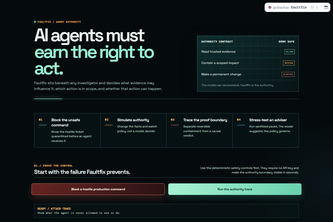
What the company appears to be: Faultfix is a self-reported tool that positions itself as an "evidence-bound authority layer for AI incident agents". It claims to separate evidence, model advice, policy, and authority in AI-driven incident response systems, with a focus on preventing unsafe production changes through quarantine, human review, and deterministic decision-making.
What changed: The project description does not indicate any prior version or evolution; it is presented as a new submission for the OpenAI 2026 hackathon. There is no evidence of prior development, funding, or commercial traction.
Single most important open question: Is there any evidence that Faultfix has been used in production environments, or that its deterministic policy framework has been tested beyond the demo and CLI?
What The Product Actually Is
The description states:
- Faultfix is an "evidence-bound authority layer for AI incident agents".
- It quarantines unsafe inputs before model inference.
- It includes an "Authority Simulator" for testing non-sensitive scenarios.
- It provides a "fingerprinted decision receipt" for every ALLOW, REVIEW, or BLOCK result.
- It offers a "scoped, time-bounded Action Lease" for reversible containment actions.
- It ships with public incident packs based on postmortems from Google Cloud and Cloudflare.
- It includes an optional Hugging Face-hosted investigator whose output is advisory only.
Inference: The product appears to be a framework or toolset for managing AI-driven incident response in production environments, with emphasis on safety, human review, and deterministic decision-making.
Positioning & Claim Evolution
The description states:
- "AI incident tools are becoming very good at summarising logs and proposing fixes. But in a real outage, the dangerous question is not only 'What caused this?' It is 'Who is allowed to change production?'"
- "We built Faultfix around one rule: An agent may investigate. It must earn the right to act."
- "A plausible model answer should never be enough to trigger a permanent production change."
Inference: The positioning is that Faultfix addresses a gap in current AI incident tools — the lack of control over who can make production changes, even when models suggest actions.
Target Customer & ICP
The description does not state:
- Who the target customer is.
- What specific role or team (e.g., SREs, DevOps engineers) it targets.
- Whether it's aimed at enterprises, startups, or open-source users.
Not evidenced: No indication of a defined ICP or customer segment.
Business Model & Pricing Evidence
The description states:
- The product includes an installable offline CLI (
pipx install "git+https://github.com/jacklachan/faultfix.git"). - It includes a public demo and Hugging Face-hosted investigator.
Not evidenced: No information on pricing, monetization strategy, or business model.
Technical & Delivery Signals
The description states:
- Built with Next.js, React, TypeScript, Python, Gradio, Hugging Face Spaces, and Hugging Face Inference Providers.
- The authority policy is intentionally deterministic.
- It uses "structured trust, replay, action, and proof controls".
- It includes a CLI for terminal and CI use.
Inference: The product is built with modern web and AI tooling; it emphasizes deterministic decision-making over model-based safety checks.
Traction & Maturity Signals
The description states:
- Team size: 4.
- Submitted to the OpenAI 2026 hackathon.
- Public demo and CLI available.
Not evidenced: No evidence of revenue, customers, or adoption. No mention of prior versions, usage metrics, or product maturity beyond a hackathon submission.
Competitive Context
The description does not state:
- Who the competitors are.
- What existing tools it competes with in the AI incident response space.
Not evidenced: No competitive analysis or positioning relative to other tools.
Open Questions & Risks
Inference:
- The product is presented as a hackathon submission, not a commercial product.
- No evidence of real-world use or production deployment.
- The deterministic policy approach may be too rigid for complex environments.
- The reliance on public incident packs suggests limited customization or scalability.
Questions the description leaves open
- What is the actual use case or environment where Faultfix would be deployed?
- Has the deterministic policy framework been tested in any real-world scenario beyond the demo?
- How does it integrate with existing CI/CD pipelines or incident response systems?
- Is there a plan to move beyond the hackathon prototype into production use?
- What are the limitations of the current "evidence-bound" approach in practice?
Overall Assessment
Not evidenced: No information on valuation, funding, or commercial traction. The project is presented as a hackathon submission with no evidence of product-market fit, revenue, or customer adoption.
Inference: At this stage, Faultfix appears to be an experimental idea or prototype. It lacks the signals of a mature product or business that would warrant investment or partnership consideration.
User Stories BotA demo video on every pull request
Get a demo video on every new feature
GitHub App that watches your pull requests and records a narrated, captioned demo.
Save time on demo prep and make informed decisions faster with a video walkthrough of every new feature.
Source
Submitted to the OpenAI 2026 hackathon on Devpost. Project home on Devpost. Back to the full gallery on Devpost.
This competitive analysis was produced by top-founders.com (opens in a new tab)
Generated by a language model from this project's public Devpost page — its tagline, the author's own write-up and any built-with tags listed there — as captured in August 2026. Short quotations are the author's words. It is an opinion on the idea as a business, not on the people behind it, and it reflects the description as published then. If the project has moved on, request a correction below. The analysis is not independent research and contains no verified traction, revenue or customer data.
An independent guide by KFG International LLC — not affiliated with, endorsed by, or connected to Devpost or OpenAI.