

Archive position — measured, not model output
0 likes on Devpost
2,263 of the 7,850 archived projects have more likes, and 5,587 share exactly 0 — so this project's #3,011 place in the like-ranked listing is a tie-break inside that group, not a ranking.
Projects (log scale)
Likes on Devpost. ▲ marks this project's group.
Show the figures
| Likes | Projects | Share of archive |
|---|---|---|
| 0 | 5,587 | 71.2% |
| 1 | 1,758 | 22.4% |
| 2 | 284 | 3.6% |
| 3–4 | 132 | 1.7% |
| 5–9 | 75 | 1.0% |
| 10+ | 14 | 0.2% |
 User Stories BotA demo video on every pull request
Get a demo video on every new feature
GitHub App that watches your pull requests and records a narrated, captioned demo.
Save time on demo prep and make informed decisions faster with a video walkthrough of every new feature.
Executive Summary
What the company appears to be
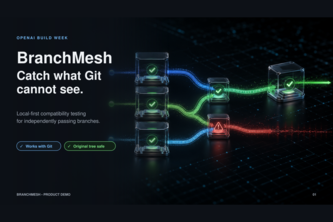
BranchMesh is a local-first command-line tool for developers that detects behavioral conflicts between Git branches by testing branch pairs in isolated worktrees before integration breaks code.
What changed
The author describes building this tool using Codex during OpenAI Build Week, with a focus on safety, deterministic execution, and offline reporting. It was submitted as a hackathon project to the OpenAI 2026 hackathon.
Single most important open question — the commercial due-diligence read
Is there a viable market need for this tool beyond its current demonstration use case? The description does not indicate any revenue, customers or adoption data. It is unclear whether the tool has been adopted by teams beyond the author’s own development environment.
What The Product Actually Is
The description states that BranchMesh is a local-first TypeScript CLI and Codex skill designed to test Git branches individually and in pairwise combinations. It operates by:
- Creating isolated temporary Git worktrees.
- Running configured commands (e.g., tests, builds) on branch pairs.
- Classifying outcomes as:
- Textual Git conflict
- Behavioral conflict
- No detected conflict
It produces JSON, raw logs, and an offline HTML compatibility report. The tool is built using Node.js, TypeScript, Commander.js, Zod, Vitest, tsup, and Picocolors.
Inference The tool appears to be a developer utility for detecting integration issues in Git-based workflows — specifically behavioral conflicts that occur even when Git merges cleanly.
Positioning & Claim Evolution
The author positions BranchMesh as a solution to a gap in modern development practices:
“Git is excellent at answering: ‘Can these file changes be merged?’ BranchMesh adds a second question: ‘After they are merged, does the combined software still work?’”
This framing suggests an evolution from traditional merge conflict detection to behavioral compatibility testing.
Inference The positioning implies a niche within developer tooling focused on preventing integration failures in collaborative environments. It is not positioned as a general-purpose CI/CD or Git platform but rather as a specific diagnostic tool for developers working with multiple feature branches.
Target Customer & ICP
The description indicates that BranchMesh targets developers who work with Git and need to ensure compatibility between independently passing branches.
It emphasizes:
- Local-first operation
- No modification of the developer’s current worktree
- Isolated, deterministic testing environments
Inference The ideal customer profile likely includes developers or engineering teams working in collaborative Git environments where branch merging is frequent and behavioral conflicts are a known risk. However, no explicit ICP or segmentation data is provided.
Business Model & Pricing Evidence
There is no evidence of any business model or pricing structure in the description.
The tool is described as a CLI package with open-source-like features (e.g., offline reports, no external API calls), but there is no mention of monetization, licensing, or paid tiers.
Inference It appears to be an open-source or freemium-style tool, possibly intended for personal or internal use. The lack of pricing or commercialization signals suggests it may not yet have a defined revenue path.
Technical & Delivery Signals
The author states that BranchMesh:
- Is built as a single Node.js and TypeScript package
- Uses Commander.js, Zod, Picocolors, tsup, and Vitest
- Executes Git commands via argument arrays (not shell strings)
- Operates in detached temporary worktrees
- Includes a Codex skill for reuse
- Produces offline HTML reports
- Has 142 automated tests across 35 test files
It also includes CLI commands such as:
branchmesh initbranchmesh doctorbranchmesh scanbranchmesh demobranchmesh cleanbranchmesh version
Inference The tool is technically well-structured, with attention to safety and determinism. It uses modern developer tooling and has a test suite, suggesting a mature development process.
Traction & Maturity Signals
There is no evidence of traction or adoption beyond the author’s own use case.
The project was submitted to a hackathon (OpenAI 2026), and the demo is manually run with npm ci, npm run build, and node dist/cli.js demo --open.
No data on:
- Number of users
- Customer feedback
- Downloads or installations
- Integration into CI/CD pipelines
Inference The tool is in a pre-production or early-stage development phase. It has not yet demonstrated real-world usage or market traction.
Competitive Context
There is no evidence of direct competitors or competitive landscape information in the description.
The author does not reference existing tools for Git conflict detection, behavioral testing, or branch integration validation.
Inference It is unclear whether similar tools exist. The tool may be unique in its approach to local-first, pairwise behavioral testing, but this cannot be confirmed without external data.
Open Questions & Risks
- No commercial traction or adoption: The project is described as a hackathon submission with no evidence of real-world use.
- Limited scope: The tool only tests up to five branches and does not claim to test all possible multi-branch combinations.
- Platform limitations: Native Windows support is not claimed, and testing is limited to macOS.
- No monetization strategy: No indication of how the tool will be commercialized or scaled.
- Developer-centric niche: The tool may appeal only to a small subset of developers who work with Git in specific ways.
Inference The risk of commercial viability is high due to lack of evidence for market demand, adoption, or scalability beyond its current demonstration.
Questions the description leaves open
- What real-world scenarios have you observed where behavioral conflicts occurred that this tool would have caught?
- Have you tested BranchMesh in production environments or with teams outside of your own development workflow?
- How do you plan to scale the tool beyond its current CLI-based, local-first approach?
- Are there any plans for CI/CD integration or cloud-based execution?
- What is the intended monetization model if any?
Overall Assessment
Not evidenced
There is no evidence of revenue, customers, traction, or commercialization beyond the author’s own development and hackathon submission.
The tool is described as a local-first CLI utility for detecting behavioral conflicts in Git branches. It has technical maturity but lacks any indication of market demand or business viability.
Confidence level Low This analysis is based entirely on self-reported information with no external corroboration. The lack of data on adoption, usage, or commercialization makes it difficult to assess the potential for investment or partnership.
User Stories BotA demo video on every pull request
Get a demo video on every new feature
GitHub App that watches your pull requests and records a narrated, captioned demo.
Save time on demo prep and make informed decisions faster with a video walkthrough of every new feature.
Source
Submitted to the OpenAI 2026 hackathon on Devpost. Project home on Devpost. Back to the full gallery on Devpost.
This competitive analysis was produced by top-founders.com (opens in a new tab)
Generated by a language model from this project's public Devpost page — its tagline, the author's own write-up and any built-with tags listed there — as captured in August 2026. Short quotations are the author's words. It is an opinion on the idea as a business, not on the people behind it, and it reflects the description as published then. If the project has moved on, request a correction below. The analysis is not independent research and contains no verified traction, revenue or customer data.
An independent guide by KFG International LLC — not affiliated with, endorsed by, or connected to Devpost or OpenAI.