

Archive position — measured, not model output
0 likes on Devpost
2,263 of the 7,850 archived projects have more likes, and 5,587 share exactly 0 — so this project's #6,937 place in the like-ranked listing is a tie-break inside that group, not a ranking.
Projects (log scale)
Likes on Devpost. ▲ marks this project's group.
Show the figures
| Likes | Projects | Share of archive |
|---|---|---|
| 0 | 5,587 | 71.2% |
| 1 | 1,758 | 22.4% |
| 2 | 284 | 3.6% |
| 3–4 | 132 | 1.7% |
| 5–9 | 75 | 1.0% |
| 10+ | 14 | 0.2% |
 User Stories BotA demo video on every pull request
Get a demo video on every new feature
GitHub App that watches your pull requests and records a narrated, captioned demo.
Save time on demo prep and make informed decisions faster with a video walkthrough of every new feature.
Executive Summary
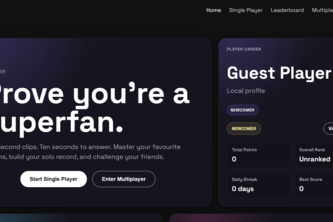
StanZer is a self-reported music quiz platform built for fans who want to prove their knowledge of albums and artists through competitive gameplay. The author describes it as a tool that turns any album into a fast-paced quiz using five-second audio clips, synchronized multiplayer modes (Duel, Group Lobbies, Party Mode), live rankings, and unlockable achievements.
The project was developed by one person (Uddy Ozoh) over the course of a hackathon. It uses React, TypeScript, Supabase, PostgreSQL, Vercel, and APIs like iTunes Search API. The author claims to have used Codex and GPT-5.6 for development support.
Key commercial signals from the description are limited: no revenue, customers, or traction data are provided. The product is described as a prototype with planned future features such as matchmaking, tournaments, native apps, and licensed music partnerships.
The single most important open question
Is there evidence of user demand or engagement beyond the author's own testing and development?
What The Product Actually Is
The description states that StanZer:
- Turns albums into fast-paced music quizzes
- Uses five-second audio clips for identification challenges
- Offers solo play, synchronized multiplayer (Duel, Group Lobbies), and Party Mode
- Includes live rankings, achievement badges, and public profiles
- Allows players to compete in real-time across devices using shared room clocks
- Supports both public and private rooms with shareable links or codes
It is built using React, TypeScript, Supabase, PostgreSQL, Vercel, and the iTunes Search API.
Inference The product appears to be a web-based multiplayer quiz game focused on music fandom. It is not described as a marketplace, SaaS platform, or developer tool — it's a consumer-facing entertainment experience.
Positioning & Claim Evolution
The author positions StanZer as:
- A competitive music quiz for fans who want to prove they know their favorite artists and albums
- An evolution of YouTube-style music challenge videos into a real game
- A platform where users can climb leaderboards, earn achievements, and build public profiles
The claim has evolved from a personal idea ("I always wanted to feel like I was their number one fan") to a functional product with multiplayer features and progression systems.
Inference The positioning suggests a niche but passionate audience — music fans seeking competitive engagement. There is no indication of broader commercial intent beyond the author’s own experience or vision.
Target Customer & ICP
The description states:
- The target audience includes people who love music, especially those who believe they truly know their favorite artists and albums
- Users want to prove themselves as superfans through competition
- The platform supports solo play and multiplayer modes (Duel, Group Lobbies, Party Mode)
Inference The ICP likely centers on young adults or teens with strong music interests, particularly fans of hip-hop, pop, and other genres where deep knowledge is valued. No explicit segmentation beyond genre preference is provided.
Business Model & Pricing Evidence
There is no evidence in the description of a business model or pricing structure.
The author mentions:
- Planned features like licensed music partnerships
- Native mobile apps
- Creator-hosted events
- Community tournaments
But does not describe monetization, subscriptions, ads, or transactional elements.
Inference No commercial model is evident from the self-reported description. The project appears to be a prototype with no stated revenue streams.
Technical & Delivery Signals
The author reports:
- Built using React, TypeScript, Vite, Supabase, PostgreSQL, and Vercel
- Uses Supabase for authentication, profiles, rankings, achievements, multiplayer rooms, and real-time updates
- Implements row-level security and shared room clocks for synchronization
- Integrated iTunes Search API for album data and audio previews
- Addressed challenges around browser autoplay, timer drift, stale rooms, and reconnection logic
Inference The technical stack suggests a modern, cloud-hosted web application with strong real-time capabilities. The author shows awareness of multiplayer complexity and has solved several synchronization issues.
Traction & Maturity Signals
The description states:
- The project was built in a hackathon
- It includes polished single-player and multiplayer experiences
- Features include live head-to-head score progression, group lobby rankings, and achievement badges
- Has more than twenty unique achievements
- Supports responsive desktop and mobile interfaces
However, there is no evidence of:
- Users or customer base
- Revenue or monetization
- Product usage metrics
- Adoption beyond the author’s own testing
Inference The product is at a prototype stage. No traction data exists in the description.
Competitive Context
The author does not reference competitors directly, but implies that similar concepts exist in YouTube music challenge videos and platforms like Kahoot or Trivia Crack.
They describe StanZer as an evolution of those formats into a more structured game with:
- Album-based challenges
- Synchronized multiplayer
- Leaderboards and achievements
Inference The competitive landscape includes general quiz games, music trivia apps, and social gaming platforms. No specific competitor names are mentioned.
Open Questions & Risks
Key risks and open questions from the self-reported description include:
- No traction or user data: The product is described only as a hackathon prototype with no evidence of adoption.
- Unproven market demand: There is no indication of whether users would pay for or engage with this type of platform.
- Limited commercialization plan: No monetization strategy, pricing model, or go-to-market approach is evident.
- Dependency on third-party APIs: Reliance on iTunes Search API may limit scalability or introduce instability.
- Single-founder development: One-person team implies limited capacity for rapid growth or feature expansion.
Inference The risk of failure lies in the gap between a functional prototype and a scalable, monetizable product. Without traction, it's unclear if there is sufficient market interest to justify further investment.
Questions the description leaves open
- What specific user feedback have you received during development?
- Have you tested the multiplayer experience with real users beyond yourself?
- How do you plan to monetize this platform?
- Are you aware of existing competitors in this space, and how does StanZer differentiate?
- What is your timeline for launching a beta or MVP to users?
- Do you have any plans for community building or user retention strategies?
- What are the key technical challenges that remain unresolved?
- How do you intend to scale beyond the current tech stack?
Overall Assessment
The description presents StanZer as a hackathon prototype with promising technical execution and clear creative direction. However, there is no evidence of traction, revenue, or customer engagement.
Assessment Not ready for investment or partnership at this stage. The product shows potential but lacks commercial validation. A follow-up evaluation would require evidence of early user adoption, monetization plans, or a clear path to market traction.
User Stories BotA demo video on every pull request
Get a demo video on every new feature
GitHub App that watches your pull requests and records a narrated, captioned demo.
Save time on demo prep and make informed decisions faster with a video walkthrough of every new feature.
Source
Submitted to the OpenAI 2026 hackathon on Devpost. Project home on Devpost. Back to the full gallery on Devpost.
This competitive analysis was produced by top-founders.com (opens in a new tab)
Generated by a language model from this project's public Devpost page — its tagline, the author's own write-up and any built-with tags listed there — as captured in August 2026. Short quotations are the author's words. It is an opinion on the idea as a business, not on the people behind it, and it reflects the description as published then. If the project has moved on, request a correction below. The analysis is not independent research and contains no verified traction, revenue or customer data.
An independent guide by KFG International LLC — not affiliated with, endorsed by, or connected to Devpost or OpenAI.