

Archive position — measured, not model output
1 like on Devpost
505 of the 7,850 archived projects have more likes, and 1,758 share exactly 1 — so this project's #1,046 place in the like-ranked listing is a tie-break inside that group, not a ranking.
Projects (log scale)
Likes on Devpost. ▲ marks this project's group.
Show the figures
| Likes | Projects | Share of archive |
|---|---|---|
| 0 | 5,587 | 71.2% |
| 1 | 1,758 | 22.4% |
| 2 | 284 | 3.6% |
| 3–4 | 132 | 1.7% |
| 5–9 | 75 | 1.0% |
| 10+ | 14 | 0.2% |
 User Stories BotA demo video on every pull request
Get a demo video on every new feature
GitHub App that watches your pull requests and records a narrated, captioned demo.
Save time on demo prep and make informed decisions faster with a video walkthrough of every new feature.
Executive Summary
What the company appears to be
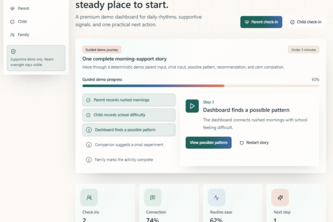
Family Companion AI is a self-reported AI-powered parenting assistant designed to support busy parents with personalized guidance, child development insights, and family memory management. It is described as an evidence-informed tool that encourages reflection and informed decision-making without replacing parental judgment.
What changed
The project was submitted as a hackathon entry for the OpenAI 2026 hackathon. The author states it is a prototype built using React, Node.js, TypeScript, and OpenAI APIs, with an emphasis on privacy, accessibility, and responsible AI design.
Single most important open question
Is there any evidence of user adoption, revenue, or traction beyond the prototype?
What The Product Actually Is
The description states that Family Companion AI is:
- An AI-powered assistant for parents
- Designed to support everyday family life
- Aims to provide personalized parenting guidance and child development insights
- Includes features such as:
- Guided family onboarding
- Parent and child profiles
- A family dashboard
- Local-only demo memories
- Personalized parenting guidance
- Child-safe communication
- Evidence-informed recommendations
- Clear explanations and safety reminders
- Privacy-first design using local demo data
It is described as a prototype built with modern web technologies including React, TypeScript, Node.js, and OpenAI APIs.
Inference The product appears to be a proof-of-concept or MVP, not yet a production-ready service. It is not evidenced to have any live users or monetization features.
Positioning & Claim Evolution
The author states that Family Companion AI is:
- An “evidence-informed AI companion for busy parents”
- A “trusted helping hand for family life”
- Designed to encourage reflection and informed decision-making
- Not intended to replace the parent but to support them
- Built with a privacy-conscious, transparent approach
- Focused on structured guidance rather than absolute answers
Inference The positioning is centered around trust, safety, and parental control. It is not positioned as a replacement for professional advice or parenting expertise, but as a supportive tool.
Target Customer & ICP
The description states that the product targets:
- Busy parents
- Families seeking support with everyday family life
- Parents who want evidence-informed guidance
- Users concerned about privacy and AI transparency
It is described as a family-friendly interface, suggesting it may appeal to parents of young children.
Inference The ICP appears to be parents or caregivers who are looking for accessible, responsible, and personalized support in parenting. No specific age group or demographic data is provided.
Business Model & Pricing Evidence
There is no evidence of a business model or pricing structure in the description.
Inference No revenue streams, monetization strategies, or pricing information are mentioned. The product is described as a prototype with no indication of commercial viability or user payment mechanisms.
Technical & Delivery Signals
The author states that:
- The application was built using:
- React
- TypeScript
- Node.js
- OpenAI APIs (including Codex)
- Vercel for deployment
- Tailwind CSS and responsive design
- It uses a modular component architecture
- Features include local state management, multi-step onboarding, and evidence-aware prompting
- The prototype includes safety guardrails and transparent AI interactions
Inference The technical stack is modern and web-based. The prototype demonstrates some level of development maturity but lacks production-grade features such as persistent data storage or secure user accounts.
Traction & Maturity Signals
The description states:
- This is a hackathon submission
- It is a working prototype
- It includes:
- Complete onboarding journey
- Consistent visual design
- Privacy-first principles
- Family-friendly UX
- Evidence-informed guidance
- Transparent AI interactions
- Scalable foundation for future features
There is no evidence of user adoption, customer base, or revenue.
Inference The product is at a very early stage. It has not demonstrated any traction or real-world usage beyond the prototype.
Competitive Context
No competitive analysis or market positioning is provided in the description.
Inference It is not evident whether there are existing products in this space, nor how Family Companion AI differentiates from them.
Open Questions & Risks
- The product is described as a hackathon prototype with no evidence of user adoption or revenue.
- No mention of data privacy compliance, security features beyond local demo data, or scalability plans.
- No indication of monetization strategy or business model.
- The author is a single individual (1-person team), which may limit development capacity.
- The product is not evidenced to have any live users, customer feedback, or market validation.
Inference The project is at an early stage and lacks commercial viability signals. It is unclear if it will evolve into a scalable or monetizable product.
Questions the description leaves open
- What is the plan for transitioning from prototype to production?
- Are there any users or beta testers beyond the author?
- How does the product handle data privacy and compliance in real-world usage?
- What are the plans for monetization or revenue generation?
- Is there a roadmap for scaling beyond the current MVP?
- What is the long-term vision for integrating with existing parenting resources or platforms?
Overall Assessment
Not evidenced.
The project is described as a hackathon prototype with no evidence of traction, revenue, or user adoption. The author states that it is a working prototype but does not provide any data on customer engagement, market demand, or commercial viability.
Inference At this stage, there is insufficient evidence to support an investment or partnership decision. The project lacks key signals of product-market fit or scalability.
User Stories BotA demo video on every pull request
Get a demo video on every new feature
GitHub App that watches your pull requests and records a narrated, captioned demo.
Save time on demo prep and make informed decisions faster with a video walkthrough of every new feature.
Source
Submitted to the OpenAI 2026 hackathon on Devpost. Project home on Devpost. Back to the full gallery on Devpost.
This competitive analysis was produced by top-founders.com (opens in a new tab)
Generated by a language model from this project's public Devpost page — its tagline, the author's own write-up and any built-with tags listed there — as captured in August 2026. Short quotations are the author's words. It is an opinion on the idea as a business, not on the people behind it, and it reflects the description as published then. If the project has moved on, request a correction below. The analysis is not independent research and contains no verified traction, revenue or customer data.
An independent guide by KFG International LLC — not affiliated with, endorsed by, or connected to Devpost or OpenAI.