

Archive position — measured, not model output
2 likes on Devpost
221 of the 7,850 archived projects have more likes, and 284 share exactly 2 — so this project's #320 place in the like-ranked listing is a tie-break inside that group, not a ranking.
Projects (log scale)
Likes on Devpost. ▲ marks this project's group.
Show the figures
| Likes | Projects | Share of archive |
|---|---|---|
| 0 | 5,587 | 71.2% |
| 1 | 1,758 | 22.4% |
| 2 | 284 | 3.6% |
| 3–4 | 132 | 1.7% |
| 5–9 | 75 | 1.0% |
| 10+ | 14 | 0.2% |
 User Stories BotA demo video on every pull request
Get a demo video on every new feature
GitHub App that watches your pull requests and records a narrated, captioned demo.
Save time on demo prep and make informed decisions faster with a video walkthrough of every new feature.
Executive Summary
What the company appears to be
Failsafe is a self-reported tool for households to map recovery dependencies—such as accounts, devices, documents, and payment methods—and analyze potential failure points in those dependencies. It claims to enable users to test recovery paths without storing passwords or sensitive data.
What changed
The project was built during the OpenAI 2026 hackathon. It is described as a prototype with a working demo loop: mapping a path, analyzing it, practicing recovery, creating repairs, and re-testing. The system uses Next.js, PostgreSQL, and AI tools like GPT-5.6 for language processing.
Single most important open question
Is there any evidence of real-world adoption or usage beyond the hackathon prototype? The description states no revenue, customers, or traction data exist beyond its own claims.
What The Product Actually Is
The description states that Failsafe:
- Maps people, accounts, devices, documents, and payment methods a household relies on.
- Records possible recovery paths, who reported the relationship, when it was checked, and what kind of evidence supports it.
- Analyzes for loops, shared failure points, unreachable accounts, stale claims, and access that should have ended.
- Enables households to pick one weak path, run a consent-based drill (without destructive actions), fix what failed, and test again.
- Never asks for passwords, recovery codes, tokens, or copies of private documents.
Inference It appears to be a dependency mapping and risk analysis tool for household digital recovery. It is not a password manager or identity vault but a system for identifying and testing recovery pathways.
Positioning & Claim Evolution
The description states:
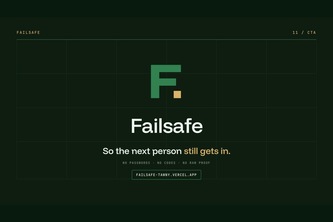
- Failsafe started with the question: “What would stop the next person from getting in?”
- It positions itself as an alternative to traditional recovery plans that are inventories, which often miss interdependencies.
- The tool aims to make recovery planning more robust by identifying shared failure points.
Inference The positioning evolved from a hackathon idea into a tool focused on mapping and testing recovery dependencies. It is not positioned as a full identity or password management solution but as a risk-assessment and planning tool.
Target Customer & ICP
The description states:
- The target is “households”.
- It focuses on mapping recovery dependencies within a household, including people, accounts, devices, documents, and payment methods.
- The tool is designed to be used by individuals or families managing their own digital recovery paths.
Inference The ICP appears to be households or individuals who are concerned about digital recovery but do not want to store sensitive credentials. It is not aimed at enterprises or large organizations.
Business Model & Pricing Evidence
Not evidenced.
Explanation
There is no mention of pricing, monetization, or business model in the description. The project is described as a hackathon prototype with no revenue or customer data.
Technical & Delivery Signals
The description states:
- Built with Next.js and PostgreSQL.
- Uses Drizzle for typed data models and SQL migrations to enforce row-level security (RLS).
- AI tools like GPT-5.6 are used where language helps, but not for making safety decisions.
- The analysis code lives in its own package and is isolated from UI, database, or HTTP layers.
- Zod validates AI responses, and a human must confirm any proposed changes.
- The system includes 71 automated tests and passes linting, type checking, and production build.
Inference The architecture shows an attempt at clean separation of concerns, with deterministic analysis code and AI used for interpretation rather than decision-making. It is built with modern tooling and testing practices.
Traction & Maturity Signals
Not evidenced.
Explanation
There is no evidence of revenue, customers, usage metrics, or product adoption beyond the hackathon prototype. The project is described as a demo loop that works but has not cleared pilot gates for real-world use.
Competitive Context
Not evidenced.
Explanation
The description does not mention competitors or market positioning relative to existing tools for digital recovery or identity management. No comparison to other products is made.
Open Questions & Risks
- No traction or adoption: The project is described as a hackathon prototype with no evidence of real-world usage.
- Unverified claims: The description makes strong claims about safety and analysis without independent validation.
- AI dependency: While AI is used for interpretation, the system's core decisions are deterministic. However, reliance on GPT-5.6 raises questions about consistency and control.
- Limited scope: It is focused only on households, not broader enterprise or organizational use cases.
- No security review: The description notes that an independent application and RLS review are needed before real-world use.
Questions the description leaves open
- What is the actual risk of using this tool in a household context?
- How does it handle edge cases or complex recovery scenarios (e.g., multiple households, shared accounts)?
- Are there any plans to integrate with existing identity providers or recovery services?
- Has the team considered how to scale beyond a single household?
- What are the specific pilot gates that need to be cleared before real-world deployment?
Overall Assessment
Not evidenced.
Explanation
There is no evidence of funding, valuation, or investment interest. The project is described as a hackathon submission with no commercial traction or business development beyond its own claims. No indication exists that it has moved beyond prototype status or attracted partners or investors.
User Stories BotA demo video on every pull request
Get a demo video on every new feature
GitHub App that watches your pull requests and records a narrated, captioned demo.
Save time on demo prep and make informed decisions faster with a video walkthrough of every new feature.
Source
Submitted to the OpenAI 2026 hackathon on Devpost. Project home on Devpost. Back to the full gallery on Devpost.
This competitive analysis was produced by top-founders.com (opens in a new tab)
Generated by a language model from this project's public Devpost page — its tagline, the author's own write-up and any built-with tags listed there — as captured in August 2026. Short quotations are the author's words. It is an opinion on the idea as a business, not on the people behind it, and it reflects the description as published then. If the project has moved on, request a correction below. The analysis is not independent research and contains no verified traction, revenue or customer data.
An independent guide by KFG International LLC — not affiliated with, endorsed by, or connected to Devpost or OpenAI.