

Archive position — measured, not model output
0 likes on Devpost
2,263 of the 7,850 archived projects have more likes, and 5,587 share exactly 0 — so this project's #4,023 place in the like-ranked listing is a tie-break inside that group, not a ranking.
Projects (log scale)
Likes on Devpost. ▲ marks this project's group.
Show the figures
| Likes | Projects | Share of archive |
|---|---|---|
| 0 | 5,587 | 71.2% |
| 1 | 1,758 | 22.4% |
| 2 | 284 | 3.6% |
| 3–4 | 132 | 1.7% |
| 5–9 | 75 | 1.0% |
| 10+ | 14 | 0.2% |
 User Stories BotA demo video on every pull request
Get a demo video on every new feature
GitHub App that watches your pull requests and records a narrated, captioned demo.
Save time on demo prep and make informed decisions faster with a video walkthrough of every new feature.
Executive Summary
What the company appears to be
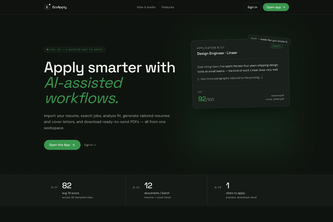
EzzApply is a self-reported job application tool built around the objective of getting a candidate’s resume in front of a human decision-maker, rather than just optimizing for document quality. It claims to analyze job listings, tailor resumes and cover letters, and track ATS vendor exposure to reduce the impact of algorithmic monocultures in hiring.
What changed
The project description reflects an evolution from a basic AI-powered resume generator to a more nuanced system that incorporates feedback loops, persona learning, and ATS-aware routing. It also signals a shift in focus from document generation to human reach — a reframing based on the Stanford FAccT paper cited by the authors.
Single most important open question
Does EzzApply actually deliver on its stated goal of increasing human reach, or does it merely optimize for document fit within a single ATS ecosystem?
Note: All claims in this summary are self-reported and unverified. The analysis is based solely on the project description provided by the caller.
What The Product Actually Is
The description states that EzzApply:
- Discovers matching job listings (via a custom-built database).
- Runs a two-stage fit analysis using both deterministic baseline scoring and an AI recruiter-style read.
- Lets users select which roles to apply to.
- Generates tailored resumes and cover letters exported as PDFs.
- Maintains a dashboard with applications, revisions, and results.
- Allows users to edit resume text, review proposed changes, and accept/reject edits.
- Uses guardrails (must_keep and do_not_claim lists) to ensure truthfulness in AI-generated content.
- Learns from user feedback to build a persona.yaml for future generations.
- Is developing a "Human-Reach Engine" that will detect ATS vendors behind job postings and track exposure concentration.
Inference: The product is described as an end-to-end system with structured import, fit analysis, truthful generation, deterministic export, revision history, and feedback loops. However, no evidence of actual customers or usage data is provided.
Positioning & Claim Evolution
The description states that EzzApply was built around a reframing of the job application process:
- It shifts focus from “making a good resume” to “getting it in front of a human.”
- This shift is rooted in the Stanford FAccT paper on algorithmic monocultures in hiring.
- The authors claim EzzApply is the first applicant-facing product working to operationalize this insight.
Inference: The positioning has evolved from a generic AI resume tool to one that addresses systemic bias in ATS-based screening. However, there is no evidence of market validation or traction.
Target Customer & ICP
The description does not explicitly define a target customer segment or ideal customer profile (ICP). It implies the product is for job seekers who are frustrated with ATS-based screening and want more control over how their applications reach human decision-makers.
Not evidenced: No explicit mention of specific personas, industries, experience levels, or geographic focus.
Business Model & Pricing Evidence
The description does not provide any information about pricing, monetization strategy, or business model. It only describes the product functionality and technical architecture.
Not evidenced: No indication of how EzzApply intends to generate revenue or whether it is a freemium, paid, or enterprise offering.
Technical & Delivery Signals
The description provides detailed technical implementation:
- Built with React + TypeScript frontend (Vercel deployment).
- Backend in Python + FastAPI with background workers.
- Uses Postgres for job queues and state management.
- AI layer powered by Codex CLI (gpt-5.6), with JSON schema validation via Pydantic.
- Documents are composed deterministically using LaTeX; PDFs compiled from validated outputs.
- Uses MinIO locally, Cloudflare R2 in production.
- Implements admission control for shared rate limits and concurrency.
Inference: The system is described as production-shaped, with concurrency handling, retries, checkpoints, and deterministic validation. However, no evidence of live users or performance metrics.
Traction & Maturity Signals
The description states:
- Team size: 4.
- Built for the OpenAI 2026 hackathon.
- The system is described as end-to-end working but not yet fully shipped (e.g., Human-Reach Engine is “not shipped yet”).
- The authors are validating concurrency and rate-limiting systems before expanding.
Not evidenced: No evidence of revenue, users, or adoption. No mention of any launch, pilot, or beta program.
Competitive Context
The description does not reference competitors or the broader marketplace for job application tools. It only mentions that the Stanford FAccT paper identified a problem and that EzzApply is the first applicant-facing product working to operationalize it.
Not evidenced: No competitive analysis, no mention of existing ATS optimization tools, AI resume builders, or job platforms.
Open Questions & Risks
- Unproven market demand: The description lacks evidence of customer traction or validation.
- Over-reliance on a single AI provider (Codex): No fallback or expansion plan for AI providers.
- No pricing or monetization strategy: Unclear how the product will be commercialized.
- High technical complexity without real-world testing: The system is described as production-ready, but no evidence of live usage or performance data.
- Unverified claims about ATS detection and routing: The Human-Reach Engine is described as a future feature with no current implementation details.
Inference: The product appears to be in an early development stage, possibly post-hackathon MVP. It lacks commercial validation.
Questions the description leaves open
- What specific user feedback has driven changes in the roadmap?
- How do you plan to validate that your ATS detection and routing logic works accurately in real-world scenarios?
- Are there any early adopters or pilot users who have provided feedback on the "human reach" objective?
- What is the current status of the Human-Reach Engine? Is it being tested or prototyped?
- How do you intend to scale beyond Codex, and what are your plans for fallback AI models?
- Have you considered how to monetize this product, especially if it's targeting job seekers directly?
Overall Assessment
The description indicates that EzzApply is a self-reported, early-stage product built around a compelling idea rooted in academic research. It shows technical sophistication and an evolving understanding of the job application problem.
However, there is no evidence of traction, revenue, customers, or even a clear go-to-market strategy. The project appears to be at the prototype or MVP stage, likely post-hackathon, with no commercial validation.
Confidence: Low.
Assessment: Not ready for investment or partnership without further evidence of traction, user feedback, and commercial viability.
User Stories BotA demo video on every pull request
Get a demo video on every new feature
GitHub App that watches your pull requests and records a narrated, captioned demo.
Save time on demo prep and make informed decisions faster with a video walkthrough of every new feature.
Source
Submitted to the OpenAI 2026 hackathon on Devpost. Project home on Devpost. Back to the full gallery on Devpost.
This competitive analysis was produced by top-founders.com (opens in a new tab)
Generated by a language model from this project's public Devpost page — its tagline, the author's own write-up and any built-with tags listed there — as captured in August 2026. Short quotations are the author's words. It is an opinion on the idea as a business, not on the people behind it, and it reflects the description as published then. If the project has moved on, request a correction below. The analysis is not independent research and contains no verified traction, revenue or customer data.
An independent guide by KFG International LLC — not affiliated with, endorsed by, or connected to Devpost or OpenAI.