

Archive position — measured, not model output
4 likes on Devpost
89 of the 7,850 archived projects have more likes, and 39 share exactly 4 — so this project's #99 place in the like-ranked listing is a tie-break inside that group, not a ranking.
Projects (log scale)
Likes on Devpost. ▲ marks this project's group.
Show the figures
| Likes | Projects | Share of archive |
|---|---|---|
| 0 | 5,587 | 71.2% |
| 1 | 1,758 | 22.4% |
| 2 | 284 | 3.6% |
| 3–4 | 132 | 1.7% |
| 5–9 | 75 | 1.0% |
| 10+ | 14 | 0.2% |
 User Stories BotA demo video on every pull request
Get a demo video on every new feature
GitHub App that watches your pull requests and records a narrated, captioned demo.
Save time on demo prep and make informed decisions faster with a video walkthrough of every new feature.
Executive Summary
What the company appears to be
cvGO! is a self-reported AI-powered platform designed to streamline the job search process by integrating vacancy discovery, resume analysis, ATS optimization, cover letter generation, and interview preparation into one workflow. The author states it aggregates data from over 1,000 job sources and uses AI to match candidates with roles based on real experience.
What changed
The project was built as a hackathon submission for the OpenAI 2026 hackathon. It is not evidenced to have launched commercially or gained users beyond its development phase.
Single most important open question — the commercial due-diligence read
Is there any evidence of real-world usage, revenue, or traction that would indicate cvGO! has moved beyond a proof-of-concept into a viable product or service?
What The Product Actually Is
The description states that cvGO! is an AI-powered platform for job seekers. It supports the entire job application journey through:
- Aggregating vacancies from over 1,000 sources;
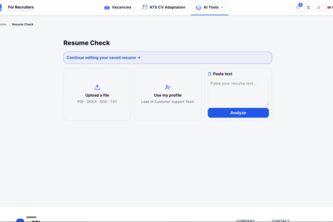
- Analyzing resumes and professional profiles;
- Matching candidates with job requirements;
- Adapting resumes for ATS filters;
- Generating personalized cover letters;
- Conducting AI voice interviews;
- Providing feedback on interview performance.
The platform is described as modular, connecting vacancy data, candidate data, and AI-generated tools into a continuous workflow. It uses technologies like GPT-5.6 and Codex throughout its development and operation.
Evidence
- The author states cvGO! aggregates data from more than 1,000 job sources.
- It analyzes resumes and compares them with job requirements.
- It generates cover letters and interview preparation materials.
- It includes an AI voice interview coach that adapts questions based on resume and vacancy context.
Inference The platform is built to reduce fragmentation in the job search process by centralizing tools into one interface.
Positioning & Claim Evolution
The author positions cvGO! as a unified, AI-powered workspace for job seekers. It claims to help candidates:
- Find suitable opportunities faster;
- Build stronger applications;
- Prepare for real interviews using their actual professional experience.
It is described as not just generating text but helping users focus on relevant opportunities and understand how their experience aligns with roles.
Evidence
- The tagline: “Personalized AI searches for job openings from hundreds of sources based on your resume.”
- The write-up states: “Our goal is simple: help candidates find suitable opportunities faster, build stronger applications, and prepare for real interviews using their actual professional experience.”
Inference The positioning emphasizes personalization, workflow integration, and alignment with real experience rather than generic tools.
Target Customer & ICP
The description identifies job seekers as the primary users of cvGO!. It is aimed at candidates who are:
- Searching for jobs;
- Wanting to improve their resume presentation;
- Preparing for interviews;
- Looking to align their experience with specific job requirements.
It is implied that the platform targets individuals who may be struggling with ATS optimization, interview preparation, or identifying relevant opportunities.
Evidence
- The write-up states: “We created cvGO to connect the entire job search journey in one AI-powered workspace.”
- It addresses challenges like “applicants being rejected before a recruiter reviews their experience because their resume is not aligned with an applicant tracking system.”
Inference The platform likely targets mid-to-senior-level professionals or job seekers who are serious about optimizing their application process.
Business Model & Pricing Evidence
There is no evidence in the description of a business model or pricing structure. The author does not state whether cvGO! will be free, subscription-based, or monetized through other means.
Evidence
- No mention of pricing.
- No indication of revenue streams.
- No statement about monetization or commercial use.
Inference The product is currently a hackathon submission and has no known business model or pricing strategy.
Technical & Delivery Signals
The platform is built using technologies like:
- AI models (GPT-5.6, Codex);
- Scraping tools;
- FastAPI, Next.js, React, Node.js;
- PostgreSQL, Docker, Vercel.
It uses AI to parse job data, analyze resumes, generate content, and conduct voice interviews.
Evidence
- The write-up mentions using Codex and GPT-5.6 for various tasks including resume analysis, interview question generation, and ATS adaptation.
- It states that the platform normalizes vacancy data from heterogeneous sources.
- Voice interviews are described as contextual and adaptive, based on resume and vacancy data.
Inference The technical architecture suggests a modern, AI-integrated SaaS-style product with backend scraping and frontend user experience.
Traction & Maturity Signals
There is no evidence of traction or maturity. The project is described as a hackathon submission and has no data on:
- Users;
- Revenue;
- Customer adoption;
- Product usage metrics.
Evidence
- It was submitted to the OpenAI 2026 hackathon.
- No mention of launch, users, or monetization.
- No customer testimonials or case studies.
Inference The product is in a pre-commercial phase and lacks any demonstrated traction or user base.
Competitive Context
The description does not provide information on competitors. It does not name similar platforms or describe how cvGO! differentiates itself from existing tools in the job search space.
Evidence
- No mention of competitors.
- No comparison with other AI-powered job platforms or resume tools.
Inference Without competitive data, it is unclear whether cvGO! offers a unique value proposition or replicates existing solutions.
Open Questions & Risks
Key risks and open questions include:
- No commercial traction: The product is a hackathon submission with no evidence of real-world usage.
- Unverified claims: All features are self-reported, with no independent validation.
- AI hallucination risk: The platform’s AI outputs are described as grounded in real data, but there's no evidence of safeguards against fabricated content.
- Lack of business model clarity: No indication of how the product will be monetized or scaled.
- Single-founder team: The project is attributed to one individual (Emil Airapetian), which may limit development capacity.
Evidence
- No revenue, users, or adoption data.
- No mention of funding or business model.
- One-person team.
Inference The lack of traction and commercial viability raises concerns about scalability and long-term sustainability.
Questions the description leaves open
- Has cvGO! been tested with real users beyond the hackathon?
- What is the plan for monetization or scaling the product?
- How does the platform ensure AI outputs are accurate and not fabricated?
- Are there any partnerships or integrations with job boards or ATS platforms?
- What is the current state of the product — is it ready for beta or launch?
Overall Assessment
Not evidenced.
The project is described as a hackathon submission with no evidence of commercial traction, revenue, or user adoption. The author states that cvGO! aggregates data from over 1,000 job sources and uses AI to match candidates with roles, but there is no independent verification of these claims.
Confidence level Low — the description is self-reported and unverified, and lacks any evidence of real-world usage or business viability.
Conclusion
cvGO! appears to be a concept or prototype built for a hackathon. There is no evidence that it has moved beyond this stage into a product with users, revenue, or traction. Any investment or partnership decision would require further due diligence into its commercial potential and real-world performance.
User Stories BotA demo video on every pull request
Get a demo video on every new feature
GitHub App that watches your pull requests and records a narrated, captioned demo.
Save time on demo prep and make informed decisions faster with a video walkthrough of every new feature.
Source
Submitted to the OpenAI 2026 hackathon on Devpost. Project home on Devpost. Back to the full gallery on Devpost.
This competitive analysis was produced by top-founders.com (opens in a new tab)
Generated by a language model from this project's public Devpost page — its tagline, the author's own write-up and any built-with tags listed there — as captured in August 2026. Short quotations are the author's words. It is an opinion on the idea as a business, not on the people behind it, and it reflects the description as published then. If the project has moved on, request a correction below. The analysis is not independent research and contains no verified traction, revenue or customer data.
An independent guide by KFG International LLC — not affiliated with, endorsed by, or connected to Devpost or OpenAI.