

Archive position — measured, not model output
0 likes on Devpost
2,263 of the 7,850 archived projects have more likes, and 5,587 share exactly 0 — so this project's #4,024 place in the like-ranked listing is a tie-break inside that group, not a ranking.
Projects (log scale)
Likes on Devpost. ▲ marks this project's group.
Show the figures
| Likes | Projects | Share of archive |
|---|---|---|
| 0 | 5,587 | 71.2% |
| 1 | 1,758 | 22.4% |
| 2 | 284 | 3.6% |
| 3–4 | 132 | 1.7% |
| 5–9 | 75 | 1.0% |
| 10+ | 14 | 0.2% |
 User Stories BotA demo video on every pull request
Get a demo video on every new feature
GitHub App that watches your pull requests and records a narrated, captioned demo.
Save time on demo prep and make informed decisions faster with a video walkthrough of every new feature.
Executive Summary
The description states that F-1 Duration Mapper is a tool built by David Maxon, a Designated School Official (DSO), to help international students navigate new U.S. immigration rules affecting F-1 visas. The tool uses AI to process student inputs and provide personalized guidance based on the new fixed-period admission system replacing Duration of Status (D/S). It is presented as a decision tree that reasons through regulatory text, citing specific sources, and designed to reduce the burden on DSOs by triaging routine questions.
The author states this is a self-contained tool built in four days for a specific rule change effective September 15, 2026. The tool is described as using GPT-5.6 for intake processing and final reporting, with a deterministic rules engine underlying the legal reasoning. It includes structured intake, temporal event modeling, and source-linked citations.
The most important open question is whether this tool will actually be used by students or DSOs before September 15, 2026, given that it was built in under a week and is described as a prototype for a single rule change. The author does not state any revenue model, customer base, or traction data.
What The Product Actually Is
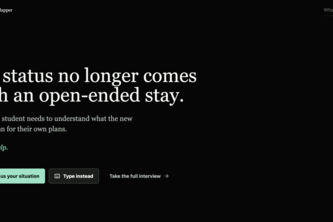
The description states that F-1 Duration Mapper is a web-based tool designed to help international students understand how new U.S. immigration rules affect their ability to remain in the country. It takes student inputs about their situation and provides personalized guidance based on the new fixed-period admission system for F-1 visas.
The tool uses AI to process information from students, converting unstructured stories into structured facts, and then applies a deterministic rules engine to determine legal implications. It is described as not being a replacement for DSO advice but rather a triage tool that absorbs routine questions so DSOs can focus on complex cases.
The description states the tool includes:
- A guided intake process where students can speak, type, or take an interview
- Structured fact extraction using GPT-5.6 Luna
- A temporal case model that tracks completed programs, current training, travel, and future study
- Source-linked regulatory citations
- Deterministic legal reasoning with strict structured outputs
The tool is built using React 19, TypeScript, Vite, Netlify Functions, and OpenAI APIs.
Positioning & Claim Evolution
The description states the product is positioned as a tool to help students navigate complex immigration rules that are changing rapidly. The author frames it as a response to the fact that students often don't understand these rules until they're too late, with information reaching them slowly through informal channels.
The claim evolution appears to be:
- A problem exists: Students don't understand new immigration rules in time
- A solution is needed: A tool that can provide personalized guidance quickly
- The approach: Using AI to process student stories and apply regulatory logic
- The value proposition: Reducing DSO workload while providing students with clarity
The description states this is a "decision tree" over precise regulatory text, not a chatbot with vibes about immigration law. It's described as being built by someone whose day job is being accountable for getting these answers right.
Target Customer & ICP
The description states that the tool serves two audiences:
- International students who need to understand how new rules affect their ability to stay in the U.S.
- Designated School Officials (DSOs) who want to triage routine questions so they can focus on complex cases
The target customer is described as international students affected by the new F-1 visa rules, particularly those who are:
- In valid F-1 status on September 15, 2026
- Subject to the new fixed-period admission system
- Need guidance about deadlines and actions they should take
The description states that the tool is designed for students who don't yet grasp the details of the rules but will need to act quickly before September 15.
Business Model & Pricing Evidence
Not evidenced. The description does not state any pricing model, revenue streams, or business model information.
Technical & Delivery Signals
The description states that the tool was built using:
- Frontend: React 19, TypeScript, Vite, Vitest
- Backend: Netlify Functions, OpenAI Responses API
- AI components: GPT-5.6 Luna for intake extraction, GPT-5.6 Sol for final advisor report
- Infrastructure: GitHub for repository, Netlify for deployment
- Additional features: Browser speech recognition, Web Audio API for oscilloscope
The description states that the regulatory core was translated into a deterministic TypeScript engine that produces consistent classifications and citations. The tool uses strict structured outputs to constrain intake and follow-ups.
The description states that Codex accelerated development by scaffolding the first rules engine, tracing regulatory text into source-linked logic, and building test suites. It mentions 112 passing tests across eight files.
Traction & Maturity Signals
Not evidenced. The description does not state any customer base, usage metrics, revenue, or traction data beyond what the author describes about the development process.
Competitive Context
Not evidenced. The description does not mention any competitors or competitive landscape.
Open Questions & Risks
The description states several risks and open questions:
- The tool was built in under four days for a single rule change, suggesting it's a prototype
- The new rule is "brand new" with edge cases that are still live and unsettled
- Legal consequences are described as being explicit in some areas but implementation details remain unsettled
- The app does not turn uncertainty into confidence - it preserves partial dates as estimates and identifies missing facts or future guidance needed
- The tool is described as being "what I'd like in their hands before they find out" suggesting it's not yet widely available or used
- The author states the complete problem could become an entire international-student compliance platform, but this version focuses on one rule, one student, and one connected case
Questions the description leaves open
- What is the actual timeline for when students will begin using this tool? Is there a launch date or deployment plan?
- How does the tool handle uncertainty in the regulatory environment where some legal consequences are still unsettled by agencies?
- What specific regulatory sources were used to build the deterministic rules engine, and how are they maintained?
- How is the tool being distributed to students and DSOs? Is there a distribution strategy beyond the prototype?
- What happens when the tool encounters contradictions in student input that cannot be resolved through follow-up questions?
- How does the tool distinguish between what it can calculate deterministically versus what requires human judgment or agency discretion?
- What is the plan for maintaining and updating the tool as regulations change over time?
Overall Assessment
Not evidenced. The description does not state any investment interest, partnership discussions, or commercial viability beyond the author's own account of building a prototype in four days.
The author states this sits inside a larger portfolio of tools they've built as a practicing DSO, but does not describe any commercialization strategy or market opportunity beyond their own practice. The tool is described as being for "smaller, lower resourced schools that enterprise SaaS overlooks," suggesting it may be positioned for educational institutions rather than direct consumer use.
The description states this was submitted to the OpenAI 2026 hackathon, indicating it's a prototype or proof-of-concept project rather than a commercial product. There is no evidence of any revenue model, customer base, or traction data beyond the author's own account.
User Stories BotA demo video on every pull request
Get a demo video on every new feature
GitHub App that watches your pull requests and records a narrated, captioned demo.
Save time on demo prep and make informed decisions faster with a video walkthrough of every new feature.
Source
Submitted to the OpenAI 2026 hackathon on Devpost. Project home on Devpost. Back to the full gallery on Devpost.
This competitive analysis was produced by top-founders.com (opens in a new tab)
Generated by a language model from this project's public Devpost page — its tagline, the author's own write-up and any built-with tags listed there — as captured in August 2026. Short quotations are the author's words. It is an opinion on the idea as a business, not on the people behind it, and it reflects the description as published then. If the project has moved on, request a correction below. The analysis is not independent research and contains no verified traction, revenue or customer data.
An independent guide by KFG International LLC — not affiliated with, endorsed by, or connected to Devpost or OpenAI.