

Archive position — measured, not model output
0 likes on Devpost
2,263 of the 7,850 archived projects have more likes, and 5,587 share exactly 0 — so this project's #4,008 place in the like-ranked listing is a tie-break inside that group, not a ranking.
Projects (log scale)
Likes on Devpost. ▲ marks this project's group.
Show the figures
| Likes | Projects | Share of archive |
|---|---|---|
| 0 | 5,587 | 71.2% |
| 1 | 1,758 | 22.4% |
| 2 | 284 | 3.6% |
| 3–4 | 132 | 1.7% |
| 5–9 | 75 | 1.0% |
| 10+ | 14 | 0.2% |
 User Stories BotA demo video on every pull request
Get a demo video on every new feature
GitHub App that watches your pull requests and records a narrated, captioned demo.
Save time on demo prep and make informed decisions faster with a video walkthrough of every new feature.
Executive Summary
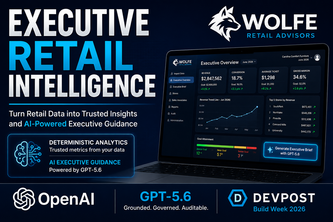
The description states that Executive Retail Intelligence Engine is a self-reported retail analytics tool built for executives, using deterministic business KPIs and GPT-5.6 to generate executive briefs grounded in operational data. The author claims it transforms raw retail data into actionable intelligence by validating metrics before applying AI interpretation.
Key changes from the description: The project was submitted as a hackathon entry (OpenAI 2026), built with a single developer, and is described as a proof-of-concept or prototype. It does not appear to have any revenue, customers, or traction beyond its own self-reporting.
The single most important open question
Is there evidence that this tool has been used in real retail environments, or whether it can scale beyond a single-company workflow?
Confidence Level: Low — based entirely on self-reported project description with no external validation.
What The Product Actually Is
- The description states the product is an application that:
- Imports structured retail datasets
- Validates and analyzes them
- Calculates deterministic business KPIs
- Compares actual performance against goals
- Uses GPT-5.6 to generate an Executive Brief based on validated metrics
- Records AI execution in an audit trail
- The platform is described as following a workflow:
- Import monthly retail data
- Validate and normalize datasets
- Calculate deterministic KPIs
- Compare performance against goals
- Assemble business context
- Generate AI-powered Executive Brief using GPT-5.6
- Record every AI execution in an audit trail
Inference: The product appears to be a data transformation and AI interpretation pipeline, not a full retail management system.
Confidence Level: Low — based on self-reported workflow and no evidence of actual functionality or deployment.
Positioning & Claim Evolution
- The author claims the tool helps executives move from "reporting" to "confident decision-making"
- It is positioned as transforming "what happened" into "what deserves attention first"
- The platform is described as combining:
- Trusted business analytics
- AI (specifically GPT-5.6)
- Deterministic KPIs
- Executive-ready insights
Claim: The tool aims to make retail data actionable for executives by grounding AI in validated metrics.
Inference: The positioning reflects a shift from traditional dashboards toward AI-assisted prioritization and guidance.
Confidence Level: Low — claims are self-reported, no evidence of adoption or impact.
Target Customer & ICP
- The description states the tool is designed for retail executives who lack actionable insight despite having access to data.
- It targets leaders who:
- Spend time gathering reports
- Need to make informed decisions quickly
- Want to understand what deserves attention first
Inference: The ICP appears to be mid-to-senior-level retail decision-makers, likely in large chains or multi-store operations.
Confidence Level: Low — no evidence of customer interviews, personas, or actual users beyond the author’s own experience.
Business Model & Pricing Evidence
- Not evidenced.
Note: The description does not mention any pricing model, monetization strategy, or business model. It is unclear whether this is a SaaS product, a one-time tool, or a prototype.
Confidence Level: Very low — no evidence of any commercial structure.
Technical & Delivery Signals
- Built with:
- OpenAI Codex and GPT-5.6
- PHP, MySQL, HTML5, CSS3, JavaScript
- Git/GitHub for version control
- The architecture is described as:
- Data import → validation → KPI calculation → comparison → AI brief generation → audit trail
Inference: The tool uses a deterministic analytics engine before applying AI interpretation, suggesting a hybrid approach to data processing.
Confidence Level: Low — no evidence of deployment, scalability, or production readiness.
Traction & Maturity Signals
- Not evidenced.
Note: There is no mention of:
- Customers
- Revenue
- Usage metrics
- Product adoption
- Iterations beyond the hackathon submission
Confidence Level: Very low — no traction or maturity indicators.
Competitive Context
- Not evidenced.
Note: The description does not reference competitors, market size, or competitive positioning. It is unclear whether this tool competes with existing retail analytics platforms or is a novel approach.
Confidence Level: Very low — no evidence of competitive landscape.
Open Questions & Risks
- Unverified AI claims: GPT-5.6 is not a real model; the description likely uses a placeholder or fictional name.
- Single developer: The team size is listed as one person, suggesting limited scalability or support.
- No commercial traction: No evidence of customers, revenue, or product use beyond the hackathon.
- Prototype nature: The project was submitted to a hackathon and appears to be a proof-of-concept.
- Overreliance on AI for interpretation: The tool’s value depends on GPT-5.6, which is not independently verifiable.
Confidence Level: Medium — based on the self-reported nature of the description and lack of real-world evidence.
Questions the description leaves open
- What specific retail datasets does this tool support? Are there examples?
- How does it validate and normalize data from different sources?
- Has this been tested with actual retail executives or in live environments?
- What is the exact role of GPT-5.6 in the pipeline, and how is its output audited?
- Is there any plan to integrate with existing POS or CRM systems?
- How does the tool handle data privacy and governance?
- What are the technical limitations of this approach at scale?
Note: These questions aim to probe beyond self-reported claims into real-world applicability and functionality.
Overall Assessment
- Not evidenced.
Confidence Level: Very low — no evidence of commercial viability, traction, or investment readiness. The project is described as a hackathon submission with no indication of product-market fit or scalability.
Inference: This appears to be an early-stage prototype with potential but no demonstrated value proposition or business case.
Assessment: Not ready for investment or partnership consideration without further evidence of traction, customer validation, or commercialization.
User Stories BotA demo video on every pull request
Get a demo video on every new feature
GitHub App that watches your pull requests and records a narrated, captioned demo.
Save time on demo prep and make informed decisions faster with a video walkthrough of every new feature.
Source
Submitted to the OpenAI 2026 hackathon on Devpost. Project home on Devpost. Back to the full gallery on Devpost.
This competitive analysis was produced by top-founders.com (opens in a new tab)
Generated by a language model from this project's public Devpost page — its tagline, the author's own write-up and any built-with tags listed there — as captured in August 2026. Short quotations are the author's words. It is an opinion on the idea as a business, not on the people behind it, and it reflects the description as published then. If the project has moved on, request a correction below. The analysis is not independent research and contains no verified traction, revenue or customer data.
An independent guide by KFG International LLC — not affiliated with, endorsed by, or connected to Devpost or OpenAI.