

Archive position — measured, not model output
0 likes on Devpost
2,263 of the 7,850 archived projects have more likes, and 5,587 share exactly 0 — so this project's #3,971 place in the like-ranked listing is a tie-break inside that group, not a ranking.
Projects (log scale)
Likes on Devpost. ▲ marks this project's group.
Show the figures
| Likes | Projects | Share of archive |
|---|---|---|
| 0 | 5,587 | 71.2% |
| 1 | 1,758 | 22.4% |
| 2 | 284 | 3.6% |
| 3–4 | 132 | 1.7% |
| 5–9 | 75 | 1.0% |
| 10+ | 14 | 0.2% |
 User Stories BotA demo video on every pull request
Get a demo video on every new feature
GitHub App that watches your pull requests and records a narrated, captioned demo.
Save time on demo prep and make informed decisions faster with a video walkthrough of every new feature.
Executive Summary
What the company appears to be
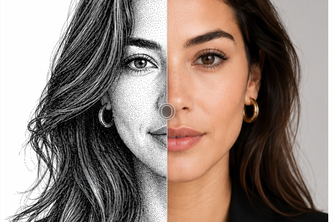
Etchr is a self-reported product that transforms one real photograph into a premium editorial portrait pack using generative AI. The founder, Steve Hole, built it through a collaboration with GPT-5.6 and Codex, focusing on preserving identity while creating publication-ready images.
What changed
The project description indicates a shift from an idea carried for years to a working prototype completed during Build Week. It evolved from a personal curiosity about editorial portraits into a functional product with a defined workflow and visual quality system.
Single most important open question
Is there evidence of traction, revenue, or customer adoption beyond the founder's own use and testing?
What The Product Actually Is
The description states that Etchr "transforms one real photograph into a premium editorial portrait." It delivers five formats (Profile, Square, Portrait, Story, Landscape) from a single input. The process includes:
- Upload of a real photograph
- Confirmation of image rights and framing
- Creation of a private editorial portrait
- Comparison between original and result
- Saving or sharing the portrait
- Delivery of a practical portrait pack
The system uses a "canonical facial-registration system" to align original and finished portraits within one stable frame, ensuring likeness is preserved during artistic transformation.
Evidence The author describes how the product works, including its technical components (e.g., GPT-5.6, Codex), visual workflow, and output formats.
Inference The product appears to be a single-user tool for personal branding or identity presentation, not a commercial service with customers or revenue streams.
Positioning & Claim Evolution
The description states that Etchr is built around the belief: "Everyone deserves one photograph they are genuinely proud to use." It positions itself as:
- Not a replacement for photographers or artists
- Not another generic AI avatar app
- Not trying to invent artificial people
- Focused on creating portraits that look like the subject but feel more refined and timeless
It emphasizes:
- Confidence over features
- Preservation of identity
- Craftsmanship behind technology
- Restraint as a competitive advantage
Evidence The founder's own words describe the positioning and intent.
Inference This is a self-positioned product for personal use, not yet proven in market or customer-facing terms.
Target Customer & ICP
The description states that Etchr is intended for:
- LinkedIn profiles
- Company profiles
- Speaker bios
- Personal websites
- Social media
- Editorial use
- Personal branding
It targets individuals who want one photograph they are proud to use, especially those seeking something "recognizable enough to feel true" and "designed enough to stand out."
Evidence The author lists specific platforms and use cases.
Inference No evidence of actual customers or user segments beyond the founder’s personal vision.
Business Model & Pricing Evidence
The description states that Etchr is not a commercial product yet, but it mentions:
- StoreKit integration
- Stripe for payments
- A "purchase-to-generation lifecycle" planned for launch
- The goal to "complete the StoreKit purchase-to-generation lifecycle"
There is no mention of pricing tiers, subscription models, or monetization strategy.
Evidence The author describes technical infrastructure related to payment processing and app store submission.
Inference No evidence of a functioning business model or pricing structure; this remains speculative.
Technical & Delivery Signals
The project was built using:
- GPT-5.6
- Codex
- React, TypeScript, Node.js, PostgreSQL, Supabase, Vercel
- iOS (Swift, Xcode, StoreKit), web app (Capacitor)
- Playwright for automation
- OpenAI APIs
It includes:
- A canonical facial-registration system
- Founder Review system with approval/revision/exclude logic
- Private benchmarking of 30 pairs across multiple subject types
- Native iOS and web deployment coordination
Evidence The author lists technologies used and describes the development process.
Inference Technical capabilities are described, but no evidence of production systems or scalability.
Traction & Maturity Signals
The description states:
- A 30-pair benchmark was completed
- 29 outputs received founder visual approval
- One output was marked for revision due to misleading comparison
- The product is being prepared for App Store launch
- It includes a private Founder Review system
- The team size is one (Steve Hole)
There is no mention of:
- Customers or users
- Revenue or monetization
- Adoption metrics
- Product usage data
Evidence The author describes internal testing, benchmarks, and readiness for launch.
Inference No evidence of traction or customer engagement beyond the founder’s own use.
Competitive Context
The description does not mention competitors directly. However, it implies a space where:
- Generative AI tools exist
- Editorial portrait creation is possible but limited to professionals
- Personal branding and identity presentation are growing trends
It positions itself as distinct from generic avatar apps or AI-generated avatars.
Evidence The author contrasts Etchr with other tools and markets.
Inference No evidence of competitive analysis, market positioning against known players, or differentiation in the marketplace.
Open Questions & Risks
- Founder-only development: Only one person built the product; no team or external validation.
- No revenue or customer data: No evidence of monetization, users, or adoption.
- Unproven commercial viability: The product is described as a prototype, not a launched service.
- Self-reported quality control: The "Founder Review" system may lack independent verification.
- Limited scalability claims: No evidence of infrastructure for scaling beyond one developer.
Evidence The description highlights the founder’s role and internal processes without external validation.
Inference Risk of overstatement or misalignment between self-perception and real-world traction.
Questions the description leaves open
- What is the current status of the App Store launch? Is it live or in review?
- Have you tested the product with any users beyond yourself?
- How do you plan to scale beyond a single developer?
- What is your strategy for monetization and pricing?
- Can you provide examples of how the canonical facial registration system works in practice?
- How are you handling privacy, data ownership, and publication rights?
- What are the key performance indicators (KPIs) you track for product success?
Overall Assessment
Not evidenced.
The description is entirely self-reported and unverified. There is no evidence of:
- Revenue
- Customers
- Traction
- Market validation
- Product-market fit
- Financials or funding rounds
This is a founder-led prototype with strong technical execution described but no commercial proof.
Confidence level Low — based on thin, self-reported evidence only.
Conclusion
Etchr appears to be an experimental, founder-driven project that has not yet demonstrated market traction or commercial viability. It may represent a promising idea, but there is insufficient evidence to assess its readiness for investment or partnership.
User Stories BotA demo video on every pull request
Get a demo video on every new feature
GitHub App that watches your pull requests and records a narrated, captioned demo.
Save time on demo prep and make informed decisions faster with a video walkthrough of every new feature.
Source
Submitted to the OpenAI 2026 hackathon on Devpost. Project home on Devpost. Back to the full gallery on Devpost.
This competitive analysis was produced by top-founders.com (opens in a new tab)
Generated by a language model from this project's public Devpost page — its tagline, the author's own write-up and any built-with tags listed there — as captured in August 2026. Short quotations are the author's words. It is an opinion on the idea as a business, not on the people behind it, and it reflects the description as published then. If the project has moved on, request a correction below. The analysis is not independent research and contains no verified traction, revenue or customer data.
An independent guide by KFG International LLC — not affiliated with, endorsed by, or connected to Devpost or OpenAI.