

Archive position — measured, not model output
1 like on Devpost
505 of the 7,850 archived projects have more likes, and 1,758 share exactly 1 — so this project's #1,015 place in the like-ranked listing is a tie-break inside that group, not a ranking.
Projects (log scale)
Likes on Devpost. ▲ marks this project's group.
Show the figures
| Likes | Projects | Share of archive |
|---|---|---|
| 0 | 5,587 | 71.2% |
| 1 | 1,758 | 22.4% |
| 2 | 284 | 3.6% |
| 3–4 | 132 | 1.7% |
| 5–9 | 75 | 1.0% |
| 10+ | 14 | 0.2% |
 User Stories BotA demo video on every pull request
Get a demo video on every new feature
GitHub App that watches your pull requests and records a narrated, captioned demo.
Save time on demo prep and make informed decisions faster with a video walkthrough of every new feature.
Executive Summary
What the company appears to be
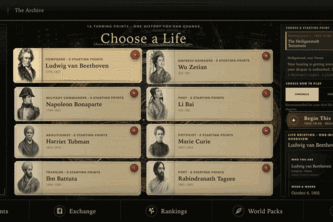
EPITAPH (千秋) is an AI-driven historical narrative roguelite game for Steam, built by a single developer (Leewaytor Li). It allows players to reincarnate as documented historical figures at pivotal moments in their lives, with gameplay centered on navigating fate through a deterministic engine and AI-generated narration. The game features three play modes: Chronicle (short auto-biography), Fate Cards (controller-first), and Immersive (full RPG). It uses an architecture where AI only narrates outcomes that are already committed by a deterministic engine, and includes tools for replayability, verification, and modularity.
What changed
The project is a self-contained game built as part of the OpenAI 2026 hackathon. The author states it was designed to avoid common pitfalls in AI games — such as infinite text with no stakes — by grounding gameplay in deterministic mechanics and using AI only for narrative generation.
Single most important open question
Is there a viable commercial or growth path beyond a single-person indie project, especially given the niche nature of the genre and the lack of any evidence of traction, revenue, or user base?
What The Product Actually Is
The description states that EPITAPH is an AI-driven historical narrative roguelite. It is built as a Steam game, with three distinct play modes:
- Chronicle: 8–15 minutes, offline auto-biography.
- Fate Cards: Reigns-style, controller-first, offline.
- Immersive: 90–180 minutes, full RPG driven by a live model.
Players are reborn as historical figures (e.g., Beethoven, Wu Zetian) at pivotal moments in their lives. They begin with:
- Their modern memory.
- The figure’s already-written future, represented as a deck of decaying prophecy cards.
Gameplay mechanics include:
- Two axes: HP and SAN (心神).
- Death is a real ending; SAN can deplete, causing the player to lose themselves.
- Epitaph Diff: a side-by-side comparison of the real encyclopedia entry and the life played, with changes highlighted.
- Points are earned and used to buy soul talents for reincarnation.
The game uses:
- A deterministic engine backed by SQLite and SHA-256 hash chains.
- AI only for narration; mechanical outcomes are committed before AI involvement.
- Tools like MCP server to allow AI agents to play the game as an agent, while maintaining deterministic control.
Not evidenced: actual gameplay footage, user reviews, monetization strategy, or any commercial data.
Positioning & Claim Evolution
The author states that EPITAPH was built in response to what they call “AI games” that are merely chatbots in a costume — infinite text, zero stakes. The positioning is:
- A historical narrative roguelite.
- Grounded in foreknowledge as a resource, with history as pressure and death as real consequence.
- AI is used for narration only, not mechanical control.
The claim evolution shows:
- Initial inspiration: dissatisfaction with current AI games.
- Core positioning: a game where the player’s knowledge of history becomes a gameplay mechanic.
- Evolution toward a hybrid deterministic-AI architecture to ensure verifiability and replayability.
Not evidenced: any market positioning beyond the author's own description, or evidence of how this positions against competitors.
Target Customer & ICP
The description states that EPITAPH is aimed at:
- Players who enjoy historical narratives.
- Fans of roguelite mechanics.
- Gamers interested in AI-generated storytelling with a deterministic core.
- Players who value replayability and verification.
The game is designed for:
- Players who want to reincarnate as historical figures.
- Those who enjoy deep, meaningful choices with consequences.
- Users who are comfortable with offline play modes (Chronicle and Fate Cards).
Not evidenced: actual user data, demographics, or customer segmentation.
Business Model & Pricing Evidence
The description states:
- The game is built for Steam launch.
- It includes a ranked tier ("Official") and a UGC world pack system.
- There are three play modes, each with different fidelity levels.
No pricing information, monetization strategy, or revenue model is provided. The author mentions:
- A live hosted "Official" ranked tier.
- Workshop UGC world packs with fail-closed moderation.
Not evidenced: pricing tiers, in-game purchases, subscriptions, or any commercial structure beyond the vague mention of a Steam launch.
Technical & Delivery Signals
The project is built as a TypeScript pnpm monorepo using:
- React 19 + Vite
- Electron shell
- Fastify API
- SQLite with SHA-256 hash chains
- Ed25519-signed receipts for verification
AI components include:
- OpenAI Chat Completions and Responses API
- Anthropic, Gemini
- Codex (as in-game agent)
- MCP server to expose game tools as AI agents
- A2A character agents with A2UI surface
Key technical signals:
- Commit-then-narrate architecture.
- AI only narrates outcomes already committed by deterministic engine.
- Replayability and verification are core features.
- Security measures include:
- Server-only providers
- Secrets brokered through macOS Keychain
- Electron fuses, ASAR integrity
Not evidenced: actual performance data, scalability, or deployment details beyond the architecture.
Traction & Maturity Signals
The description states:
- The project was built for the OpenAI 2026 hackathon.
- It is a single-person project (Leewaytor Li).
- The author claims to have accomplished:
- A deterministic-AI architecture.
- Full English/简体中文 switching mid-life.
- One plugin package that works in both Codex and Claude Code.
No evidence of:
- User base or engagement metrics.
- Revenue or monetization.
- Public playtesting or feedback.
- Any form of traction beyond the hackathon submission.
Competitive Context
The description does not provide any information about:
- Direct competitors.
- Market positioning relative to other roguelites or historical narrative games.
- AI game trends or how EPITAPH fits into them.
Not evidenced: competitive analysis, market size, or positioning against similar products.
Open Questions & Risks
- Single-person development: The project is built by one developer (Leewaytor Li), which raises questions about scalability and long-term maintenance.
- Niche genre: Historical narrative roguelites are a small niche; it’s unclear how the game will attract a broad audience.
- No commercial traction or monetization strategy: No evidence of revenue, users, or monetization beyond a Steam launch.
- High technical complexity: The architecture is complex (deterministic engine + AI narration), which may slow development or limit future expansion.
- Unproven market demand: There’s no evidence that the target audience exists in sufficient numbers to support a commercial game.
Questions the description leaves open
- What is your plan for monetization beyond a Steam launch?
- How do you intend to attract and retain players in a niche genre like historical roguelites?
- Do you have any plans for community or UGC features beyond the Workshop packs mentioned?
- How do you plan to scale beyond a single developer?
- What is your roadmap for expanding the number of historical figures or play modes?
- Have you considered how AI-generated content will be managed in terms of quality and consistency?
- Are there any partnerships or distribution strategies planned with Steam or other platforms?
Overall Assessment
The description states that EPITAPH is a single-person indie project built for the OpenAI 2026 hackathon. It has a unique technical architecture that separates AI narration from mechanical control, but there is no evidence of:
- Revenue
- Users
- Traction
- Commercial viability beyond a Steam launch
The project is self-reported, and the author’s own account does not include any data on monetization, customer base, or market demand.
Assessment: Not evidenced. The project shows strong technical execution and a clear vision for a niche genre, but lacks commercial signals or evidence of traction to support an investment or partnership decision at this stage.
User Stories BotA demo video on every pull request
Get a demo video on every new feature
GitHub App that watches your pull requests and records a narrated, captioned demo.
Save time on demo prep and make informed decisions faster with a video walkthrough of every new feature.
Source
Submitted to the OpenAI 2026 hackathon on Devpost. Project home on Devpost. Back to the full gallery on Devpost.
This competitive analysis was produced by top-founders.com (opens in a new tab)
Generated by a language model from this project's public Devpost page — its tagline, the author's own write-up and any built-with tags listed there — as captured in August 2026. Short quotations are the author's words. It is an opinion on the idea as a business, not on the people behind it, and it reflects the description as published then. If the project has moved on, request a correction below. The analysis is not independent research and contains no verified traction, revenue or customer data.
An independent guide by KFG International LLC — not affiliated with, endorsed by, or connected to Devpost or OpenAI.