

Archive position — measured, not model output
0 likes on Devpost
2,263 of the 7,850 archived projects have more likes, and 5,587 share exactly 0 — so this project's #3,952 place in the like-ranked listing is a tie-break inside that group, not a ranking.
Projects (log scale)
Likes on Devpost. ▲ marks this project's group.
Show the figures
| Likes | Projects | Share of archive |
|---|---|---|
| 0 | 5,587 | 71.2% |
| 1 | 1,758 | 22.4% |
| 2 | 284 | 3.6% |
| 3–4 | 132 | 1.7% |
| 5–9 | 75 | 1.0% |
| 10+ | 14 | 0.2% |
 User Stories BotA demo video on every pull request
Get a demo video on every new feature
GitHub App that watches your pull requests and records a narrated, captioned demo.
Save time on demo prep and make informed decisions faster with a video walkthrough of every new feature.
Executive Summary
What the company appears to be
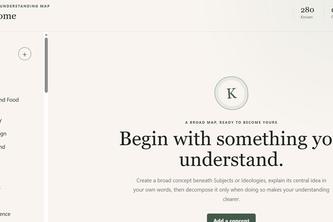
Epistome is a self-reported personal knowledge management tool that structures user understanding into an interactive hierarchy of concepts. The author states it organizes knowledge not just as notes but as a model of what someone knows, what they're learning, and how concepts connect.
What changed
This project was submitted to the OpenAI 2026 hackathon by one person (John Ding). It is described as an experimental system built in a short timeframe with no evidence of prior traction or commercialization.
Single most important open question
Is there any evidence that users actually engage with Epistome beyond its initial development, or that it has been adopted by others?
What The Product Actually Is
The description states that Epistome is a tool for organizing personal knowledge into an interactive hierarchy of concepts. It allows users to:
- Record concepts they understand
- Expand concepts into subtopics
- Track areas known, partially understood, or unexplored
- View definitions within explanations
- Navigate concept relationships visually
- Give AI agents structured context about the user's existing knowledge
The system is built with a backend for managing knowledge structure, an AI-assisted expansion system, and an interactive frontend. It uses technologies including Codex, FastAPI, OpenAI, Python, React, SQLite, TypeScript, and Vite.
Evidence The author describes how Epistome works in detail, including its layered architecture and use of AI for reasoning tasks like suggesting subtopics and generating explanations.
Inference Based on the description, Epistome appears to be a prototype or proof-of-concept rather than a fully developed product. It is not evidenced as having reached market readiness or user adoption.
Positioning & Claim Evolution
The author positions Epistome as a tool that models personal understanding—not just storing information but reflecting how someone actually comprehends it. The tagline “Map what you know” suggests mapping one’s own knowledge state.
Key claims include:
- It represents knowledge more than a list of notes
- It can model both knowledge and knowledge gaps
- It preserves terminology without overcrowding the graph
- It provides AI agents with explicit information about user understanding
The project evolved from an idea to build a structured, evolving record of personal knowledge. The author emphasizes distinguishing between concepts and embedded terms, which keeps the structure understandable while preserving vocabulary.
Evidence All claims are self-reported by the author; there is no external validation or demonstration of these features beyond the description.
Inference The positioning reflects a niche market need for personal knowledge modeling, but lacks evidence of traction or competitive differentiation in practice.
Target Customer & ICP
The target customer appears to be individuals who want to organize and understand their own knowledge—likely students, researchers, professionals seeking continuous learning, or AI enthusiasts. The system is designed for personal use rather than enterprise adoption.
The author does not specify a precise ICP beyond the general category of people interested in structured knowledge representation.
Evidence The description focuses on individual users and their understanding of concepts, but gives no indication of segmentation or targeting specific user types.
Inference Without further evidence, it is unclear whether Epistome targets any particular demographic or professional group. It seems aimed at a broad audience of self-directed learners.
Business Model & Pricing Evidence
There is no evidence provided about pricing, monetization strategy, or business model. The description does not mention any revenue streams, subscriptions, or commercial offerings.
Evidence Not evidenced.
Inference Given that this is a hackathon submission and the only team member is one person (John Ding), it's likely not yet monetized or even launched as a product.
Technical & Delivery Signals
Epistome is built using modern web technologies including React, TypeScript, Python, FastAPI, SQLite, and OpenAI APIs. It uses Codex for AI assistance and Vite for development.
The system separates knowledge management into three layers:
- Backend for storing and managing the knowledge structure
- AI-assisted expansion system
- Interactive frontend
It is designed to allow both human editing and machine-readable context, with AI acting as a structured collaborator rather than source of truth.
Evidence The author describes the technical stack and architecture in detail.
Inference The tech stack suggests a lightweight, developer-focused approach. However, there is no evidence that it has been scaled or deployed beyond prototype status.
Traction & Maturity Signals
There is no evidence of user traction, adoption, or product maturity. The project was submitted to a hackathon and built by one person (John Ding). No data on users, retention, usage metrics, or product iterations are available.
Evidence Not evidenced.
Inference This is clearly an early-stage prototype with no indication of real-world engagement or market validation.
Competitive Context
The author does not reference competitors. The description does not mention existing tools for personal knowledge management such as Notion, Obsidian, Roam Research, or similar platforms.
Evidence Not evidenced.
Inference Without knowing the competitive landscape, it's impossible to assess whether Epistome offers unique value or addresses unmet needs in the space.
Open Questions & Risks
- Single founder: The project is built by one person (John Ding), raising questions about scalability and long-term maintenance.
- No traction: No evidence of users, adoption, or product usage beyond the hackathon submission.
- Unproven market demand: While the idea seems interesting, there's no indication that users actually need this type of tool.
- Limited scope: The system is described as a prototype and lacks features like import/export capabilities, multi-user support, or integration with other tools.
- AI dependency: Reliance on AI for expansion raises concerns about consistency, accuracy, and control over content.
Evidence These are inferred from the lack of evidence regarding users, product development, or market validation.
Questions the description leaves open
- What specific problem does Epistome solve that current tools don’t?
- Have you tested Epistome with real users? If so, what feedback did they give?
- How do you plan to scale beyond a single developer?
- Are there any existing users or early adopters of Epistome?
- What are the key challenges in making this tool usable for non-developers?
- How does Epistome handle contradictions or inconsistencies in user knowledge?
- What is your roadmap for monetization, if any?
Overall Assessment
There is no evidence that Epistome has reached a stage where investment or partnership would be appropriate. It is described as a hackathon project built by one person with no indication of traction, revenue, or product-market fit.
Evidence Not evidenced.
Inference At this point, Epistome is an experimental idea with potential but not yet validated in the market. Any investment or partnership would require significant due diligence into its future development and user engagement.
User Stories BotA demo video on every pull request
Get a demo video on every new feature
GitHub App that watches your pull requests and records a narrated, captioned demo.
Save time on demo prep and make informed decisions faster with a video walkthrough of every new feature.
Source
Submitted to the OpenAI 2026 hackathon on Devpost. Project home on Devpost. Back to the full gallery on Devpost.
This competitive analysis was produced by top-founders.com (opens in a new tab)
Generated by a language model from this project's public Devpost page — its tagline, the author's own write-up and any built-with tags listed there — as captured in August 2026. Short quotations are the author's words. It is an opinion on the idea as a business, not on the people behind it, and it reflects the description as published then. If the project has moved on, request a correction below. The analysis is not independent research and contains no verified traction, revenue or customer data.
An independent guide by KFG International LLC — not affiliated with, endorsed by, or connected to Devpost or OpenAI.