

Archive position — measured, not model output
0 likes on Devpost
2,263 of the 7,850 archived projects have more likes, and 5,587 share exactly 0 — so this project's #3,951 place in the like-ranked listing is a tie-break inside that group, not a ranking.
Projects (log scale)
Likes on Devpost. ▲ marks this project's group.
Show the figures
| Likes | Projects | Share of archive |
|---|---|---|
| 0 | 5,587 | 71.2% |
| 1 | 1,758 | 22.4% |
| 2 | 284 | 3.6% |
| 3–4 | 132 | 1.7% |
| 5–9 | 75 | 1.0% |
| 10+ | 14 | 0.2% |
 User Stories BotA demo video on every pull request
Get a demo video on every new feature
GitHub App that watches your pull requests and records a narrated, captioned demo.
Save time on demo prep and make informed decisions faster with a video walkthrough of every new feature.
Executive Summary
What the company appears to be
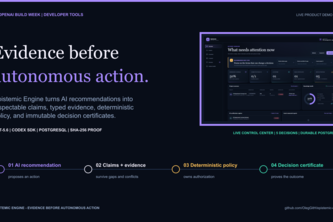
Epistemic Engine is a self-reported system that claims to provide a "verification layer" for AI agents. It is described as a tool that breaks down agent decisions into atomic claims, binds typed evidence to each, and enforces deterministic policy-based outcomes before an action can proceed.
What changed
The project description indicates this is a single-person effort (Oleg Grishanovich) submitted to the OpenAI 2026 hackathon. It describes a working prototype built with Go, Next.js, Docker, Python, and GPT-5.6, deployed on Google Cloud.
Single most important open question
Is there any evidence of real-world adoption or integration beyond this self-reported demo?
What The Product Actually Is
The description states that Epistemic Engine is a system designed to verify AI agent decisions before they act. It breaks down an agent’s recommendation into atomic claims, binds typed evidence to each, and tracks contradictions and unknowns.
It includes:
- A control plane built in Go for event ingestion, claim processing, contradiction tracking, verification orchestration, and policy evaluation.
- A web UI built with Next.js, React, and React Flow that visualizes the decision process: execution timeline, claim graph, evidence inspector, etc.
- Integration with GPT-5.6 for proposing epistemic objects (claims, contradictions, assumptions), but only after validation through JSON schema, domain rules, and policy checks.
- Codex-generated tests under strict constraints to perform verification.
- A deterministic policy engine returning one of five outcomes: VERIFIED, VERIFIED_WITH_CONDITIONS, INSUFFICIENT_EVIDENCE, CONTRADICTED, or REJECTED.
- Content-addressed Decision Certificates that include claims, evidence, verification results, and hashes for reproducibility.
Inference The system appears to be a proof-of-concept prototype built as part of a hackathon project. It is not evidenced to have been deployed in production or integrated into any existing workflows beyond the demo.
Positioning & Claim Evolution
The author states that Epistemic Engine addresses a gap in current observability tools — which answer “what did the agent do” but not “which claims justify this conclusion, what evidence supports them, and what contradicts them.”
It positions itself as:
- A verification layer for AI agents.
- A system that enforces deterministic decision-making over probabilistic confidence scores.
- A tool that makes decisions explainable and reproducible through content-addressed certificates.
The author also mentions a long-term vision: “Instrument once. Use any compatible engine. Display decisions in any interface. Gate any autonomous workflow.”
Inference This is a self-described positioning shift from generic AI observability to a structured, verifiable decision-making framework. No evidence of prior versions or market traction is provided.
Target Customer & ICP
The description does not name specific customers or use cases beyond the demo scenario involving pull requests and deployment safety.
However, it implies:
- Developers or DevOps teams working with AI agents in CI/CD pipelines.
- Organizations that want to gate autonomous actions based on verifiable claims.
- Teams looking for reproducible, explainable decision-making in agent workflows.
Inference The target ICP is likely software engineering teams using AI agents in development and deployment contexts. No evidence of actual customer interviews or use cases beyond the demo.
Business Model & Pricing Evidence
There is no mention of pricing, monetization strategy, or business model in the description.
Not evidenced
Technical & Delivery Signals
The system is built with:
- Go (control plane)
- Next.js / React / React Flow (UI)
- Docker
- Python (for agent SDK)
- GPT-5.6 (structured outputs)
- PostgreSQL (storage)
- Google Cloud (deployment)
It includes:
- Idempotent event ingestion
- Content-addressed storage of evidence and proofs
- Deterministic policy evaluation
- Restricted Codex execution for verification tests
- SSE for live updates
Inference The architecture is described as modular, with clear separation between AI modeling and application-level decision logic. It supports reproducibility and safety through deterministic components.
Traction & Maturity Signals
The project is presented as a hackathon submission (OpenAI 2026). The author states:
- It’s a working prototype.
- It includes a demo that shows the system in action.
- It has a long-term vision for adoption via an “Epistemic Protocol.”
There is no evidence of:
- Revenue
- Customers
- Product usage metrics
- Deployment beyond the demo
Inference This is a pre-product, pre-commercial stage prototype. No traction or maturity signals are evident.
Competitive Context
The description does not name competitors or reference existing tools in this space.
It implies that current AI observability tools do not address epistemic verification — i.e., the question of what justifies a decision rather than what happened.
Inference There is no evidence of direct competition. The author positions Epistemic Engine as solving a gap in agent decision-making, but no market context or competitive analysis is provided.
Open Questions & Risks
- Unproven commercial viability: No revenue, customers, or adoption data.
- Single-person team: Limited capacity for execution and scaling.
- Demo-only functionality: No evidence of integration into real workflows.
- High technical complexity: Requires tight control over AI outputs, verification, and policy enforcement — a significant engineering challenge.
- Unclear path to adoption: The long-term vision is described but not demonstrated in practice.
Inference The project is at an early stage. It may be technically sound, but there are no signs of real-world utility or commercial traction.
Questions the description leaves open
- What specific workflows or use cases have you tested this system with beyond the demo?
- How do you plan to scale verification for large-scale agent deployments?
- Are there any existing integrations or partnerships in place?
- What is your roadmap for monetization and product development?
- How do you intend to make the Epistemic Protocol accessible and interoperable across platforms?
Overall Assessment
Not evidenced
The project is described as a hackathon submission with no evidence of traction, revenue, or customer adoption. It presents an ambitious technical vision but lacks commercial signals.
Confidence Level Low This analysis is based entirely on the self-reported description provided by the author. No external validation or data exists to support any claims beyond what was written.
User Stories BotA demo video on every pull request
Get a demo video on every new feature
GitHub App that watches your pull requests and records a narrated, captioned demo.
Save time on demo prep and make informed decisions faster with a video walkthrough of every new feature.
Source
Submitted to the OpenAI 2026 hackathon on Devpost. Project home on Devpost. Back to the full gallery on Devpost.
This competitive analysis was produced by top-founders.com (opens in a new tab)
Generated by a language model from this project's public Devpost page — its tagline, the author's own write-up and any built-with tags listed there — as captured in August 2026. Short quotations are the author's words. It is an opinion on the idea as a business, not on the people behind it, and it reflects the description as published then. If the project has moved on, request a correction below. The analysis is not independent research and contains no verified traction, revenue or customer data.
An independent guide by KFG International LLC — not affiliated with, endorsed by, or connected to Devpost or OpenAI.