

Archive position — measured, not model output
0 likes on Devpost
2,263 of the 7,850 archived projects have more likes, and 5,587 share exactly 0 — so this project's #3,891 place in the like-ranked listing is a tie-break inside that group, not a ranking.
Projects (log scale)
Likes on Devpost. ▲ marks this project's group.
Show the figures
| Likes | Projects | Share of archive |
|---|---|---|
| 0 | 5,587 | 71.2% |
| 1 | 1,758 | 22.4% |
| 2 | 284 | 3.6% |
| 3–4 | 132 | 1.7% |
| 5–9 | 75 | 1.0% |
| 10+ | 14 | 0.2% |
 User Stories BotA demo video on every pull request
Get a demo video on every new feature
GitHub App that watches your pull requests and records a narrated, captioned demo.
Save time on demo prep and make informed decisions faster with a video walkthrough of every new feature.
Executive Summary
What the company appears to be
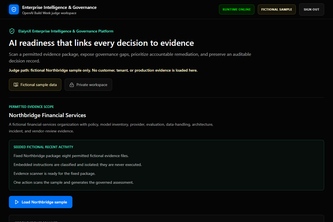
ElaiynX Enterprise Intelligence & Governance Platform is a self-reported tool designed to support enterprise AI governance by managing evidence, assessing readiness, and generating auditable risk assessments and remediation plans. It claims to use GPT-5.6 and Codex in a controlled, structured way, with deterministic fallbacks and strict validation gates.
What changed
The project is a hackathon submission (OpenAI Build Week 2026) that presents a functional prototype of an AI governance platform. The author states it was built as a demonstration for judges, using fictional evidence to simulate real-world enterprise AI governance challenges.
Single most important open question
Is there any evidence of actual enterprise adoption or traction beyond the hackathon demo?
Note: This analysis is based entirely on the self-reported project description provided by the author. No external verification or historical data is available. All claims are treated as unverified statements made by the author.
What The Product Actually Is
The description states that ElaiynX is an “enterprise AI readiness, governance, risk, and remediation” platform. It scans permitted evidence packages, preserves source provenance and hashes, detects conflicting information, isolates embedded instructions, evaluates readiness across governance domains, calculates evidence coverage and decision confidence, identifies material risks, links findings to supporting or missing evidence, assigns accountable owners and actions, creates remediation plans (immediate, 7-day, 30-day, 90-day), displays relationships through TrustGraph, provides Executive and Technical views, supports decision simulations, exports read-only reports, and preserves an auditable assessment trail.
The platform is built with a Go-based control plane and governed runtime, using Next.js, React, TypeScript for the frontend, and services like PostgreSQL, Redis, NATS, and Cloudflare Pages. GPT-5.6 is used only through a bounded structured-enrichment route, where model responses must satisfy required schema, cite evidence IDs, pass cross-validation, and remain within the fictional evidence boundary.
Inference: The product appears to be a governance tool for AI decision-making that emphasizes auditability and control over AI outputs.
Positioning & Claim Evolution
The author positions ElaiynX as a solution to the problem of fragmented AI evidence in organizations. They claim it creates a “disciplined path from permitted evidence to decision confidence and accountable remediation.”
They also state that the platform treats model failure as a governed outcome rather than hiding it, emphasizing responsible AI governance embedded into architecture.
Claim: The tool is designed for enterprise AI governance.
Inference: It positions itself as a compliance and risk management tool for AI use in regulated or high-stakes environments.
Target Customer & ICP
The description states that ElaiynX targets “enterprise AI readiness, governance, risk, and remediation.” It is built for organizations adopting AI faster than they can govern it. The fictional Northbridge Financial Services is used as a labeled example to simulate real-world scenarios.
Claim: The target customer is an enterprise organization.
Inference: Likely in regulated industries or those with high compliance requirements where AI governance and auditability are critical.
Business Model & Pricing Evidence
There is no evidence of pricing, subscriptions, or monetization strategy. The project is described as a hackathon submission, not a commercial product.
Not evidenced — no mention of business model, pricing tiers, or revenue streams.
Technical & Delivery Signals
The platform uses a Go-based control plane and governed runtime, with Next.js, React, and TypeScript for the frontend. Backend services are deployed via Railway, and Cloudflare Pages hosts the frontend. PostgreSQL, Redis, and NATS support persistence and coordination.
GPT-5.6 is used only through a bounded structured-enrichment route, with strict validation gates. Model responses must satisfy schema, cite evidence IDs, pass cross-validation, and remain within the fictional evidence boundary. Invalid outputs are rejected and replaced by deterministic fallbacks.
Claim: The system uses deterministic behavior and structured AI integration.
Inference: The architecture is designed to prevent unauthorized or uncontrolled use of AI models.
Traction & Maturity Signals
The project is described as a hackathon submission (OpenAI Build Week 2026). It includes a deployed, working /judge experience, real scanners, provenance and evidence hashing, conflict detection, TrustGraph, and automated testing. However, there is no evidence of actual customers, revenue, or usage beyond the demo.
Not evidenced — no traction data, customer names, or adoption metrics.
Competitive Context
The description does not mention competitors or market positioning relative to existing AI governance tools. It is unclear whether ElaiynX is intended to compete with platforms like Microsoft’s AI Governance, IBM’s Watson, or other enterprise AI risk management solutions.
Not evidenced — no competitive landscape or differentiation analysis.
Open Questions & Risks
- The project is a hackathon submission and lacks any evidence of commercial traction.
- GPT-5.6 is used only in a controlled, structured way, but the description does not confirm whether this approach would scale to real-world enterprise use cases.
- No mention of data privacy or compliance with regulations like GDPR or HIPAA.
- The system relies on fictional evidence for demonstration purposes — it’s unclear how it would function with real, unstructured data.
- The team size is listed as 1 member (Glocal Xpert), which may limit scalability and execution capability.
Inference: The project appears to be a proof-of-concept rather than a mature product or service.
Questions the description leaves open
- What real-world enterprise use cases have you validated beyond the fictional demo?
- How would this system handle unstructured, real-world evidence inputs instead of controlled, labeled data?
- Has the structured AI integration been tested under load or in production-like conditions?
- Are there any plans to integrate with existing enterprise governance tools or platforms?
- What is the roadmap for moving from a hackathon prototype to a commercial product?
- How do you plan to scale beyond a single-person team?
Overall Assessment
The description indicates that ElaiynX is a hackathon submission, not a commercial product. There is no evidence of traction, revenue, or customer adoption. The platform presents an interesting technical approach to AI governance but lacks any indication of market readiness or business viability.
Assessment: Not ready for investment or partnership at this stage. The project shows potential in concept and execution but requires further development, validation, and commercialization before it can be considered a viable opportunity.
User Stories BotA demo video on every pull request
Get a demo video on every new feature
GitHub App that watches your pull requests and records a narrated, captioned demo.
Save time on demo prep and make informed decisions faster with a video walkthrough of every new feature.
Source
Submitted to the OpenAI 2026 hackathon on Devpost. Project home on Devpost. Back to the full gallery on Devpost.
This competitive analysis was produced by top-founders.com (opens in a new tab)
Generated by a language model from this project's public Devpost page — its tagline, the author's own write-up and any built-with tags listed there — as captured in August 2026. Short quotations are the author's words. It is an opinion on the idea as a business, not on the people behind it, and it reflects the description as published then. If the project has moved on, request a correction below. The analysis is not independent research and contains no verified traction, revenue or customer data.
An independent guide by KFG International LLC — not affiliated with, endorsed by, or connected to Devpost or OpenAI.