

Archive position — measured, not model output
0 likes on Devpost
2,263 of the 7,850 archived projects have more likes, and 5,587 share exactly 0 — so this project's #3,848 place in the like-ranked listing is a tie-break inside that group, not a ranking.
Projects (log scale)
Likes on Devpost. ▲ marks this project's group.
Show the figures
| Likes | Projects | Share of archive |
|---|---|---|
| 0 | 5,587 | 71.2% |
| 1 | 1,758 | 22.4% |
| 2 | 284 | 3.6% |
| 3–4 | 132 | 1.7% |
| 5–9 | 75 | 1.0% |
| 10+ | 14 | 0.2% |
 User Stories BotA demo video on every pull request
Get a demo video on every new feature
GitHub App that watches your pull requests and records a narrated, captioned demo.
Save time on demo prep and make informed decisions faster with a video walkthrough of every new feature.
Executive Summary
What the company appears to be
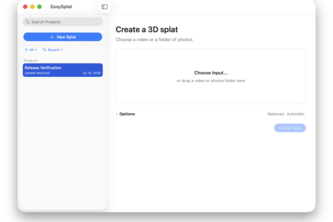
EasySplat is a self-reported open-source project that claims to enable fast end-to-end Gaussian splatting on Apple Silicon Macs. It was built by one person (David Xu) using GPT-5.6 in Codex, with minimal handholding from the author. The project focuses on performance optimization for Apple GPUs and aims to make Gaussian splatting accessible to users without NVIDIA hardware.
What changed
The author reports a significant speedup in processing time (from ~21 minutes to ~3:14) using GPT-5.6-assisted engineering, including custom Metal optimizations and algorithmic improvements tailored for Apple Silicon. The project was submitted as part of an OpenAI hackathon.
Single most important open question
Is there any evidence of commercial traction or adoption beyond the author’s own use case? The description does not indicate any revenue, customers, or product-market fit beyond a proof-of-concept.
What The Product Actually Is
The description states that EasySplat is an application for Gaussian splatting — a technique used in 3D reconstruction and rendering — optimized specifically for Apple Silicon Macs. It claims to be "completely commercially licensable" and aims to simplify the process of creating splats from photos or videos on macOS.
It was built using GPT-5.6 via Codex, with minimal technical direction from the author. The tool reportedly integrates existing libraries like COLMAP and Brush, and implements new optimizations such as custom Metal code for performance gains.
Inference The product is described as a software tool that runs locally on Macs, likely targeting developers or creators who want to experiment with 3D content generation but lack access to NVIDIA GPUs. It does not appear to be a SaaS offering or cloud-based service.
Positioning & Claim Evolution
The author positions EasySplat as the “world’s fastest end-to-end Gaussian splatter on Apple Silicon Macs.” This is a strong claim, but it is self-reported and lacks independent validation.
The project evolved from a personal need — simplifying Gaussian splatting workflows for Mac users — into an open-source tool that leverages AI to improve performance. The evolution shows a shift from a prototype to a release-ready version with measurable speedups.
Inference The positioning is framed around accessibility and performance on Apple hardware, suggesting a niche audience rather than broad commercial appeal. There is no indication of branding or marketing efforts beyond the hackathon submission.
Target Customer & ICP
The description does not name specific customer segments or personas. However, it implies that the target user is someone who wants to perform Gaussian splatting on a Mac and lacks access to NVIDIA GPUs.
It also suggests that users may be developers, content creators, or researchers working with 3D modeling or computer vision tools.
Inference The ICP (Ideal Customer Profile) appears to be individuals or small teams using Apple Silicon devices for creative or technical projects involving 3D reconstruction. No evidence of enterprise customers or institutional adoption is provided.
Business Model & Pricing Evidence
There is no evidence of a business model or pricing strategy in the description. The project is described as being released as open-source, and the tagline mentions it is "completely commercially licensable," which may imply potential licensing options, but no details are given.
Inference The business model remains unclear. It could be either freemium, open-source with optional commercial licenses, or a future monetization strategy not yet implemented.
Technical & Delivery Signals
- The project uses GPT-5.6 in Codex to automate research and engineering decisions.
- It includes custom Metal code for performance optimization.
- It integrates tools like COLMAP and Brush.
- Speed improvements are reported: 6.5× faster processing, reduced core download size from 159 MB to 9.3 MB.
Inference The technical approach involves AI-assisted development and GPU-specific optimizations. The delivery signal is strong in terms of performance gains and codebase reduction, but there’s no evidence of scalability or production deployment beyond the author's testing.
Traction & Maturity Signals
There is no evidence of user traction, revenue, or customer adoption. The project was submitted to a hackathon and described as an open-source release. No metrics on downloads, usage, or feedback are provided.
Inference The maturity level appears to be early-stage prototype or proof-of-concept. It has not yet reached a market-ready state with measurable impact or user engagement.
Competitive Context
The description does not mention competitors or existing solutions in the Gaussian splatting space. It notes that most available software assumes NVIDIA GPUs and CUDA, implying a gap in Apple Silicon support.
Inference There is likely a lack of optimized tools for Mac users in this domain, but no clear competitive landscape is described. The project may be addressing an underserved niche.
Open Questions & Risks
- Unverified claims: All performance and capability claims are self-reported without external validation.
- Limited scope: Only one developer (David Xu) is involved; no team or organizational structure is evident.
- No commercial traction: No evidence of revenue, customers, or product-market fit beyond the author’s own use case.
- Open-source nature: While open-source can attract users, it does not inherently signal a scalable business model.
- AI dependency: Heavy reliance on GPT-5.6 raises questions about reproducibility and long-term maintainability.
Questions the description leaves open
- What are the actual use cases or industries where this tool would be applied?
- How is the commercial licensing structured, and what does that mean for users?
- Are there any plans to expand beyond Apple Silicon or support other platforms?
- Has the tool been tested in real-world scenarios outside of the benchmark environment?
- What are the long-term maintenance and development plans for EasySplat?
Overall Assessment
Not evidenced.
The description provides no data on financials, traction, or strategic fit. It describes a prototype with performance improvements but does not indicate whether it has moved beyond experimental status or attracted any users or investors. The lack of evidence precludes any conclusion about investment or partnership potential at this time.
User Stories BotA demo video on every pull request
Get a demo video on every new feature
GitHub App that watches your pull requests and records a narrated, captioned demo.
Save time on demo prep and make informed decisions faster with a video walkthrough of every new feature.
Source
Submitted to the OpenAI 2026 hackathon on Devpost. Project home on Devpost. Back to the full gallery on Devpost.
This competitive analysis was produced by top-founders.com (opens in a new tab)
Generated by a language model from this project's public Devpost page — its tagline, the author's own write-up and any built-with tags listed there — as captured in August 2026. Short quotations are the author's words. It is an opinion on the idea as a business, not on the people behind it, and it reflects the description as published then. If the project has moved on, request a correction below. The analysis is not independent research and contains no verified traction, revenue or customer data.
An independent guide by KFG International LLC — not affiliated with, endorsed by, or connected to Devpost or OpenAI.