

Archive position — measured, not model output
0 likes on Devpost
2,263 of the 7,850 archived projects have more likes, and 5,587 share exactly 0 — so this project's #6,505 place in the like-ranked listing is a tie-break inside that group, not a ranking.
Projects (log scale)
Likes on Devpost. ▲ marks this project's group.
Show the figures
| Likes | Projects | Share of archive |
|---|---|---|
| 0 | 5,587 | 71.2% |
| 1 | 1,758 | 22.4% |
| 2 | 284 | 3.6% |
| 3–4 | 132 | 1.7% |
| 5–9 | 75 | 1.0% |
| 10+ | 14 | 0.2% |
 User Stories BotA demo video on every pull request
Get a demo video on every new feature
GitHub App that watches your pull requests and records a narrated, captioned demo.
Save time on demo prep and make informed decisions faster with a video walkthrough of every new feature.
Executive Summary
What the company appears to be
Safety Alarm is an offline-first disaster response system designed to enable SOS messaging, coordination of rescue efforts, and synchronization of operations when connectivity returns. It is described as a mesh/store-and-forward system with a focus on emergency response during disasters.
What changed
The project was submitted as part of the OpenAI 2026 hackathon. The author describes it as a proof-of-concept built in a short timeframe, using a strict TypeScript monorepo architecture and offline-first principles.
Single most important open question
Is there any evidence of real-world deployment or testing beyond the hackathon context? The description states no revenue, customers, or traction data are available — only self-reported claims about functionality and architecture.
What The Product Actually Is
The description states that Safety Alarm is an offline-first disaster response system. It includes:
- A one-tap SOS mechanism.
- Sealed sensitive details using cryptographic signing.
- Mesh/store-and-forward transport for message delivery.
- Local rescue node coordination.
- Cursor-based operation log to synchronize data when connectivity returns.
- A management UI at
/adminshowing priority queues, status counts, and rescue tasks.
It is built with a strict TypeScript monorepo, including:
- Core package with schemas, state machines, priority rules, HLC/oplog sync, conflict resolution, signatures, and sealed-box primitives.
- Mobile app using Expo/React Native with SQLite oplog and transport adapters for HTTP, mock mesh, and BLE.
- Server built on Fastify with better-sqlite3, using oplog as source of truth.
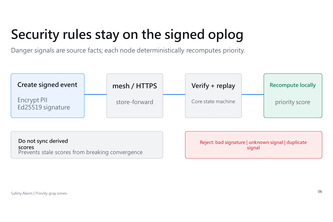
The system uses Ed25519 for signing operations, x25519 for encryption, and Zod for schema validation. It supports operation log-based synchronization, real-time clocks to sort operations, and a bounded danger signal metric scoring up to 120 points.
Not evidenced: actual product usage, customer base, or revenue.
Positioning & Claim Evolution
The author states that the system is intended to respond to disasters where connectivity may be lost. It is positioned as an offline-first emergency response tool that keeps SOS messages moving and coordinates rescue work until connectivity returns.
Key claims:
- The system prioritizes life-threatening cases.
- It uses a six-signal danger metric with a hard floor of 120 points.
- It avoids clinical triage but supports coordination through scoring.
- It is built to handle delay, duplication, disconnection, conflict, consistency, and concurrency.
The positioning has evolved from a hackathon prototype into a system that claims to support:
- End-to-end offline-first architecture.
- Deterministic convergence via property-based testing.
- Signature rejection at ingest boundaries.
- Explainable UI reasons for priority scoring.
Not evidenced: market positioning beyond the hackathon, competitive differentiation, or adoption by emergency responders.
Target Customer & ICP
The description states that Safety Alarm is designed for disaster response scenarios, where people need to send SOS messages and be coordinated with rescue efforts when connectivity is lost. It targets:
- Residents in disaster zones.
- Local rescue nodes and coordinators.
- Emergency response organizations.
It also mentions a management center at /admin for coordinators to acknowledge requests and create tasks.
Not evidenced: specific customer segments, user personas, or organizational buyers beyond the hackathon context.
Business Model & Pricing Evidence
The description does not provide any evidence of a business model or pricing structure. It is unclear whether Safety Alarm intends to be sold as a SaaS product, offered for free, or funded through grants or partnerships.
Not evidenced: revenue model, pricing tiers, monetization strategy, or customer acquisition costs.
Technical & Delivery Signals
The system is built with:
- TypeScript monorepo.
- Expo/React Native for mobile client.
- Fastify and better-sqlite3 for server.
- SQLite for local oplog storage.
- Ed25519, x25519, Zod, and NaCl for cryptographic operations.
- Mesh/store-and-forward transport abstraction.
- Operation log with HLC (Hybrid Logical Clocks) for ordering.
- Cursor-based synchronization when connectivity returns.
It includes:
- Core package with shared logic between client and server.
- Mobile app with mock mesh and BLE support.
- Server identity creates signed operations that are verified and replayed through the same pipeline as other nodes.
- Bounded danger signal metrics.
- Operation log used for deterministic convergence.
Not evidenced: production deployment, scalability, or performance data.
Traction & Maturity Signals
The project is described as a hackathon submission (OpenAI 2026). No evidence of:
- Revenue.
- Customers.
- Product usage.
- Market traction.
- Deployment beyond the prototype stage.
It includes a mention of future milestones such as BLE transport on Android, relay tests, and organization keys — but no indication that these have been implemented or tested in real-world conditions.
Not evidenced: any form of traction or maturity beyond the hackathon prototype.
Competitive Context
The description does not provide any information about competitors or market context. It does not mention:
- Similar tools or platforms.
- Market size or opportunity.
- Competitive advantages or differentiators.
Not evidenced: competitive landscape, market positioning, or differentiation from existing solutions.
Open Questions & Risks
- No real-world testing or deployment: The system is described as a hackathon prototype with no evidence of field use.
- Unverified claims: All features and functionality are self-reported without independent verification.
- Unclear monetization strategy: No indication of how the product would be sold or funded beyond the hackathon.
- Limited team size: Only one member (Gu CHEN) is listed, which may limit development capacity.
- Technical complexity without validation: The system uses advanced concepts like HLC, oplog sync, and cryptographic signing — but no evidence of successful implementation or testing.
Inference: If this were to be commercialized, it would face significant challenges in proving reliability, scalability, and usability in real emergency scenarios.
Questions the description leaves open
- What is the actual use case for which this system was tested? Was it in a real disaster or simulated environment?
- Has the system been tested with multiple users or devices under realistic offline conditions?
- How does the bounded danger signal metric translate into real-world triage decisions?
- Are there any plans to integrate with existing emergency response systems or platforms?
- What is the roadmap for moving from a prototype to a production-ready system?
- Is there any funding or support beyond the hackathon for further development?
- How does the system handle data privacy and compliance in different jurisdictions?
Overall Assessment
The project is described as a hackathon prototype with no evidence of traction, revenue, or customer adoption. It shows technical sophistication but lacks real-world validation.
Confidence level: Low — based entirely on self-reported claims.
Assessment: Not ready for investment or partnership at this stage. The system may have potential as a proof-of-concept, but there is no demonstrated market need, product-market fit, or scalability beyond the prototype phase.
Inference: If the founders intend to commercialize this, they will need to demonstrate real-world use cases, secure funding, and build out the product significantly before it can be considered for investment or partnership.
User Stories BotA demo video on every pull request
Get a demo video on every new feature
GitHub App that watches your pull requests and records a narrated, captioned demo.
Save time on demo prep and make informed decisions faster with a video walkthrough of every new feature.
Source
Submitted to the OpenAI 2026 hackathon on Devpost. Project home on Devpost. Back to the full gallery on Devpost.
This competitive analysis was produced by top-founders.com (opens in a new tab)
Generated by a language model from this project's public Devpost page — its tagline, the author's own write-up and any built-with tags listed there — as captured in August 2026. Short quotations are the author's words. It is an opinion on the idea as a business, not on the people behind it, and it reflects the description as published then. If the project has moved on, request a correction below. The analysis is not independent research and contains no verified traction, revenue or customer data.
An independent guide by KFG International LLC — not affiliated with, endorsed by, or connected to Devpost or OpenAI.