

Archive position — measured, not model output
1 like on Devpost
505 of the 7,850 archived projects have more likes, and 1,758 share exactly 1 — so this project's #965 place in the like-ranked listing is a tie-break inside that group, not a ranking.
Projects (log scale)
Likes on Devpost. ▲ marks this project's group.
Show the figures
| Likes | Projects | Share of archive |
|---|---|---|
| 0 | 5,587 | 71.2% |
| 1 | 1,758 | 22.4% |
| 2 | 284 | 3.6% |
| 3–4 | 132 | 1.7% |
| 5–9 | 75 | 1.0% |
| 10+ | 14 | 0.2% |
 User Stories BotA demo video on every pull request
Get a demo video on every new feature
GitHub App that watches your pull requests and records a narrated, captioned demo.
Save time on demo prep and make informed decisions faster with a video walkthrough of every new feature.
Executive Summary
What the company appears to be
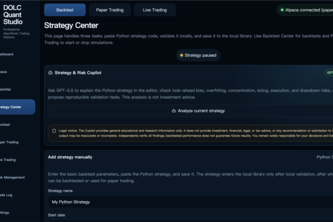
DOLC Quant Studio is a self-reported desktop application for quantitative trading, built with AI assistance (specifically Codex and ChatGPT) during an OpenAI Build Week hackathon. It supports Python-based strategy development, backtesting, risk analysis, and live or paper trading via Alpaca integration. The product includes multilingual support (Chinese, English, German), a GPT-5.6-powered Strategy & Risk Copilot, and cross-platform distribution for Windows and macOS.
What changed
The project evolved from an existing quantitative trading foundation into a more accessible, production-ready, and internationally usable desktop product during the Build Week period. Key additions included a GPT-5.6-powered copilot, multilingual UI, secure credential handling, and reproducible builds across platforms.
Single most important open question
Is there any evidence of actual usage or adoption beyond the demo and development phase? The description states that it was built for demonstration purposes only, with no revenue, customer data, or traction metrics provided.
What The Product Actually Is
The description states that DOLC Quant Studio is a cross-platform desktop workspace for researching and operating systematic trading strategies using Alpaca. It allows users to:
- Connect Alpaca paper and live trading accounts
- Create and manage Python trading strategies
- Run historical backtests with realistic commissions and slippage
- Perform walk-forward analysis
- Compare risk metrics (Sharpe ratios, drawdowns, win rates)
- Monitor positions, orders, watchlists, alerts, and account equity
- Apply order-size and portfolio risk controls before execution
- Switch between Chinese, English, and German interfaces
- Use a demo mode without exposing brokerage credentials
- Analyze Python strategies with a GPT-5.6-powered Strategy & Risk Copilot
The application is built using Electron, React, TypeScript, Vite, Recharts, and Python, with Alpaca APIs for market data and execution.
Inference The product appears to be an end-to-end tool designed for retail or semi-professional traders who want to research, test, and execute trading strategies in a controlled environment. It is not a SaaS platform but a desktop application.
Positioning & Claim Evolution
The description states that the project was inspired by a practical problem: retail traders often have to choose between overly simple apps and complex professional platforms. The goal was to create an accessible, explainable, and safer quantitative trading tool.
It positions itself as a solution that makes the path from idea to tested decision visible and explainable. It claims to offer:
- A production-ready desktop application, not just a prototype
- Integration with Alpaca for live/paper trading
- Use of AI (Codex, ChatGPT) throughout development and as part of its core functionality via the Strategy & Risk Copilot
- Multilingual support and cross-platform compatibility
Inference The positioning is that of a developer-oriented desktop tool aimed at traders or researchers who want to build, test, and validate trading strategies in a secure, reproducible environment. It does not claim to be a full-fledged trading platform for general consumers.
Target Customer & ICP
The description states that the product targets users who are interested in quantitative trading, particularly those who need tools to research, backtest, and manage risk in their strategies. It is designed for:
- Retail traders
- Semi-professional or academic researchers
- Developers working with Python-based strategies
It also mentions a focus on making research more understandable, reproducible, and safer.
Inference The ICP likely includes individuals or small teams who are already familiar with Python and quantitative finance, and who want to streamline their workflow using AI-assisted tools. There is no evidence of institutional or enterprise customers.
Business Model & Pricing Evidence
The description does not provide any information about pricing, monetization, or business model. It only states that the software is for research, education, and demonstration purposes only.
Inference No commercial model is evident from the self-reported description. The product appears to be a prototype or demo tool with no indication of paid features or revenue streams.
Technical & Delivery Signals
The application is built using:
- Electron, React, TypeScript, Vite, Recharts, Python
- Integration with Alpaca APIs for trading and data
- AI tools like Codex, ChatGPT (GPT-5.6) used in development and as part of the Strategy & Risk Copilot
- Use of OpenAI Responses API, Structured Outputs, and Electron safeStorage for secure handling of credentials
The project includes:
- Four native release builds (Windows x64, Windows ARM64, macOS Intel, macOS Apple Silicon)
- Apple notarization and Developer ID signing
- Multilingual UI support
- Reproducible builds and documentation
Inference The technical stack suggests a developer-focused desktop application, with attention to security, cross-platform compatibility, and reproducibility. AI was used in development but not necessarily embedded as a core feature for end-users beyond the copilot.
Traction & Maturity Signals
The description states that this is a demo or prototype built during an OpenAI Build Week hackathon. It includes:
- A working, installable desktop application
- Demo mode available without credentials
- Download links provided (0.1.7 builds)
- Documentation distinguishing pre-existing functionality from Build Week work
However, there is no evidence of actual users, customers, or revenue.
Inference The product is at a very early stage, likely in the prototype or demo phase. It has not demonstrated traction or adoption beyond its own development and demonstration.
Competitive Context
The description does not mention specific competitors. However, based on the stated functionality (backtesting, risk analysis, strategy management), it would compete with:
- Desktop-based quantitative trading platforms
- Alpaca-integrated tools
- AI-assisted development tools for finance
It is positioned as a tool for researchers and developers, not a general-purpose trading platform.
Inference The competitive landscape includes existing desktop or web-based platforms for algorithmic trading, but no specific competitor names are mentioned. The product’s differentiation lies in its integration of AI during both development and user-facing features like the Strategy & Risk Copilot.
Open Questions & Risks
- No revenue or customer data: The project is described as a demo, with no evidence of monetization or adoption
- AI used for development only: While AI was used in building the product, there’s no indication that it's embedded in the final user experience beyond the copilot
- Self-reported and unverified: All claims are based on the author’s own description; no independent verification
- Limited scope: The project is described as a hackathon submission with no clear roadmap for further development or commercialization
- No financial risk controls in practice: Although the product claims to support risk management, there is no evidence of real-world usage or validation
Questions the description leaves open
- What is the actual use case or problem you're solving beyond the demo?
- Are there any users or early adopters who have tested this in practice?
- How does the GPT-5.6 copilot integrate into the user workflow? Is it optional or mandatory?
- Has the product been tested for security, especially with real credentials and live trading?
- What is the long-term vision for monetization or commercialization?
- Are there any plans to expand beyond Alpaca or support other brokers?
- How are Python strategies sandboxed or validated in practice?
Overall Assessment
Not evidenced.
There is no evidence of revenue, customers, traction, or a clear business model. The project is described as a demo or prototype, built during a hackathon. It shows technical capability and ambition but lacks commercial viability indicators.
Confidence level: Low
This is a self-reported, unverified account of a demo-level product with no evidence of real-world usage or monetization. Any investment or partnership decision should be based on further due diligence beyond this description.
User Stories BotA demo video on every pull request
Get a demo video on every new feature
GitHub App that watches your pull requests and records a narrated, captioned demo.
Save time on demo prep and make informed decisions faster with a video walkthrough of every new feature.
Source
Submitted to the OpenAI 2026 hackathon on Devpost. Project home on Devpost. Back to the full gallery on Devpost.
This competitive analysis was produced by top-founders.com (opens in a new tab)
Generated by a language model from this project's public Devpost page — its tagline, the author's own write-up and any built-with tags listed there — as captured in August 2026. Short quotations are the author's words. It is an opinion on the idea as a business, not on the people behind it, and it reflects the description as published then. If the project has moved on, request a correction below. The analysis is not independent research and contains no verified traction, revenue or customer data.
An independent guide by KFG International LLC — not affiliated with, endorsed by, or connected to Devpost or OpenAI.