

Archive position — measured, not model output
0 likes on Devpost
2,263 of the 7,850 archived projects have more likes, and 5,587 share exactly 0 — so this project's #2,928 place in the like-ranked listing is a tie-break inside that group, not a ranking.
Projects (log scale)
Likes on Devpost. ▲ marks this project's group.
Show the figures
| Likes | Projects | Share of archive |
|---|---|---|
| 0 | 5,587 | 71.2% |
| 1 | 1,758 | 22.4% |
| 2 | 284 | 3.6% |
| 3–4 | 132 | 1.7% |
| 5–9 | 75 | 1.0% |
| 10+ | 14 | 0.2% |
 User Stories BotA demo video on every pull request
Get a demo video on every new feature
GitHub App that watches your pull requests and records a narrated, captioned demo.
Save time on demo prep and make informed decisions faster with a video walkthrough of every new feature.
Executive Summary
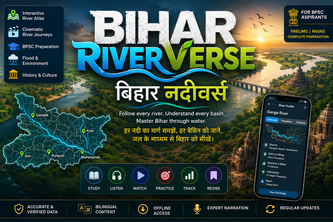
Bihar RiverVerse is a self-reported bilingual interactive river atlas and BPSC (Bihar Public Service Commission) learning platform. The project is described as a web/PWA application that combines geographic mapping, educational content, and exam preparation tools for Bihar’s rivers. It includes features such as an 864-river atlas index, cinematic journeys, PYQ-based practice modes, offline packs, and optional account sync via Python/SQLite server.
The author states that the platform was built using HTML, CSS, JavaScript, Leaflet maps, local browser storage, service workers, and OpenAI Codex/GPT-5 for development support. It is presented as a single-developer project submitted to the OpenAI Build Week 2026 hackathon.
Key commercial due-diligence read: The description does not evidence any revenue, customers, or adoption. There is no indication of traction, pricing, or business model beyond self-reported claims. The platform appears to be an experimental educational tool with no known market presence or monetization strategy.
What The Product Actually Is
The description states that Bihar RiverVerse is a bilingual interactive river atlas and BPSC learning platform. It integrates:
- Interactive basin maps
- 864-river atlas index
- Cinematic journeys
- PYQ-based preparation
- Flood/environment intelligence
- Wetland/biodiversity context
- Historical river-course learning
- Saved revision, progress tracking, notes
- Offline PWA packs
- Optional Python/SQLite server for accounts, sync, leaderboard, and administration
It is built as a web/PWA application, using technologies like HTML, CSS, JavaScript, Leaflet map layers, local browser storage, service workers, and a bundled Python/SQLite server.
Inference: The product appears to be a local-first educational platform designed for students preparing for the BPSC exam, with a focus on Bihar’s rivers. It is not yet demonstrated as a commercial product or deployed in production.
Positioning & Claim Evolution
The author positions Bihar RiverVerse as:
- A structured, explorable, bilingual learning experience for Bihar’s rivers
- A unified platform that consolidates scattered academic and geographic materials into one application
- A cinematic and interactive educational tool, combining visual storytelling with exam prep
- An offline-first study workspace, suitable for low-bandwidth environments
The project is described as a single-developer hackathon submission, not a commercial product. The author emphasizes the educational and local-first nature of the platform, but does not claim any market traction or monetization.
Claim vs Fact: The positioning is self-reported and unverified. There is no evidence that this has been adopted by institutions, students, or educators beyond its own submission.
Target Customer & ICP
The description states that Bihar RiverVerse is intended for:
- Students preparing for the BPSC exam
- Learners interested in Bihar’s river systems, including geography, environment, and history
- Users who benefit from offline-first learning tools in low-bandwidth environments
It is described as a local-first study workspace, suggesting it targets users within Bihar or those with access to similar regional content.
Inference: The ICP appears to be students preparing for BPSC exams, with a focus on regional geography and river systems. No evidence of broader customer segments or institutional adoption is provided.
Business Model & Pricing Evidence
The description does not provide any information about:
- Revenue streams
- Pricing models
- Monetization strategy
- Customer acquisition or retention plans
It mentions an optional Python/SQLite server for accounts, sync, leaderboard, and administration, but no commercial offering or pricing structure is described.
Claim vs Fact: The business model is not evidenced. It is unclear whether the platform will be offered free, paid, or through institutional licensing.
Technical & Delivery Signals
The project is built as a web/PWA application, using:
- HTML, CSS, JavaScript
- Leaflet map layers
- Local browser storage and service-worker caching
- A bundled Python/SQLite server for optional account features
It includes:
- Offline packs
- Static hosted demo adapter
- README, privacy notes, deployment notes, testing instructions
The author states that OpenAI Codex and GPT-5 were used to support development, including debugging, documentation, and packaging.
Inference: The platform is technically self-contained, with a focus on offline-first delivery and local storage. It is not yet demonstrated as a scalable or production-ready system.
Traction & Maturity Signals
The description states that this is a hackathon submission (OpenAI Build Week 2026), and no evidence of traction, revenue, or adoption is provided.
It includes:
- A static hosted demo
- A README, privacy notes, deployment notes, and testing instructions
- Accomplishments such as consolidation of features and offline support
But there are no metrics, user feedback, customer data, or market validation.
Claim vs Fact: The project is in a pre-commercial prototype phase. There is no evidence of real-world usage or product-market fit.
Competitive Context
The description does not mention any competitors, nor does it describe how Bihar RiverVerse differentiates from existing educational or geographic platforms.
It is positioned as a regional, bilingual, interactive river learning tool, but there is no evidence of similar products in the market or competitive analysis.
Inference: The competitive landscape is unknown. No known direct competitors are cited.
Open Questions & Risks
- No revenue, customers, or traction: The platform is a hackathon submission with no commercial validation.
- Single developer: The team size is listed as 1, suggesting limited capacity for scaling or maintenance.
- Unverified content: The description does not provide any evidence of source verification or accuracy of the river data.
- No monetization strategy: No indication of how the platform will generate revenue or sustain itself.
- Limited scalability: The use of local storage and offline-first design may limit long-term growth.
Questions the description leaves open
- What is the source of the river data, and how is it verified for accuracy?
- Is there a plan to expand beyond BPSC exam prep into broader educational or environmental uses?
- How will the platform be monetized, if at all?
- Are there any institutional partnerships or pilot programs in place?
- What are the technical limitations of the current PWA architecture for scaling?
- How is the bilingual content being maintained and updated?
- Is there a roadmap for moving from a hackathon prototype to a production-grade product?
Overall Assessment
The description states that Bihar RiverVerse is a single-developer hackathon submission with no evidence of traction, revenue, or commercial viability.
It is described as an experimental educational tool, not a commercial product. There is no indication of:
- Revenue
- Customers
- Market adoption
- Pricing
- Product-market fit
Assessment: Not evidenced as a viable investment or partnership opportunity at this stage. The project appears to be a pre-commercial prototype with potential for future development, but lacks any demonstrated commercial readiness or traction.
User Stories BotA demo video on every pull request
Get a demo video on every new feature
GitHub App that watches your pull requests and records a narrated, captioned demo.
Save time on demo prep and make informed decisions faster with a video walkthrough of every new feature.
Source
Submitted to the OpenAI 2026 hackathon on Devpost. Project home on Devpost. Back to the full gallery on Devpost.
This competitive analysis was produced by top-founders.com (opens in a new tab)
Generated by a language model from this project's public Devpost page — its tagline, the author's own write-up and any built-with tags listed there — as captured in August 2026. Short quotations are the author's words. It is an opinion on the idea as a business, not on the people behind it, and it reflects the description as published then. If the project has moved on, request a correction below. The analysis is not independent research and contains no verified traction, revenue or customer data.
An independent guide by KFG International LLC — not affiliated with, endorsed by, or connected to Devpost or OpenAI.