

Archive position — measured, not model output
0 likes on Devpost
2,263 of the 7,850 archived projects have more likes, and 5,587 share exactly 0 — so this project's #3,765 place in the like-ranked listing is a tie-break inside that group, not a ranking.
Projects (log scale)
Likes on Devpost. ▲ marks this project's group.
Show the figures
| Likes | Projects | Share of archive |
|---|---|---|
| 0 | 5,587 | 71.2% |
| 1 | 1,758 | 22.4% |
| 2 | 284 | 3.6% |
| 3–4 | 132 | 1.7% |
| 5–9 | 75 | 1.0% |
| 10+ | 14 | 0.2% |
 User Stories BotA demo video on every pull request
Get a demo video on every new feature
GitHub App that watches your pull requests and records a narrated, captioned demo.
Save time on demo prep and make informed decisions faster with a video walkthrough of every new feature.
Executive Summary
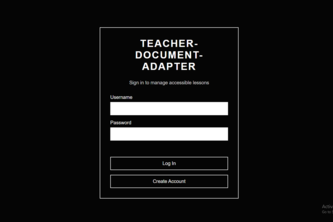
The company appears to be a solo-developer project submitted to the OpenAI 2026 hackathon. The author states it aims to help teachers adapt educational documents for students with varying disabilities by automatically modifying documents based on classroom needs. It is described as a functional prototype built using Codex, MongoDB, and basic frontend technologies.
What changed
This is a self-reported project from a single developer, likely built in a short timeframe during a hackathon. No evidence of prior development, funding, or commercial traction exists beyond the author's own description.
The single most important open question
Is there any evidence that teachers or educational institutions are interested in using this tool, or that it has been tested with real users?
What The Product Actually Is
- The description states: “It allows teacher to set up classrooms, what difficulties require in terms of document adaptation, and it builds a ZIP file with all the adaptions that can be downloaded.”
- It is described as an app that adapts documents for students with disabilities.
- The tool is said to generate a ZIP file containing adapted versions of documents.
- Built using Codex (likely OpenAI’s code generation tool), MongoDB, CSS, JavaScript, and Visual Studio.
Not evidenced What specific types of adaptations are made, how the AI or logic determines those adaptations, or whether the app supports real-time editing or document formats beyond ZIPs.
Positioning & Claim Evolution
- The author states: “Adapting lessons to student with varying disabilities is a struggle. We aim to create an app that saves teachers' time by establishing the class needs and automatically modifying the docs accordingly.”
- This positions the product as a time-saving tool for educators.
- It claims to automate document adaptation, reducing manual effort.
Inference The positioning implies a solution for inclusive education, but no evidence of market validation or user feedback is provided.
Target Customer & ICP
- The description states: “It allows teacher to set up classrooms, what difficulties require in terms of document adaptation.”
- The target customer is described as teachers.
- It is intended for use in educational settings where students have varying disabilities.
Not evidenced No information on specific disability types, grade levels, or school sizes. No evidence of segmentation or targeting beyond “teachers.”
Business Model & Pricing Evidence
- The description does not state a business model or pricing structure.
- No mention of monetization, licensing, or subscription models.
- The tool is described as generating ZIP files — no indication of ongoing service or SaaS elements.
Not evidenced Revenue model, pricing tiers, or customer acquisition costs.
Technical & Delivery Signals
- Built with: Codex, MongoDB, CSS, JavaScript, Visual Studio.
- The author states: “Made the design by hand and built the base code with Codex.”
- The project was submitted to a hackathon — suggesting it is a prototype or proof-of-concept.
- Challenges included running out of Codex tokens, leading to manual testing.
Not evidenced Scalability, performance metrics, deployment architecture, or integration capabilities beyond basic document generation.
Traction & Maturity Signals
- The project was submitted to the OpenAI 2026 hackathon.
- The author states: “Having a fully functional project.”
- No evidence of user testing, feedback loops, or adoption.
- No mention of customers, usage data, or product iteration history.
Not evidenced Any traction, customer base, or real-world usage beyond the prototype phase.
Competitive Context
- The description does not mention competitors.
- No evidence of existing tools in the educational accessibility space.
- The author’s own write-up does not reference similar products or market analysis.
Not evidenced Competitive landscape, differentiation, or market gaps addressed.
Open Questions & Risks
- Solo developer project: Only one team member (Yann Giffaux) is mentioned — raises questions about scalability and long-term maintenance.
- Prototype nature: Built for a hackathon, not validated with real users or institutions.
- Limited technical depth: Reliance on Codex tokens and manual testing suggests limited automation or robustness.
- No commercialization plan: No evidence of monetization strategy or go-to-market approach.
Inference The project may be a useful idea but lacks the maturity or traction to be considered a viable business.
Questions the description leaves open
- Who are your target users, and have you spoken with any teachers or schools about this tool?
- What specific types of document adaptations does the app support?
- How does the AI determine what adaptations are needed for each student?
- Have you tested the app with real users or in a classroom setting?
- What is your plan for scaling beyond the prototype phase?
Overall Assessment
- Not evidenced No commercial traction, revenue, or customer validation.
- The project is described as a functional prototype built during a hackathon.
- It is not clear whether this idea has been validated with real users or markets.
Assessment This is a self-reported concept with no evidence of product-market fit or commercial viability. It may be an early-stage idea worth exploring, but it does not meet the criteria for investment or partnership at this stage.
User Stories BotA demo video on every pull request
Get a demo video on every new feature
GitHub App that watches your pull requests and records a narrated, captioned demo.
Save time on demo prep and make informed decisions faster with a video walkthrough of every new feature.
Source
Submitted to the OpenAI 2026 hackathon on Devpost. Project home on Devpost. Back to the full gallery on Devpost.
This competitive analysis was produced by top-founders.com (opens in a new tab)
Generated by a language model from this project's public Devpost page — its tagline, the author's own write-up and any built-with tags listed there — as captured in August 2026. Short quotations are the author's words. It is an opinion on the idea as a business, not on the people behind it, and it reflects the description as published then. If the project has moved on, request a correction below. The analysis is not independent research and contains no verified traction, revenue or customer data.
An independent guide by KFG International LLC — not affiliated with, endorsed by, or connected to Devpost or OpenAI.