

Archive position — measured, not model output
0 likes on Devpost
2,263 of the 7,850 archived projects have more likes, and 5,587 share exactly 0 — so this project's #3,767 place in the like-ranked listing is a tie-break inside that group, not a ranking.
Projects (log scale)
Likes on Devpost. ▲ marks this project's group.
Show the figures
| Likes | Projects | Share of archive |
|---|---|---|
| 0 | 5,587 | 71.2% |
| 1 | 1,758 | 22.4% |
| 2 | 284 | 3.6% |
| 3–4 | 132 | 1.7% |
| 5–9 | 75 | 1.0% |
| 10+ | 14 | 0.2% |
 User Stories BotA demo video on every pull request
Get a demo video on every new feature
GitHub App that watches your pull requests and records a narrated, captioned demo.
Save time on demo prep and make informed decisions faster with a video walkthrough of every new feature.
Executive Summary
What the company appears to be
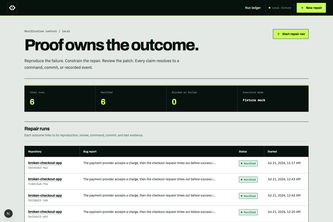
Docket : Evidence-First AI Repair Verification is a self-reported local developer tool that aims to verify software repairs made by AI agents through independent, recorded evidence. It is built as a CLI and web interface using Next.js, React, and TypeScript, with an architecture designed for sandboxed execution, adversarial review, and tamper-evident logging.
What changed
The project description indicates this is a hackathon submission (OpenAI 2026) and not yet a commercial product. It was built to address a perceived gap in AI agent verification — that agents claim fixes without independent proof. The tool is described as an adversarial verification system for code repairs, with a focus on evidence-based status reporting.
Single most important open question
Is there any evidence of real-world adoption or usage beyond the hackathon demo? The description does not state whether Docket has been used in production environments or by teams outside the author’s own development.
What The Product Actually Is
The description states that Docket is a local developer tool for verified software repair. It operates by:
- Inspecting a repository and reproducing a bug.
- Drafting an acceptance contract with pass/fail assertions.
- Running a repair agent (Codex) in an isolated environment.
- Sending the patch to an adversarial reviewer model.
- Re-running verification commands to determine final status: VERIFIED, REVISION_REQUIRED, or FAILED.
- Exporting a repair receipt backed by a content-addressed evidence ledger.
It is built using Next.js 16, React 19, TypeScript, and runs in an npm-workspaces monorepo with components for domain logic, event logging, sandbox execution, repository inspection, ledger storage, and orchestration. The tool supports three execution modes: fixture (deterministic), openrouter (free-tier models), and real (paid GPT-5.6 + Codex).
Not evidenced: any commercial product features, pricing, or customer usage.
Positioning & Claim Evolution
The description states that Docket is built to address a gap in AI agent behavior — agents are good at editing code but not at proving fixes. The tool positions itself as a skeptical judge that refuses to trust the agent’s word and instead requires independent, recorded proof.
It claims to offer:
- Reproduction of bugs with matching exit codes and test names.
- Adversarial review by a second model.
- Verification via real command execution.
- Tamper-evident evidence ledger.
The author also states that the tool’s own development process mirrors its output discipline — it applies “evidence-first” principles to its own codebase, catching bugs in development through the same mechanisms it uses for verification.
Not evidenced: any market positioning beyond this self-description, or whether Docket has evolved from an idea into a product with traction.
Target Customer & ICP
The description states that Docket is a local developer tool. It is intended for developers who want to verify AI-generated code repairs in a controlled and auditable way.
It targets users working with:
- Trusted repositories.
- JavaScript/TypeScript projects (initially).
- AI agents like Codex or GPT models.
Not evidenced: specific customer segments, use cases beyond the hackathon demo, or any existing customer base.
Business Model & Pricing Evidence
The description does not state anything about a business model or pricing. It only describes the tool’s architecture and functionality.
Not evidenced: revenue streams, monetization strategy, or pricing plans.
Technical & Delivery Signals
The tool is built with:
- Next.js 16 (App Router) + React 19 + TypeScript
- npm-workspaces monorepo
- SQLite for event logging
- Docker and Playwright for sandboxing and testing
- Zod schemas for validation
- Vitest and Playwright for unit/integration tests
It supports three execution modes:
- Fixture (deterministic)
- OpenRouter (free-tier models)
- Real (paid GPT-5.6 + Codex)
Not evidenced: any production deployment, scalability, or delivery infrastructure beyond the demo.
Traction & Maturity Signals
The project is described as a hackathon submission to the OpenAI 2026 hackathon on Devpost. It includes:
- A full end-to-end demo.
- A forensic interface.
- Evidence of internal bug fixes caught during development (e.g., SQLite transaction leak, CSS overflow).
- A genuine fresh-clone proof.
However, there is no evidence of:
- Real-world usage or adoption.
- Customer feedback or product-market fit.
- Any revenue or funding.
Not evidenced: traction, customer data, or market validation beyond the author’s own account.
Competitive Context
The description does not mention any direct competitors. It positions itself as a tool for AI agent verification, but no comparison to existing tools in that space is made.
Not evidenced: competitive landscape, differentiation from other AI debugging or verification tools, or market positioning relative to similar offerings.
Open Questions & Risks
- No commercial traction: The project is a hackathon submission with no evidence of real-world usage.
- Limited scope: It currently supports only JavaScript/TypeScript and trusted repositories.
- Highly technical interface: The tool is described as unglamorous and forensic, which may limit adoption.
- Unclear path to monetization: No pricing or business model is stated.
- Single-person team: The project was built by one developer (Olamide Adedeji), raising questions about scalability.
Not evidenced: any risk mitigation strategies or plans for growth beyond the demo.
Questions the description leaves open
- What is the intended path from this hackathon prototype to a commercial product?
- Has Docket been tested in real-world development environments, or is it limited to demos?
- Are there any plans to expand support beyond JavaScript/TypeScript?
- How does the tool intend to scale beyond local execution and sandboxing?
- What are the long-term plans for monetization or product-market fit?
Overall Assessment
The description states that Docket is a self-reported hackathon submission with no evidence of commercial traction, revenue, or customer adoption.
At this stage, it appears to be an experimental prototype built by one developer to explore the concept of AI repair verification. It has strong technical execution and a clear problem statement but lacks any indication of product-market fit or scalability.
Assessment Not ready for investment or partnership. The tool is in early-stage development with no evidence of real-world usage or commercial viability beyond the author’s own demo.
User Stories BotA demo video on every pull request
Get a demo video on every new feature
GitHub App that watches your pull requests and records a narrated, captioned demo.
Save time on demo prep and make informed decisions faster with a video walkthrough of every new feature.
Source
Submitted to the OpenAI 2026 hackathon on Devpost. Project home on Devpost. Back to the full gallery on Devpost.
This competitive analysis was produced by top-founders.com (opens in a new tab)
Generated by a language model from this project's public Devpost page — its tagline, the author's own write-up and any built-with tags listed there — as captured in August 2026. Short quotations are the author's words. It is an opinion on the idea as a business, not on the people behind it, and it reflects the description as published then. If the project has moved on, request a correction below. The analysis is not independent research and contains no verified traction, revenue or customer data.
An independent guide by KFG International LLC — not affiliated with, endorsed by, or connected to Devpost or OpenAI.