

Archive position — measured, not model output
0 likes on Devpost
2,263 of the 7,850 archived projects have more likes, and 5,587 share exactly 0 — so this project's #6,793 place in the like-ranked listing is a tie-break inside that group, not a ranking.
Projects (log scale)
Likes on Devpost. ▲ marks this project's group.
Show the figures
| Likes | Projects | Share of archive |
|---|---|---|
| 0 | 5,587 | 71.2% |
| 1 | 1,758 | 22.4% |
| 2 | 284 | 3.6% |
| 3–4 | 132 | 1.7% |
| 5–9 | 75 | 1.0% |
| 10+ | 14 | 0.2% |
 User Stories BotA demo video on every pull request
Get a demo video on every new feature
GitHub App that watches your pull requests and records a narrated, captioned demo.
Save time on demo prep and make informed decisions faster with a video walkthrough of every new feature.
Executive Summary
What the company appears to be
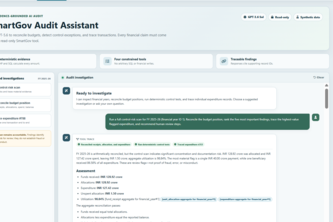
SmartGov AI is a self-reported proof-of-concept project that presents an AI agent designed for public-sector financial audit operations. The author describes it as an "evidence-grounded GPT-5.6 audit agent" intended to assist in reviewing workforce, payroll, and budget data without altering records.
What changed
This is a single-person project built during a hackathon (Devpost submission). It was not previously operational or deployed; it is a demonstration of an idea and architecture, not a product in use.
Single most important open question
Is there any evidence that this concept has been tested beyond the demo environment, or validated with real public-sector users?
Note: All findings are based on the self-reported description provided by the author. No external verification, traction data, revenue figures, customer names, or third-party sources were included in this analysis.
What The Product Actually Is
The description states that SmartGov AI is an "evidence-grounded GPT-5.6 audit agent" for public workforce, payroll, and budget operations. It is described as a constrained audit investigator that:
- reconciles funds received, allocated, spent, and remaining;
- identifies high-value payments and beneficiary concentration;
- flags missing GST registration on GST-rated transactions;
- detects near-full allocation utilization;
- traces expenditures through financial year, office, budget head, object head, beneficiary, deductions, and net amount arithmetic;
- cites underlying synthetic records (e.g., [expenditure#788]).
It is explicitly stated to be read-only — it cannot insert, update, delete, approve, block, or release a transaction. Its purpose is to provide human reviewers with traceable starting points for audits.
The system uses PHP, MySQL/MariaDB, HTML5, CSS3, and vanilla JavaScript. It integrates GPT-5.6 Sol via the OpenAI Responses API through four strict function tools:
list_financial_yearsget_budget_positionfind_control_exceptionstrace_expenditure
These tools are used in a bounded loop to gather evidence before synthesizing a review brief.
Inference: The product is not a general-purpose chatbot but an agentic system designed for specific audit workflows within public finance contexts. It is built as a demonstration, not a production-ready tool.
Positioning & Claim Evolution
The author positions SmartGov AI as a neutral, synthetic GovTech demonstration that shows how an AI agent can reduce investigation time in public-sector audits without changing financial records.
Key claims:
- The system is “read-only” and does not replace responsible officers.
- It provides deterministic checks and evidence-linked reviews.
- It was built to avoid unsafe freedoms such as unrestricted database access or model-generated calculations.
- It uses a constrained architecture where the AI plans and explains, while code performs calculations and retrieves data.
There is no indication of prior versions or evolution from an earlier product. This appears to be a one-off prototype developed during a hackathon.
Claim vs Fact: The positioning reflects intent and design philosophy, not actual usage or adoption in real-world environments.
Target Customer & ICP
The description indicates that the target audience includes public-sector finance teams working across employee, payroll, allocation, voucher, beneficiary, tax, and expenditure records. These users are likely government departments or agencies managing budgets and financial operations.
It is implied that these customers would benefit from reducing manual effort in audit investigations by leveraging AI to gather evidence and prioritize findings.
Inference: The ICP is public-sector finance officers or auditors who manage complex financial workflows involving multiple data silos. However, no explicit segmentation or customer personas are provided.
Business Model & Pricing Evidence
No business model or pricing information is evident in the description. The project is described as a demonstration and not a commercial offering.
Not evidenced: No indication of monetization strategy, pricing tiers, or revenue streams.
Technical & Delivery Signals
The system is built using:
- PHP, MySQL/MariaDB, HTML5, CSS3, JavaScript
- GPT-5.6 Sol via OpenAI Responses API
- Four strict function tools:
list_financial_years,get_budget_position,find_control_exceptions,trace_expenditure
Key technical features include:
- Bounded tool loops with stopping rules
- Authentication and CSRF protection
- Masking of bank-account values
- Role-aware organization-unit scope
- Synthetic data for demo purposes
The author notes that Codex was used as a development collaborator during Build Week.
Inference: The architecture reflects a deliberate attempt to balance AI autonomy with safety constraints, particularly around access control and determinism. However, no production deployment or scalability details are mentioned.
Traction & Maturity Signals
There is no evidence of traction, customers, or adoption beyond the hackathon demo. The project was submitted to the OpenAI 2026 hackathon and is described as a demonstration only.
Not evidenced: No revenue, ARR, headcount, user base, or operational metrics are reported.
Competitive Context
The description does not mention direct competitors or similar products in the market. However, it implies a space involving:
- AI-powered audit tools
- Public sector financial management systems
- GovTech solutions for transparency and accountability
No competitive landscape is described, nor any differentiation from existing tools.
Not evidenced: No information on market positioning, competitive advantages, or existing alternatives.
Open Questions & Risks
- Unproven concept in real-world settings: The system exists only as a demo; no evidence of testing with actual public-sector users.
- Single-person development team: Only one member (Tayum Sanjo) is listed, suggesting limited capacity for scaling or iteration.
- No production-grade infrastructure or security validation: While the demo includes protections like CSRF tokens and masking, it lacks real-world deployment experience.
- Unverified claims about AI behavior: The description states that the agent is “read-only” and “deterministic,” but these behaviors are not independently validated.
- Limited scope of functionality: The system focuses on a narrow set of audit tasks; no indication of broader capabilities or extensibility.
Inference: The project shows architectural maturity in design, but lacks real-world validation or commercial viability indicators.
Questions the description leaves open
- Has the system been tested with any public-sector finance teams beyond the demo?
- What are the actual limitations of GPT-5.6 Sol in handling complex financial queries? Are there known edge cases?
- How does the current architecture scale to larger datasets or more complex audit rules?
- Is there a plan for integrating with existing government systems or databases?
- What is the timeline and roadmap for moving from demo to potential production use?
Overall Assessment
This project is a self-reported hackathon prototype that demonstrates an interesting architectural approach to AI-assisted auditing in public finance. It shows thoughtful separation of AI planning and deterministic execution, but lacks evidence of traction, real-world testing, or commercial viability.
Confidence Level: Low
Assessment: Not ready for investment or partnership at this stage. The project is a compelling idea with strong design principles, but no demonstrated market need, user feedback, or operational history. It may be worth revisiting once there is evidence of pilot testing or early adoption.
User Stories BotA demo video on every pull request
Get a demo video on every new feature
GitHub App that watches your pull requests and records a narrated, captioned demo.
Save time on demo prep and make informed decisions faster with a video walkthrough of every new feature.
Source
Submitted to the OpenAI 2026 hackathon on Devpost. Project home on Devpost. Back to the full gallery on Devpost.
This competitive analysis was produced by top-founders.com (opens in a new tab)
Generated by a language model from this project's public Devpost page — its tagline, the author's own write-up and any built-with tags listed there — as captured in August 2026. Short quotations are the author's words. It is an opinion on the idea as a business, not on the people behind it, and it reflects the description as published then. If the project has moved on, request a correction below. The analysis is not independent research and contains no verified traction, revenue or customer data.
An independent guide by KFG International LLC — not affiliated with, endorsed by, or connected to Devpost or OpenAI.