

Archive position — measured, not model output
0 likes on Devpost
2,263 of the 7,850 archived projects have more likes, and 5,587 share exactly 0 — so this project's #3,724 place in the like-ranked listing is a tie-break inside that group, not a ranking.
Projects (log scale)
Likes on Devpost. ▲ marks this project's group.
Show the figures
| Likes | Projects | Share of archive |
|---|---|---|
| 0 | 5,587 | 71.2% |
| 1 | 1,758 | 22.4% |
| 2 | 284 | 3.6% |
| 3–4 | 132 | 1.7% |
| 5–9 | 75 | 1.0% |
| 10+ | 14 | 0.2% |
 User Stories BotA demo video on every pull request
Get a demo video on every new feature
GitHub App that watches your pull requests and records a narrated, captioned demo.
Save time on demo prep and make informed decisions faster with a video walkthrough of every new feature.
Executive Summary
What the company appears to be
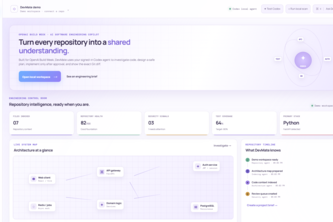
DevMate AI is a self-reported local web application for developers that integrates with Git repositories and Codex (via GPT-5.6) to support an approval-first workflow for code changes. It allows developers to understand unfamiliar codebases, plan changes before editing, and review actual Git diffs after execution.
What changed
The project was built as a hackathon submission for the OpenAI 2026 hackathon. The author describes it as a tool that aims to make AI-assisted development more transparent, safe, and reviewable by enforcing an explicit approval step before any code changes are made in the repository.
Single most important open question
Is there evidence of real-world usage or traction beyond this single-person hackathon project? The description does not indicate any revenue, customers, or adoption beyond its own author’s use case.
Note: This analysis is based solely on the self-reported and unverified project description provided by the caller. No external verification or historical data is available.
What The Product Actually Is
The description states that DevMate AI is:
- A local web application built with HTML, CSS, JavaScript, and Node.js.
- Designed to work with local Git repositories.
- Built using Codex and GPT-5.6, both for development and in its own workflow.
- Uses a lightweight interface including a dashboard, architecture view, source explorer, security signals, plan approval screen, changes page, command palette, file upload option, and theme support.
- Operates through a defined workflow: Understand → Investigate → Plan → Approve → Implement → Review diff.
The author claims it connects to the developer’s locally signed-in Codex CLI. Read-only tasks use a sandboxed environment; write access is only triggered after explicit approval.
Inference: The product appears to be a prototype or proof-of-concept, not yet a commercial offering. It is described as a local tool with no cloud components mentioned.
Positioning & Claim Evolution
The author positions DevMate AI as:
- A “careful software-engineering teammate”.
- An alternative to generic AI chat windows.
- A workspace that helps developers understand repositories, investigate safely, plan changes, and review Git diffs afterward.
- A tool that enforces an approval-first model for AI-generated code changes.
The claim evolution shows a shift from general-purpose AI tools toward developer-centric, safe, and transparent workflows. The emphasis is on control, reviewability, and local integration rather than automation or speed.
Claim: DevMate AI is positioned as an “approval-first Codex copilot”.
Inference: This reflects a growing trend in developer tooling toward safer, more auditable AI usage — but no evidence of market traction or adoption exists.
Target Customer & ICP
The description states that DevMate AI is intended for:
- Developers working with unfamiliar codebases.
- Users who want to understand architecture, review risks, and plan changes before editing.
- Developers who value transparency, safety, and control in their AI-assisted workflows.
There is no explicit mention of specific industries, roles (e.g., junior vs. senior dev), or enterprise use cases beyond the general developer audience.
Claim: The target customer is a developer using local Git repositories.
Not evidenced: No segmentation, personas, or user types are defined.
Business Model & Pricing Evidence
The description does not contain any information about:
- Revenue streams
- Pricing models
- Monetization strategy
- Subscription plans or licensing
It only describes the tool as a local web application and mentions that it integrates with Codex CLI, but says nothing about how users pay for access.
Not evidenced: No business model or pricing data provided.
Technical & Delivery Signals
The author reports:
- Built using HTML, CSS, JavaScript, Node.js, Git, and Codex (GPT-5.6).
- Uses a local server with repository validation, source indexing, and Git-diff retrieval.
- Includes a PowerShell bridge for Codex CLI integration on Windows.
- Features a read-only sandbox for non-editing tasks.
- Implements an approval-first workflow where changes are only applied after explicit approval.
- Has diagnostics, run IDs, and connection checks to ensure reliability.
Inference: The tool is designed with developer safety and transparency in mind, but lacks evidence of scalability or production-grade infrastructure.
Traction & Maturity Signals
The description contains no evidence of:
- Revenue
- Customers or user base
- Product adoption
- Market traction
- Product maturity beyond the hackathon prototype
It was submitted as a hackathon project and is described as a single-person effort (team size: 1).
Not evidenced: No signs of traction, growth, or commercial viability.
Competitive Context
The description does not mention any competitors or direct market comparisons. However, the author references:
- The idea of moving away from generic AI chat windows.
- A focus on approval-first workflows, which aligns with trends in tools like GitHub Copilot, Cursor, and other AI-assisted IDEs.
Inference: DevMate AI may be positioned as a more controlled or safer alternative to current AI copilots, but no competitive analysis is provided.
Open Questions & Risks
- Single-person team: No evidence of scaling beyond one developer.
- Hackathon prototype: Not yet proven in real-world usage.
- No commercialization strategy: No pricing, monetization or go-to-market plans are evident.
- Limited technical detail: While the architecture is described, no performance, scalability, or security data is shared.
- Dependency on Codex CLI: Relies heavily on local setup and integration, which may limit usability for some developers.
Open question: The lack of any commercial or user-facing signals raises concerns about viability beyond a prototype.
Questions the description leaves open
- What is the current status of DevMate AI — is it still under active development?
- Has there been any real-world usage or feedback from developers outside the hackathon?
- Are there plans to expand beyond local Git repositories or support more integrations?
- How does the tool handle edge cases in repository structure, especially large or complex ones?
- What are the long-term plans for monetization and product roadmap?
- Is there any interest from enterprise users or development teams in adopting this workflow?
Overall Assessment
Not evidenced: No data on valuation, funding rounds, revenue, or partnership opportunities.
Assessment: Based on the self-reported description alone, DevMate AI is a hackathon prototype with a clear idea and some technical execution. However, there is no evidence of traction, commercial viability, or market readiness. It appears to be an early-stage concept that may evolve into a product, but currently lacks any commercial due-diligence signals.
Confidence level: Low — this analysis is based entirely on the author’s own account and contains no verifiable data about customers, revenue, or adoption.
User Stories BotA demo video on every pull request
Get a demo video on every new feature
GitHub App that watches your pull requests and records a narrated, captioned demo.
Save time on demo prep and make informed decisions faster with a video walkthrough of every new feature.
Source
Submitted to the OpenAI 2026 hackathon on Devpost. Project home on Devpost. Back to the full gallery on Devpost.
This competitive analysis was produced by top-founders.com (opens in a new tab)
Generated by a language model from this project's public Devpost page — its tagline, the author's own write-up and any built-with tags listed there — as captured in August 2026. Short quotations are the author's words. It is an opinion on the idea as a business, not on the people behind it, and it reflects the description as published then. If the project has moved on, request a correction below. The analysis is not independent research and contains no verified traction, revenue or customer data.
An independent guide by KFG International LLC — not affiliated with, endorsed by, or connected to Devpost or OpenAI.