

Archive position — measured, not model output
1 like on Devpost
505 of the 7,850 archived projects have more likes, and 1,758 share exactly 1 — so this project's #940 place in the like-ranked listing is a tie-break inside that group, not a ranking.
Projects (log scale)
Likes on Devpost. ▲ marks this project's group.
Show the figures
| Likes | Projects | Share of archive |
|---|---|---|
| 0 | 5,587 | 71.2% |
| 1 | 1,758 | 22.4% |
| 2 | 284 | 3.6% |
| 3–4 | 132 | 1.7% |
| 5–9 | 75 | 1.0% |
| 10+ | 14 | 0.2% |
 User Stories BotA demo video on every pull request
Get a demo video on every new feature
GitHub App that watches your pull requests and records a narrated, captioned demo.
Save time on demo prep and make informed decisions faster with a video walkthrough of every new feature.
Executive Summary
What the company appears to be
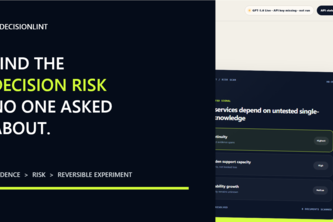
DecisionLint is a self-reported tool that claims to help organizations identify unasked-for risks in decision-making by scanning company evidence folders (e.g., operating, financial, governance documents) and returning three prioritized, supportable risks. It is described as not generic RAG but rather an early-stage intervention before user diagnosis, with structured outputs, risk mapping, and bounded experiment comparisons.
What changed
The project description indicates this is a hackathon submission (submitted to the OpenAI 2026 hackathon), suggesting it is in an early prototype or proof-of-concept phase. It has no evidence of revenue, customers, or traction beyond synthetic evaluations.
Single most important open question
Is there any evidence that DecisionLint has been used in real-world settings with actual organizational data, or does it remain a synthetic demonstration?
What The Product Actually Is
The description states that DecisionLint:
- Scans company evidence folders (operating, financial, delivery, governance, continuity, people-system) without a leading question.
- Returns exactly three supportable risks with categorical priority.
- Separates claims into OBSERVED, INFERRED, HYPOTHESIS, COUNTEREVIDENCE, UNKNOWN, and SCENARIO.
- Resolves observations to exact source spans.
- Creates a one-screen Decision Brief for the priority risk.
- Compares maintaining current state, broad intervention, and bounded experiment across eight decision axes.
- Traces every experiment value to evidence, design assumption, safety constraint, configurable default, or approval still needed.
- Maps related risks with typed edges linked to evidence.
It also includes:
- A responsive English interface and a Japanese companion.
- A zero-dependency local Python service.
- Bounded in-memory Office/text ingestion.
- Local Preflight for no-key judging.
- Optional two-stage GPT-5.6 Responses API path, with structured-output discovery and deep-dive calls.
- Strict schema validation, citation resolution, prompt-injection checks, source-authority verification, counterevidence handling, and decision-support checks before display.
Inference The product is described as a local or semi-local system that uses AI to analyze organizational documents and surface risks. It is not a hosted SaaS offering but rather a tool that can be run locally with synthetic data.
Positioning & Claim Evolution
The description states:
- DecisionLint intervenes one step earlier than conventional assistants by identifying risks before the user’s diagnosis.
- It is not generic RAG, but rather a structured risk discovery system.
- The goal is to find “the decision risk no one asked about.”
- It supports bounded experiments and avoids overreaction or blame.
Inference The positioning is that of an AI-powered decision support tool for enterprise risk identification. It is positioned as a proactive, non-blaming, evidence-based assistant to help leaders make better decisions by surfacing hidden risks.
Target Customer & ICP
The description states:
- The product targets companies with evidence folders (operating, financial, governance, etc.).
- It supports whole-company, folder, or file-level analysis.
- It is designed for operators who can add files and scope decision workspaces.
Inference The target customer appears to be internal decision-makers or risk managers in large enterprises or organizations with structured documentation. The ICP is likely a small team or individual within an organization who has access to internal documents and wants to assess risks without being led by a pre-existing question.
Business Model & Pricing Evidence
Not evidenced.
Inference There is no indication of pricing, monetization strategy, or business model in the description. The product is described as a hackathon submission with no commercial deployment.
Technical & Delivery Signals
The description states:
- Built with codex, CSS, GPT-5.6, HTML, JavaScript, OpenAI Responses API, Python.
- Includes a responsive English interface and Japanese companion.
- Zero-dependency local Python service.
- Bounded in-memory Office/text ingestion.
- Local Preflight for no-key judging.
- Optional two-stage GPT-5.6 Responses API path with strict structured output.
- All generated output must pass schema, citation-resolution, prompt-injection, source-authority, counterevidence, and decision-support checks before display.
Inference The system is built as a local or semi-local tool, with optional AI integration via GPT-5.6. It emphasizes safety and structured outputs, suggesting a focus on accuracy and traceability in risk analysis.
Traction & Maturity Signals
Not evidenced.
Inference There is no evidence of revenue, customers, usage, or adoption beyond synthetic testing and a demo video. The project is described as a hackathon submission with no real-world impact claimed.
Competitive Context
Not evidenced.
Inference No mention of competitors or market positioning beyond the claim that it's not generic RAG. It appears to be in a nascent stage, without clear competitive differentiation or market presence.
Open Questions & Risks
- The product is described as a hackathon submission with no real-world usage.
- No evidence of revenue, customers, or adoption.
- The demo uses synthetic data and does not claim to have used real company documents or employee data.
- The system relies on GPT-5.6, which may introduce hallucination or misalignment risks.
- The product is described as a local tool with no indication of scalability or enterprise deployment.
Inference The main risk is that the product remains unproven in real-world settings and may not scale beyond synthetic testing. It also lacks commercial traction or evidence of market fit.
Questions the description leaves open
- What are the actual use cases for DecisionLint beyond the synthetic demo?
- Has it been tested with any real organizational data or internal documents?
- How does it handle edge cases in document ingestion or AI interpretation?
- What is the plan for scaling beyond a local prototype?
- Are there any plans to integrate with existing enterprise tools (e.g., Confluence, SharePoint)?
- What are the limitations of the current GPT-5.6 integration in terms of accuracy and bias?
Overall Assessment
Not evidenced.
Inference Given that this is a hackathon submission with no evidence of traction, revenue, or real-world usage, there is insufficient basis to recommend investment or partnership at this time. The product shows potential but lacks commercial proof-of-concept.
User Stories BotA demo video on every pull request
Get a demo video on every new feature
GitHub App that watches your pull requests and records a narrated, captioned demo.
Save time on demo prep and make informed decisions faster with a video walkthrough of every new feature.
Source
Submitted to the OpenAI 2026 hackathon on Devpost. Project home on Devpost. Back to the full gallery on Devpost.
This competitive analysis was produced by top-founders.com (opens in a new tab)
Generated by a language model from this project's public Devpost page — its tagline, the author's own write-up and any built-with tags listed there — as captured in August 2026. Short quotations are the author's words. It is an opinion on the idea as a business, not on the people behind it, and it reflects the description as published then. If the project has moved on, request a correction below. The analysis is not independent research and contains no verified traction, revenue or customer data.
An independent guide by KFG International LLC — not affiliated with, endorsed by, or connected to Devpost or OpenAI.