

Archive position — measured, not model output
0 likes on Devpost
2,263 of the 7,850 archived projects have more likes, and 5,587 share exactly 0 — so this project's #3,674 place in the like-ranked listing is a tie-break inside that group, not a ranking.
Projects (log scale)
Likes on Devpost. ▲ marks this project's group.
Show the figures
| Likes | Projects | Share of archive |
|---|---|---|
| 0 | 5,587 | 71.2% |
| 1 | 1,758 | 22.4% |
| 2 | 284 | 3.6% |
| 3–4 | 132 | 1.7% |
| 5–9 | 75 | 1.0% |
| 10+ | 14 | 0.2% |
 User Stories BotA demo video on every pull request
Get a demo video on every new feature
GitHub App that watches your pull requests and records a narrated, captioned demo.
Save time on demo prep and make informed decisions faster with a video walkthrough of every new feature.
Executive Summary
What the company appears to be
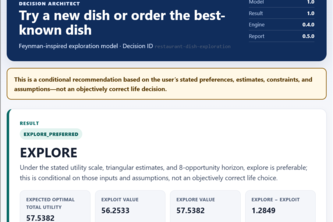
Decision Architect is a self-reported tool built as a Codex Skill that turns difficult decisions into transparent, reproducible mathematical models. It uses GPT-5.6 for conversational interaction and deterministic engines for decision analysis.
What changed
The author states this project was built in response to a personal decision-making challenge, with the goal of making decision processes more visible and auditable through structured modeling and AI-assisted interviews.
Single most important open question
Is there any evidence of user adoption or real-world usage beyond the author’s own development experience?
What The Product Actually Is
The description states that Decision Architect is a repository-scoped Codex Skill. It allows users to describe difficult choices in natural language, and then uses GPT-5.6 to conduct an adaptive interview before triggering deterministic decision engines.
It supports two modes:
- Sequential exploration, using finite-horizon dynamic programming for explore-versus-exploit decisions.
- Multi-criteria analysis, handling multiple alternatives with constraints, weighted preferences, and uncertain outcomes.
The result is a local HTML report containing inputs, methodology, ranking, sensitivity results, limitations, and assumptions.
Evidence
- The author states it is a Codex Skill.
- It uses GPT-5.6 for conversational layer and deterministic engines for math.
- It generates local HTML reports.
- It has two decision modes: sequential exploration and multi-criteria analysis.
Inference It appears to be a developer-facing tool integrated into an AI coding environment (Codex), designed to support structured decision-making through AI and mathematical modeling.
Positioning & Claim Evolution
The author claims that Decision Architect:
- Turns difficult choices into transparent, reproducible mathematical models.
- Combines natural conversation with mathematical rigor.
- Makes assumptions visible and reasoning inspectable.
- Does not decide for the user; the human remains in control.
It positions itself as a tool for responsible decision support, where AI helps structure problems but does not replace human judgment or silently invent assumptions.
Evidence
- The tagline: “Turn difficult choices into transparent, reproducible mathematical decision models.”
- The author’s own write-up emphasizes transparency, audibility, and user control.
- It explicitly separates the conversational layer from the mathematical authority.
Inference It is positioned as a tool for individuals or teams who want to make better decisions through structured modeling, not as a commercial product with a market-facing brand.
Target Customer & ICP
The description does not state a specific customer segment or ideal customer profile (ICP). It implies the tool is for people making difficult choices, but does not define who those people are in terms of industry, role, or scale.
Evidence
- The author describes using it for personal decisions like university transfer.
- It is built as a Codex Skill, suggesting a developer or technical user base.
- No explicit mention of target industries, roles, or use cases beyond the author’s own experience.
Inference It may be aimed at developers or technical professionals who work with decision-making tools in code environments. However, no evidence supports a defined ICP.
Business Model & Pricing Evidence
There is no evidence of pricing, monetization, or business model in the description.
Evidence
- The tool is described as a Codex Skill built for personal use.
- No mention of fees, subscriptions, or commercial offerings.
- It is presented as an open-source or self-hosted project with no indication of revenue streams.
Inference It appears to be a prototype or personal project, not a commercial offering. No business model is evident.
Technical & Delivery Signals
The tool is built using:
- Codex
- GPT-5.6 (Sol)
- HTML and Python
- GitHub for version control
It includes:
- Adaptive interview workflows
- Structured schemas and validation rules
- Deterministic decision engines
- Automated tests (>200)
- Cross-platform reproducibility checks
- Local HTML report generation
Evidence
- The author lists the technologies used.
- It supports two distinct decision modes with mathematical backends.
- It includes automated testing and documentation.
Inference It is a technical prototype built in a specific AI development environment, with strong engineering rigor for a proof-of-concept.
Traction & Maturity Signals
There is no evidence of traction or adoption beyond the author’s own use. No customers, users, or real-world impact are mentioned.
Evidence
- The project was submitted to a hackathon.
- It has no stated user base or customer data.
- No mention of usage metrics, feedback, or product growth.
Inference It appears to be an early-stage prototype or personal project with no demonstrated traction or maturity in the market.
Competitive Context
The description does not provide any information about competitors or similar tools. It does not reference existing decision support systems, AI modeling platforms, or tools for structured decision-making.
Evidence
- No mention of competitors.
- No comparison to other tools or platforms.
Inference No competitive context is evident from the self-reported description.
Open Questions & Risks
- No commercial traction or user base: The tool appears to be a personal project with no evidence of adoption.
- Unproven market demand: There is no indication that users actually need this type of decision support.
- Limited scope and audience: It is built for Codex, which may limit its reach.
- No monetization strategy: No business model or pricing structure is evident.
- Self-reported only: All claims are unverified, with no third-party validation.
Evidence
- No revenue, customers, or usage data.
- No mention of commercialization plans.
- No external feedback or market testing.
Questions the description leaves open
- What is the actual user base for this tool? Has it been used beyond your own development?
- Are there any real-world use cases or feedback from people who have used it?
- How does this differ from existing decision-making tools or frameworks?
- Is there a plan to commercialize this, and if so, how?
- What is the long-term vision for Decision Architect beyond its current prototype?
Overall Assessment
Not evidenced.
The description provides no evidence of revenue, customers, traction, or commercial viability. It is a self-reported personal project built as part of a hackathon submission. There is no indication that it has moved beyond the prototype stage or has any market demand.
This is not a commercial opportunity based on the provided information. Any investment or partnership potential would require further evidence of traction, user adoption, and a defined business model.
Confidence Low — based entirely on self-reported description with no external validation or data.
User Stories BotA demo video on every pull request
Get a demo video on every new feature
GitHub App that watches your pull requests and records a narrated, captioned demo.
Save time on demo prep and make informed decisions faster with a video walkthrough of every new feature.
Source
Submitted to the OpenAI 2026 hackathon on Devpost. Project home on Devpost. Back to the full gallery on Devpost.
This competitive analysis was produced by top-founders.com (opens in a new tab)
Generated by a language model from this project's public Devpost page — its tagline, the author's own write-up and any built-with tags listed there — as captured in August 2026. Short quotations are the author's words. It is an opinion on the idea as a business, not on the people behind it, and it reflects the description as published then. If the project has moved on, request a correction below. The analysis is not independent research and contains no verified traction, revenue or customer data.
An independent guide by KFG International LLC — not affiliated with, endorsed by, or connected to Devpost or OpenAI.