

Archive position — measured, not model output
1 like on Devpost
505 of the 7,850 archived projects have more likes, and 1,758 share exactly 1 — so this project's #924 place in the like-ranked listing is a tie-break inside that group, not a ranking.
Projects (log scale)
Likes on Devpost. ▲ marks this project's group.
Show the figures
| Likes | Projects | Share of archive |
|---|---|---|
| 0 | 5,587 | 71.2% |
| 1 | 1,758 | 22.4% |
| 2 | 284 | 3.6% |
| 3–4 | 132 | 1.7% |
| 5–9 | 75 | 1.0% |
| 10+ | 14 | 0.2% |
 User Stories BotA demo video on every pull request
Get a demo video on every new feature
GitHub App that watches your pull requests and records a narrated, captioned demo.
Save time on demo prep and make informed decisions faster with a video walkthrough of every new feature.
Executive Summary
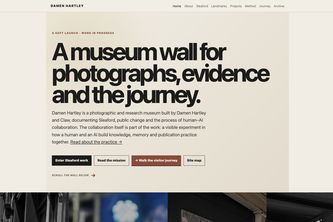
What the company appears to be: A human-controlled AI publishing house built as an extension of a live photographic and research museum. The project is described as a cultural initiative that uses AI tools (specifically Codex and GPT-5.6 Sol) to support research, production, and publication workflows while maintaining human authority over editorial decisions.
What changed: During Build Week, the team extended an existing live museum into a more complete publishing practice with:
- An evidence-led research program
- Formal supporting papers and source ledger
- A rights-cleared mailing issue zero
- Film production elements including a caption-free 2:58 animatic
- Proof Desk plugin for deterministic validation of sources, claims, and release reasoning
- Accessible HTML presentation of Markdown and CSV records
The single most important open question: Is this a viable model for sustainable publishing that can be scaled beyond the Build Week prototype? The description states no revenue or traction data exists.
Analysis basis: This is entirely self-reported by the author. No independent verification, funding rounds, customer data, or commercial metrics are provided. The project appears to be an experimental extension of an existing cultural institution rather than a commercial venture.
What The Product Actually Is
The description states that Damen Hartley is:
- A "live photographic and research museum"
- Extended into "an evidence-led publishing house"
- Built using Codex-assisted tools with GPT-5.6 Sol
- Incorporating a "Proof Desk" plugin for source, claim, rights, and release reasoning validation
- Featuring "a branded Evidence Reader that presents selected Markdown and CSV records as accessible HTML without replacing their auditable sources"
The product appears to be a hybrid cultural/technical system that combines:
- A museum website with visitor journey and archive surfaces
- AI-assisted research and production workflows
- Publishing machinery for mailings, films, and papers
- Human-authority gates for publication decisions
Not evidenced: What the actual commercial product is beyond this prototype extension.
Positioning & Claim Evolution
The description states that Damen Hartley:
- "Already existed as a live museum about Sleaford, public change and human–AI collaboration"
- "Invites visitors to Look, Understand and Dig"
- "Offers the chance to test whether that museum could become a more complete publishing practice without hiding sources, flattening uncertainty or automating away human authority"
The positioning appears to be:
- A cultural project that extends a live museum into publishing
- Emphasizing human control over AI tools
- Focused on transparency and source readability
- Positioned as an alternative to content generators
Not evidenced: How this positions itself in the broader publishing market or what its competitive advantages are.
Target Customer & ICP
The description states:
- The project is built around "a live photographic and research museum"
- It involves "an owned mailing relationship"
- It includes "film-production gates"
- It has "named and bounded roles for Simon, April, Clint, Claw and the Timeline Curator"
Target customer appears to be:
- Cultural institutions or researchers who want to publish with transparency
- Museums or archives seeking AI-assisted research tools
- Publishers interested in human-AI collaboration models
Not evidenced: Specific customer segments, market size, or adoption metrics.
Business Model & Pricing Evidence
The description states:
- The project is "a live cultural project with an unusually deep collaboration record"
- It includes "an owned mailing relationship"
- It has "rights-cleared mailing issue zero"
- It uses "human review surfaces" and "human decision instrument"
Not evidenced: Revenue model, pricing structure, or monetization strategy.
Technical & Delivery Signals
The description states:
- Built with: codex, css, gpt-5.6-sol, html, javascript, netlify, python, reportlab
- Uses Codex-assisted work with GPT-5.6 Sol
- Proof Desk plugin that turns source, claim, rights, access and release reasoning into a testable review pack
- Deterministic Python validation checks references, controlled classifications, timed sequences and mandatory human release boundary
- "A portable evidence companion that clearly separates the pre-existing museum from the eligible extension"
- "A branded Evidence Reader that presents selected Markdown and CSV records as accessible HTML without replacing their auditable sources"
Technical signals:
- Uses AI tools (Codex, GPT-5.6 Sol) for research synthesis, production planning, documentation
- Incorporates deterministic validation checks
- Maintains human review gates
- Separates pre-existing work from new Build Week work
Not evidenced: Technical scalability, infrastructure requirements, or performance metrics.
Traction & Maturity Signals
The description states:
- The live website, photographic rooms, Visitor Journey, Method, Journey and Archive surfaces predate the submission period
- "Seven formal supporting papers and a source ledger"
- "An accessible mailing prototype with plain-text and interactive test counterparts"
- "A caption-free 2:58 photograph-led film proof with rights, provenance and a human decision instrument"
- "Proof Desk, a reusable Codex plugin with deterministic validation and four automated tests"
Not evidenced: Customer adoption, revenue, user growth, or market traction beyond this prototype.
Competitive Context
The description states:
- This is "not a content generator and not a challenge-only microsite"
- It is "a live cultural project with an unusually deep collaboration record"
- It adds "practical publishing machinery while keeping sources readable, rights attached, accessibility early and publication authority human"
Not evidenced: Direct competitors, market positioning, or competitive advantages.
Open Questions & Risks
Key risks identified:
- Lack of commercial viability: The project is described as a cultural initiative without evidence of revenue or traction
- Scalability concerns: No indication of how this model would scale beyond the Build Week prototype
- Human dependency: Heavy reliance on individual human authority (Simon) for publication decisions
- Unclear monetization: No evidence of business model or pricing strategy
- Prototype-only status: All work appears to be Build Week prototype, not production-ready product
Open questions:
- No evidence of customer base or market demand
- No financial data or funding information
- Heavy dependence on one person for editorial decisions
- Unclear path to commercialization
Questions the description leaves open
- What is the long-term vision for this project beyond the Build Week prototype?
- How would you scale this model beyond a single-person operation?
- What are the actual costs of maintaining human review gates and source tracking?
- How do you plan to monetize this cultural publishing approach?
- What specific problems in current publishing workflows does this solve?
- How do you ensure consistency when multiple people take on editorial roles?
- What would constitute success for this project beyond the prototype phase?
- How do you handle privacy and data protection at scale?
Overall Assessment
Not evidenced: No commercial metrics, revenue, or traction data available.
The description states that this is a "live cultural project" with "an unusually deep collaboration record" but provides no evidence of:
- Revenue generation
- Customer adoption
- Market demand
- Scalability potential
- Commercial viability
The project appears to be an experimental extension of an existing museum rather than a commercial venture. The Build Week work shows technical capability in AI-assisted research and publishing workflows, but there is no evidence that this represents a viable business model or product that can be scaled beyond the prototype phase.
Confidence level: Low - based entirely on self-reported information with no independent verification of claims or traction.
User Stories BotA demo video on every pull request
Get a demo video on every new feature
GitHub App that watches your pull requests and records a narrated, captioned demo.
Save time on demo prep and make informed decisions faster with a video walkthrough of every new feature.
Source
Submitted to the OpenAI 2026 hackathon on Devpost. Project home on Devpost. Back to the full gallery on Devpost.
This competitive analysis was produced by top-founders.com (opens in a new tab)
Generated by a language model from this project's public Devpost page — its tagline, the author's own write-up and any built-with tags listed there — as captured in August 2026. Short quotations are the author's words. It is an opinion on the idea as a business, not on the people behind it, and it reflects the description as published then. If the project has moved on, request a correction below. The analysis is not independent research and contains no verified traction, revenue or customer data.
An independent guide by KFG International LLC — not affiliated with, endorsed by, or connected to Devpost or OpenAI.