

Archive position — measured, not model output
1 like on Devpost
505 of the 7,850 archived projects have more likes, and 1,758 share exactly 1 — so this project's #919 place in the like-ranked listing is a tie-break inside that group, not a ranking.
Projects (log scale)
Likes on Devpost. ▲ marks this project's group.
Show the figures
| Likes | Projects | Share of archive |
|---|---|---|
| 0 | 5,587 | 71.2% |
| 1 | 1,758 | 22.4% |
| 2 | 284 | 3.6% |
| 3–4 | 132 | 1.7% |
| 5–9 | 75 | 1.0% |
| 10+ | 14 | 0.2% |
 User Stories BotA demo video on every pull request
Get a demo video on every new feature
GitHub App that watches your pull requests and records a narrated, captioned demo.
Save time on demo prep and make informed decisions faster with a video walkthrough of every new feature.
Executive Summary
What the company appears to be
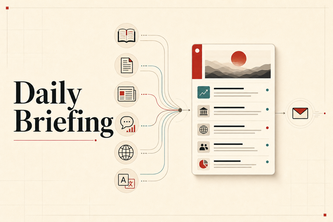
Daily Briefing is a self-reported research intelligence pipeline built as a Flask application for collecting, organizing, and delivering academic publications, policy news, public trends, and user-defined material. It was developed during OpenAI Build Week 2026 and presented as a production-ready workflow with scheduled email digests, a web interface, and source provenance.
What changed
During the hackathon event, the project evolved from an internal Flask tool into a more robust system with explicit refresh round ownership, public-mode security boundaries, improved error handling, and a redesigned UI. The author notes that these changes were implemented during Build Week, not before.
The single most important open question — the commercial due-diligence read
Is there evidence of any traction, revenue, or customer adoption beyond the author’s own development and testing? The description states no such data exists, and all claims are self-reported without verification.
What The Product Actually Is
The description states that Daily Briefing is a research intelligence pipeline. It collects academic publications, NBER working papers, public news, social trends, AI news, and user-defined research material. It deduplicates and organizes this content, enriches it with translations and relevance signals, and presents one stable daily snapshot through:
- A responsive web interface;
- Configurable research-field tracking (journals and topics);
- Source links and visible provenance;
- HTML reports and scheduled email digests;
- Public-safe source and refresh status.
The system uses a Flask API and is built with Python, JavaScript, CSS3, HTML5, and various libraries including OpenAI, Codex, Playwright, and others. It does not call external research or model providers directly from the browser; instead, it reads from a stable server snapshot.
Inference The product appears to be an internal tool for researchers or analysts who want a consolidated daily view of relevant information sources, with a focus on reliability and traceability.
Positioning & Claim Evolution
The author positions Daily Briefing as a production-ready intelligence pipeline, designed to help researchers manage information overload by collecting, organizing, and delivering reliable daily views of research, policy, news, and trends. The tagline reads: “One reliable daily view of research, policy, news, and trends—collected, translated, organized, and delivered by a production-ready intelligence pipeline.”
The project evolved from a personal working Flask application into a more structured and publicly deployable system during OpenAI Build Week 2026. The author emphasizes that the goal was to make it safer, clearer, easier to maintain, and more efficient for daily use.
Inference The positioning has shifted from an internal utility to a potential public-facing service or SaaS offering, though no evidence supports this transition beyond the author’s own development efforts.
Target Customer & ICP
The description does not explicitly identify target customers or personas. However, it implies that the intended users are researchers, analysts, and others who need to stay updated on academic publications, policy news, and emerging trends across multiple sources.
It also mentions a user-defined research profile as part of future development, suggesting customization for individual needs.
Inference The ICP likely includes individuals or teams in academia, think tanks, policy research groups, or data-driven organizations that require curated daily updates from diverse information streams.
Business Model & Pricing Evidence
There is no evidence of a business model or pricing strategy in the description. The product is described as a self-hosted or public demo, with no mention of monetization, subscriptions, or paid features.
The author notes that the public demo is intentionally read-only and does not allow triggering data collection or sending emails — indicating a possible limitation on functionality for users without access to backend controls.
Inference No commercial model has been defined or demonstrated. The system may be intended as an open-source tool or a prototype for future monetization, but no evidence supports either.
Technical & Delivery Signals
The system is built using:
- Flask API
- Python, JavaScript, CSS3, HTML5
- Libraries: OpenAI, Codex, Playwright, RSS feeds, Crossref, NBER, NewsNow, etc.
- APScheduler for scheduling tasks
- Codex used as a development collaborator and reviewer
- GPT-5.6 Sol reserved for architecture, concurrency, security, debugging, and adversarial verification
The pipeline includes:
- Source-specific collectors;
- Refresh rounds with stable snapshots and per-source status;
- Translation, relevance screening, annotation, clustering;
- Public-safe source and refresh status;
- Scheduled email digests with safeguards against partial delivery.
It supports:
- Responsive web interface;
- Keyboard navigation;
- Reduced-motion behavior;
- Multiple themes;
- Section-level lazy rendering.
Inference The technical stack suggests a mature, modular system built for reliability and maintainability. However, no evidence indicates deployment beyond the developer’s environment or use in production by others.
Traction & Maturity Signals
The description states that:
- There are 384 automated tests passing locally and in GitHub Actions.
- Older refresh rounds cannot overwrite newer published snapshots.
- Public and management behavior is enforced server-side, not only in the UI.
- Source failures and stale data are explicitly handled.
- The judge-facing repository contains synthetic examples and excludes credentials or private data.
However, there is no evidence of customer adoption, revenue, ARR, or usage metrics beyond the author’s own testing and development.
Inference The system shows signs of technical maturity and robustness but lacks any indication of real-world traction or user engagement.
Competitive Context
The description does not provide information about competitors or market positioning. It does not reference similar tools or platforms that offer daily research summaries, news aggregation, or academic intelligence pipelines.
Inference No competitive analysis is available from the provided description. The project may be unique in its approach to combining multiple sources with translation and relevance filtering, but this cannot be confirmed without external context.
Open Questions & Risks
- No evidence of traction or revenue: The system appears to exist only as a developer tool, not a product with users.
- Self-reported only: All claims are unverified; no third-party validation or independent data is provided.
- Limited scope for monetization: No indication that the product is designed for commercial use or has features to support a business model.
- Single-person team: The project was built by one person (Shuai Yan), which raises questions about scalability and long-term maintenance.
- No public-facing deployment details: While it supports public mode, there’s no evidence of actual deployment or user access beyond the demo.
Inference The risk of misalignment between self-perception and real-world utility is high. The project may not yet be ready for commercialization or partnership.
Questions the description leaves open
- What is the intended use case for this product outside of personal development?
- Has anyone else used or tested this system beyond the author’s own testing?
- Are there any plans to monetize or scale the offering?
- How would you handle data privacy and compliance if deployed in a corporate setting?
- What are the specific challenges in transitioning from a prototype to a scalable SaaS product?
- Do you have any feedback loops with users or stakeholders about relevance, translation quality, or usability?
Overall Assessment
There is no evidence of commercial traction, revenue, or customer adoption. The project is described as a self-developed Flask application that was extended during a hackathon event. It shows technical maturity and robustness but lacks any indication of real-world usage or market demand.
Assessment Not ready for investment or partnership at this stage. The product may be a promising prototype, but it has not demonstrated viability as a commercial offering.
User Stories BotA demo video on every pull request
Get a demo video on every new feature
GitHub App that watches your pull requests and records a narrated, captioned demo.
Save time on demo prep and make informed decisions faster with a video walkthrough of every new feature.
Source
Submitted to the OpenAI 2026 hackathon on Devpost. Project home on Devpost. Back to the full gallery on Devpost.
This competitive analysis was produced by top-founders.com (opens in a new tab)
Generated by a language model from this project's public Devpost page — its tagline, the author's own write-up and any built-with tags listed there — as captured in August 2026. Short quotations are the author's words. It is an opinion on the idea as a business, not on the people behind it, and it reflects the description as published then. If the project has moved on, request a correction below. The analysis is not independent research and contains no verified traction, revenue or customer data.
An independent guide by KFG International LLC — not affiliated with, endorsed by, or connected to Devpost or OpenAI.